
In early 2024, one of the most unexpected digital disruptions in Latin America occurred when access to X, formerly known as Twitter, was temporarily blocked across Brazil. The ban sent shockwaves through political, journalistic, and civil society circles, raising urgent questions about free speech, judicial authority, and the responsibilities of global tech platforms. While the restriction was later lifted under specific conditions, the incident revealed deep tensions between national sovereignty and digital governance.
The block wasn’t a spontaneous decision by the Brazilian government but rather the result of a prolonged legal standoff involving the country’s Supreme Court, social media regulation, and high-profile disinformation campaigns. Understanding why X was banned requires unpacking a complex web of judicial rulings, political polarization, and Elon Musk’s controversial leadership style.
The Immediate Trigger: Non-Compliance with Court Orders
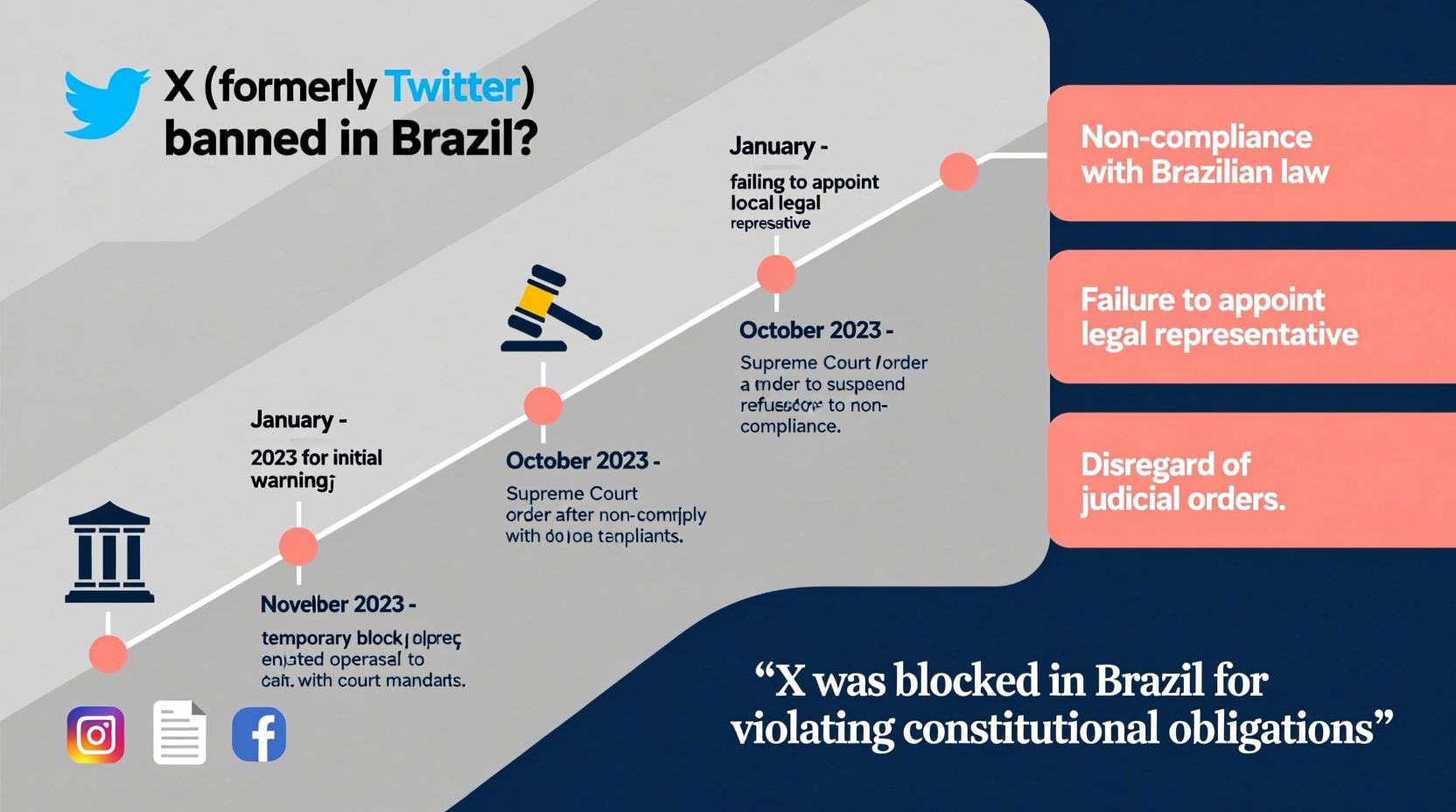
The most direct cause of the ban was X’s refusal to comply with a series of court orders issued by Justice Alexandre de Moraes, one of Brazil’s most influential Supreme Federal Court (STF) justices. In March 2024, Moraes ordered the suspension of several accounts accused of spreading disinformation, inciting violence, and undermining democratic institutions—allegations tied to supporters of former President Jair Bolsonaro.
X, under CEO Elon Musk, responded by reinstating some of the suspended accounts, citing free speech principles. This act of defiance prompted Moraes to escalate the matter. On April 5, 2024, he issued a nationwide injunction requiring all internet service providers (ISPs) in Brazil to block access to X unless the platform complied fully with prior rulings, including the re-suspension of flagged accounts and the appointment of a legally recognized local representative.
Judicial Authority vs. Digital Free Speech
Brazil’s judiciary, particularly Justice Moraes, has taken an aggressive stance against online disinformation since the January 8, 2023, attacks on government buildings in Brasília. Those riots were widely attributed to coordinated misinformation networks active on social media. Since then, Moraes has led investigations into “digital militias” spreading anti-democratic content.
His legal rationale rests on Article 220 of Brazil’s Constitution, which guarantees freedom of expression but also allows for restrictions to protect public order and democratic integrity. In his view, unchecked disinformation poses a tangible threat to national security. As he stated in a 2023 ruling: “The right to free speech does not extend to criminal activity conducted under its banner.”
“The digital space cannot be a lawless zone where hate, threats, and lies flourish without consequence.” — Justice Alexandre de Moraes, Supreme Federal Court of Brazil
Musk, however, framed the issue differently. In a post on X, he criticized Moraes as a “dictator,” calling the account suspensions “censorship” and accusing the justice of silencing political dissent. This public confrontation escalated the conflict from a legal dispute into an international debate over tech autonomy and authoritarianism.
Legal Requirements for Foreign Tech Companies in Brazil
A key factor often overlooked in the controversy is Brazil’s requirement that foreign digital platforms appoint a legal representative within the country. This rule, established under the Marco Civil da Internet (Brazil’s Internet Bill of Rights), ensures accountability and facilitates cooperation with law enforcement and judicial bodies.
At the time of the ban, X had failed to maintain an active local representative—a position previously held but abandoned after Musk’s restructuring of the company. Without this point of contact, Brazilian authorities argued they could not enforce court decisions or investigate illegal activities effectively.
By contrast, platforms like Facebook, Instagram, and TikTok have maintained compliance with this requirement, allowing them to operate uninterrupted despite facing similar content moderation challenges.
Comparison of Major Platforms’ Compliance in Brazil
| Platform | Local Representative Appointed? | Complied with Moraes’ Orders? | Status in Brazil (April 2024) |
|---|---|---|---|
| X (Twitter) | No (at time of ban) | No | Temporarily blocked |
| Facebook / Meta | Yes | Yes | Active |
| TikTok | Yes | Yes (after initial delays) | Active |
| YouTube | Yes | Yes | Active |
Political Context: Democracy Under Pressure
The ban cannot be fully understood without acknowledging Brazil’s recent political volatility. After the 2022 election that brought President Luiz Inácio Lula da Silva back to power, thousands of Bolsonaro supporters rejected the results, echoing false claims of electoral fraud. These narratives gained traction online, particularly on platforms like X, where algorithmic amplification favored sensational and polarizing content.
Justice Moraes, tasked with safeguarding electoral integrity, launched Operation Anti-Fake News, targeting influencers and bots spreading conspiracy theories. Several individuals linked to these networks were arrested, and their accounts suspended. When X reversed some suspensions, it was seen not just as a policy disagreement, but as interference in an ongoing judicial investigation.
This context explains why the Brazilian government and judiciary reacted so decisively: they viewed X’s actions as enabling destabilization efforts during a fragile democratic transition.
Mini Case Study: The Role of Influencer @Tuiavirtual
In early 2024, the account @Tuiavirtual—followed by over 1.2 million users—was suspended by X at the request of Brazilian authorities. The influencer had repeatedly shared unverified claims about voting machine manipulation and called for protests against the Supreme Court. Days later, the account reappeared under a new handle, posting identical content.
Investigative reports later showed that the account used automated tools to bypass detection. Its resurgence coincided with a spike in offline threats against judges. When questioned, X claimed the reinstatement was due to a “moderation error.” Critics argued it reflected a broader pattern of negligence—or even tacit support—for anti-institutional voices.
The case became emblematic of the risks posed by decentralized content moderation in politically sensitive environments.
Resolution and Reinstatement
The block lasted approximately 48 hours before X agreed to key terms set by the Supreme Court. On April 7, 2024, the company appointed a legal representative in Brazil and committed to complying with existing court orders, including the permanent suspension of several accounts under investigation.
In exchange, Justice Moraes lifted the access ban. However, he maintained fines of BRL 1 million per day (approx. USD 200,000) for any future non-compliance, signaling that the platform remains under close judicial scrutiny.
Step-by-Step Timeline of the Block
- March 2024: Brazilian Supreme Court orders suspension of multiple accounts spreading disinformation.
- Early April: X reinstates some accounts, defying court mandate.
- April 5: Justice Moraes orders nationwide block of X and imposes daily fines.
- April 6: ISPs begin restricting access; public outcry grows.
- April 7: X appoints local representative and complies with suspensions.
- April 8: Access restored; monitoring continues.
Frequently Asked Questions
Was the ban a government censorship move?
No, the ban was imposed by the judiciary—not the executive branch. It stemmed from a legal dispute over compliance, not political suppression. Brazil’s President Lula did not initiate the block and later expressed concern about access limitations, though he affirmed respect for judicial independence.
Can X be banned again in Brazil?
Yes. The Supreme Court retains the authority to reimpose restrictions if X fails to comply with future rulings. Ongoing monitoring means the platform operates under heightened legal risk compared to competitors.
Did users find ways around the block?
Many Brazilians used virtual private networks (VPNs) to access X during the outage. Usage of privacy tools surged by over 300% during the two-day period, according to cybersecurity firm Psafe. However, reliance on such tools raises concerns about digital inequality, as not all users can afford or navigate them.
Key Takeaways for Users and Platforms
- National courts are increasingly asserting jurisdiction over global tech companies.
- Free speech policies must be balanced with local legal frameworks and democratic safeguards.
- Failure to establish local legal representation can lead to operational shutdowns.
- Disinformation campaigns have real-world consequences, including judicial intervention.
Conclusion
The temporary ban of X in Brazil was not merely a clash between a billionaire CEO and a powerful judge—it was a landmark moment in the evolving relationship between digital platforms and national democracies. It underscored that while the internet is global, accountability is local.
For users, it served as a reminder of how quickly access to information can be disrupted. For tech companies, it highlighted the dangers of neglecting regulatory obligations in favor of ideological stances. And for democracies worldwide, it offered a cautionary tale about the fragility of truth in the digital age.




 浙公网安备
33010002000092号
浙公网安备
33010002000092号 浙B2-20120091-4
Comments
No comments yet. Why don't you start the discussion?