
The papacy has long been one of the most enduring institutions in Western history, and for centuries, its leaders came predominantly from a single nation: Italy. Of the 266 popes in recorded history, more than 80 were born within the borders of modern-day Italy—particularly during critical periods such as the Renaissance and early modern era. This overwhelming trend raises an important question: why were most popes Italian, and what does this reveal about the intersection of religion, power, and geography in Europe?
The answer lies not in doctrine or divine selection, but in a complex interplay of politics, geography, language, and institutional structure. The Catholic Church was deeply embedded in the fabric of Italian society, especially during the first millennium and a half of its existence. Rome, as both the spiritual center of Catholicism and a political city-state, became the epicenter of ecclesiastical influence. Understanding this dominance requires examining historical context, church governance, and the rare but significant moments when non-Italians broke through.
The Historical Roots of Italian Papal Dominance
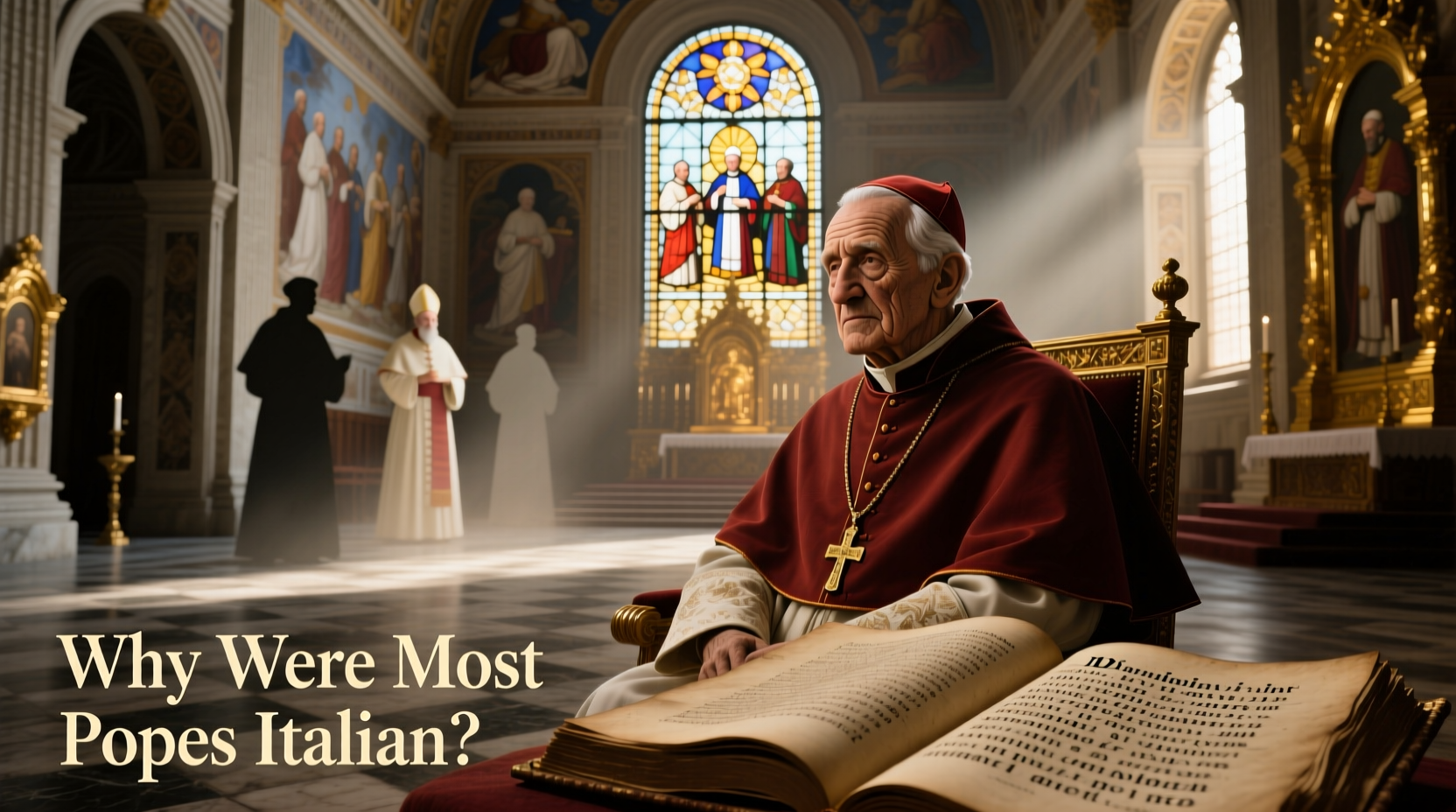
From the earliest days of Christianity, Rome held symbolic and administrative primacy. As the reputed burial site of Saint Peter—the apostle Jesus named as the “rock” upon which the Church would be built—Rome became the natural seat of the Bishop of Rome, later known as the Pope. Over time, this religious authority translated into temporal power, especially after Emperor Constantine legalized Christianity in the 4th century.
By the Middle Ages, the Papal States—a collection of territories in central Italy governed directly by the pope—gave the pontiff both spiritual and political leverage. This dual role meant that choosing a pope was never purely theological; it was also a geopolitical decision. Italian cardinals, often drawn from powerful noble families like the Medicis, Orsinis, and Borgias, dominated the College of Cardinals. These men controlled papal elections and naturally favored candidates who understood local politics, spoke Latin fluently, and could navigate the intricate web of alliances between city-states, monarchs, and emperors.
Furthermore, until the 20th century, the Church operated largely in Latin, and Italian clergy had unparalleled access to education, theology, and ecclesiastical networks. Seminaries, monasteries, and universities across Italy produced generations of well-trained clerics who rose through the ranks. This created a self-reinforcing cycle: Italian popes appointed Italian bishops and cardinals, who in turn elevated more Italians to positions of influence.
The Role of the College of Cardinals
The election of a pope rests with the College of Cardinals, a body historically composed largely of Italians. Until the 19th century, over 70% of cardinals were Italian. Even after the unification of Italy in 1870, which ended the Papal States and reduced the pope’s temporal power, the Curia—the administrative apparatus of the Holy See—remained heavily Italianized.
This institutional inertia made it difficult for non-Italians to gain influence. Speaking Italian, understanding Roman bureaucracy, and having decades of service in Vatican departments became de facto requirements for high office. It wasn’t until Pope John XXIII (elected in 1958) began reforming the College and expanding representation from Africa, Asia, and the Americas that the balance slowly began to shift.
Notable Non-Italian Popes: Breaking the Mold
Despite centuries of Italian dominance, several non-Italian popes stand out as pivotal figures in Church history. Their elections often reflected broader shifts in European power or internal Church reform.
- Pope Adrian VI (1522–1523) – Born Adriaan Floriszoon in Utrecht (modern-day Netherlands), he remains the only Dutchman to hold the papacy. His brief reign occurred during the rise of the Protestant Reformation. A scholar and reformer, he criticized corruption in the Curia—an irony given his outsider status in a deeply Italian institution.
- Pope Gregory III (731–741) – Syrian by birth, he was one of the last Eastern-born popes. His election highlights the earlier cosmopolitan nature of the Church before Rome became insular.
- Pope Lando (c. 913–914) – Possibly of Frankish origin, though records are sparse, his election during the chaotic \"Saeculum Obscurum\" suggests foreign influence amid political instability.
- Pope Sergius III (904–911) – Though born in Rome, some sources suggest partial Arab ancestry due to his family’s roots in Sicily under Muslim rule, illustrating the Mediterranean complexity of early medieval Italy.
However, the most transformative break came in the 20th century.
Pope John Paul II: A Watershed Moment
The election of Karol Józef Wojtyła in 1978 marked a turning point. As the first non-Italian pope in 455 years—since Adrian VI—he symbolized a global Church. Born in Wadowice, Poland, John Paul II brought a fresh perspective shaped by life under communist rule. His charisma, multilingual abilities, and emphasis on human dignity resonated worldwide.
“Do not be afraid. Open wide the doors for Christ.” — Pope John Paul II, inaugural homily, 1978
His papacy reinvigorated Catholic identity beyond Europe, particularly in Latin America, Africa, and Eastern Europe. He traveled more than any previous pope, visiting 129 countries, and played a visible role in the fall of communism in his homeland.
A Comparative Look at Modern Papacies
| Pope | Nationality | Reign | Significance |
|---|---|---|---|
| John Paul II | Polish | 1978–2005 | First non-Italian in nearly five centuries; global evangelist |
| Benedict XVI | German | 2005–2013 | Scholar-theologian; emphasized doctrinal continuity |
| Francis | Argentine | 2013–present | First Jesuit, first from the Americas, first from the Southern Hemisphere |
| Pius IX | Italian | 1846–1878 | Longest-reigning pope; defined papal infallibility |
| Adrian VI | Dutch | 1522–1523 | Last non-Italian before the 20th century |
This table illustrates how recent decades have dramatically diversified the papacy. While Italians still hold considerable influence in the Curia, the symbolic importance of electing popes from outside Italy reflects a Church adapting to a pluralistic world.
Factors That Enabled Non-Italian Popes
Several key developments allowed for the election of non-Italians in modern times:
- Globalization of the Church: By the mid-20th century, the majority of Catholics lived outside Europe. The Second Vatican Council (1962–1965) emphasized collegiality and inclusivity, encouraging greater representation from Africa, Asia, and Latin America.
- Decline of Italian Political Influence: With the loss of the Papal States and Italy becoming a secular republic, Italian nobility no longer wielded the same power in Vatican affairs.
- Modern Communication: Radio, television, and later digital media allowed cardinals from remote regions to build reputations and visibility, making them viable candidates.
- Cold War Dynamics: The election of a Polish pope during the height of East-West tensions sent a powerful message of resistance to authoritarian regimes.
Mini Case Study: The Election of Pope Francis
In 2013, following Benedict XVI’s unprecedented resignation, the conclave faced a choice between continuity and change. Cardinal Jorge Mario Bergoglio of Buenos Aires was not the initial frontrunner, but after several ballots, his humility, pastoral focus, and experience in a developing country won support. His background as a Jesuit—who traditionally take vows of poverty—and his work among the urban poor distinguished him from traditional Curial figures.
His election signaled a desire for reform, decentralization, and a Church focused on mercy rather than rigid doctrine. Speaking fluent Italian, Spanish, German, and Portuguese, Bergoglio bridged linguistic and cultural divides. Today, Pope Francis continues to challenge entrenched systems, advocating for environmental stewardship, social justice, and interfaith dialogue.
Frequently Asked Questions
Was there ever an American pope?
No, there has never been a pope from the United States. While several American cardinals have participated in conclaves, none have received enough votes to be elected. However, their influence within the Church is growing.
Why did it take so long for a non-Italian to become pope?
For over a millennium, the Catholic Church was centered in Italy, both geographically and politically. The College of Cardinals was overwhelmingly Italian, and the internal culture of the Vatican favored insiders familiar with Roman traditions and language. Only in the late 20th century did demographic and institutional changes make non-Italian candidacies viable.
Could a pope come from Africa or Asia in the future?
Yes. With over 200 million Catholics in Africa—more than in Latin America or North America—and vibrant communities in the Philippines, India, and South Korea, the next non-European pope may emerge from these regions. Cardinals from Nigeria, Ghana, and the Democratic Republic of Congo have already gained prominence.
Conclusion: The Future of the Papacy
The predominance of Italian popes is a historical phenomenon rooted in geography, politics, and institutional tradition—not divine mandate. As the Catholic Church becomes increasingly global, the pool of potential leaders expands far beyond the Alps. The elections of John Paul II, Benedict XVI, and Francis demonstrate that the papacy can transcend national boundaries while still maintaining doctrinal unity.
The story of the popes is ultimately a story of adaptation. From Roman bishops presiding over a small community to spiritual leaders of over 1.3 billion people, the office has evolved in response to changing times. While Italy will always hold a special place in Catholic history, the future of the papacy lies in its ability to represent a truly universal Church.




 浙公网安备
33010002000092号
浙公网安备
33010002000092号 浙B2-20120091-4
Comments
No comments yet. Why don't you start the discussion?