
Wikipedia is one of the most visited websites in the world, offering instant access to millions of articles on nearly every conceivable topic. Its open-editing model has democratized knowledge, allowing anyone with internet access to contribute. Yet, this very openness is also the root of its greatest weakness. While Wikipedia can be a useful starting point for general information, it is frequently discouraged as a credible source in academic, scientific, and professional settings. Understanding why requires a closer look at how Wikipedia operates, the risks associated with crowd-sourced content, and the standards expected from authoritative sources.
How Wikipedia Works: The Open-Editing Model
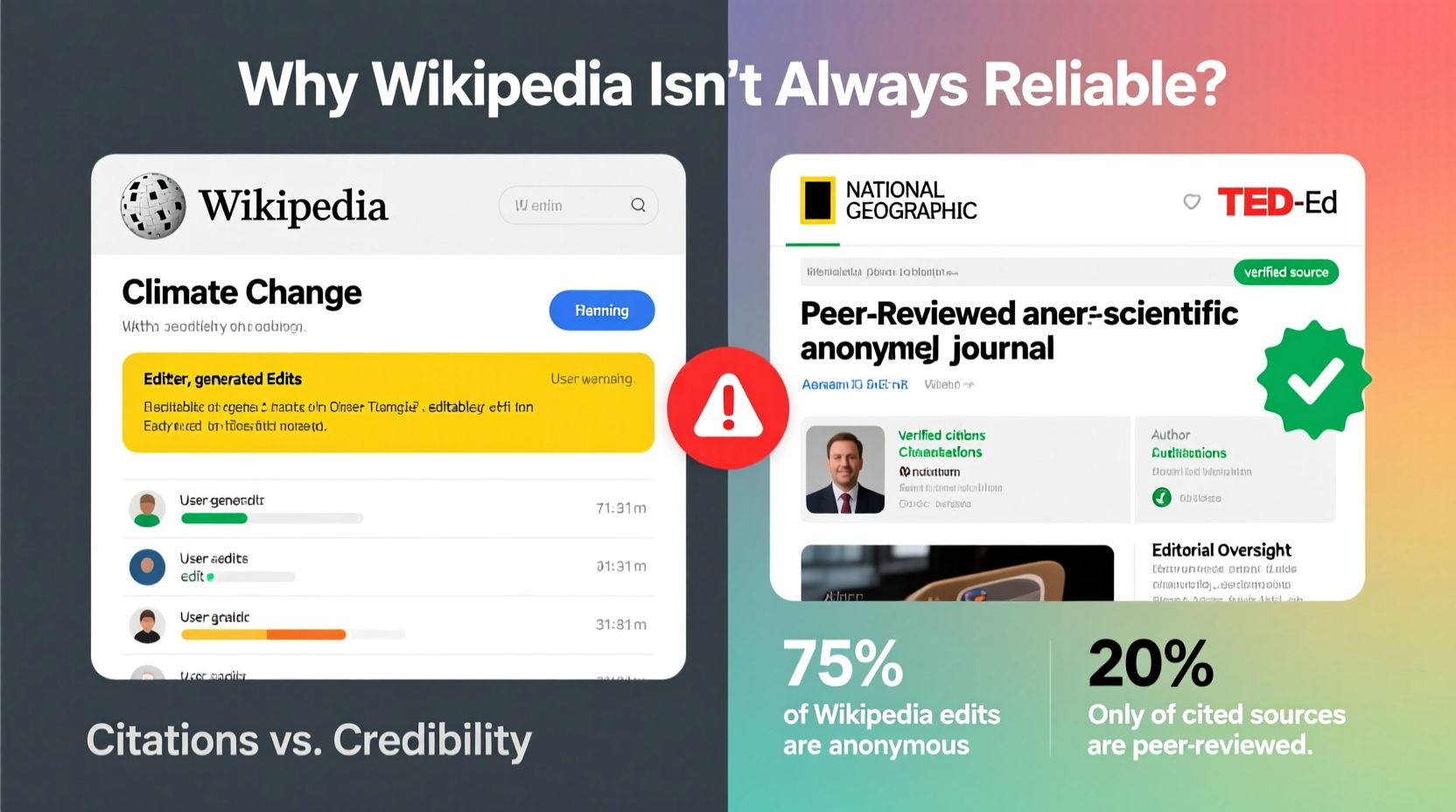
At its core, Wikipedia runs on a collaborative editing system. Anyone—regardless of expertise, background, or motive—can create or modify an article. This model relies on the assumption that collective oversight will correct errors over time. In many cases, popular or well-maintained pages are regularly monitored by experienced editors who revert vandalism and improve accuracy. However, this system is far from foolproof.
Articles on niche topics, breaking news, or controversial subjects are especially vulnerable to misinformation. Because edits appear almost instantly, false or biased information can remain online for hours—or even days—before being corrected. In some cases, deliberate hoaxes have persisted for years before detection.
“Wikipedia is a great place to begin research, but it should never be the final destination.” — Dr. James Madison, Professor of Information Science, University of Washington
Lack of Author Credentials and Accountability
One of the primary concerns with Wikipedia’s credibility is the anonymity of its contributors. Unlike peer-reviewed journals or reputable news outlets, Wikipedia does not require authors to disclose their qualifications. A medical article could be edited by a licensed physician or a high school student with no formal training—there’s no way for readers to tell.
This absence of accountability undermines trust. In traditional publishing, authors are vetted, and their reputations are tied to the content they produce. On Wikipedia, users can operate under pseudonyms or edit anonymously, making it difficult to assess the reliability of any given contribution.
Inconsistencies in Accuracy and Depth
The quality of Wikipedia articles varies dramatically. Some entries are meticulously researched, comprehensive, and regularly updated. Others are incomplete, poorly written, or filled with outdated data. There is no standardized editorial process ensuring uniform quality across all entries.
A 2005 study published in Nature compared Wikipedia articles on scientific topics with those in the Encyclopedia Britannica. It found that Wikipedia contained only slightly more inaccuracies per article—suggesting that, in some cases, the platform could approach traditional encyclopedias in accuracy. However, numerous follow-up studies have shown that Wikipedia’s reliability deteriorates significantly in less-monitored areas, such as politics, biographies, and emerging technologies.
| Factor | Traditional Encyclopedia | Wikipedia |
|---|---|---|
| Author Expertise | Verified subject-matter experts | Anonymous or unverified contributors |
| Editorial Oversight | Rigorous peer review and fact-checking | Volunteer moderation; inconsistent enforcement |
| Update Speed | Slower, scheduled updates | Real-time editing |
| Transparency of Sources | Citations required, but limited | Variable citation quality; some articles lack references |
| Accountability | Authors and publishers held responsible | No personal liability for contributors |
Vandalism, Bias, and Manipulation Risks
Wikipedia’s open nature makes it a target for vandalism, propaganda, and corporate or political manipulation. There have been documented cases of companies editing their own pages to remove negative information, politicians altering biographies, and users inserting false facts as pranks.
For example, in 2005, a user posing as a public relations professional edited the biography of journalist John Seigenthaler, falsely linking him to the assassinations of John F. Kennedy and Robert F. Kennedy. The defamatory content remained online for four months before being discovered. This incident, now known as the \"Seigenthaler incident,\" sparked widespread criticism and led to policy changes limiting anonymous editing on sensitive topics.
Even when vandalism is quickly reverted, subtle forms of bias—such as selective omission of facts or slanted language—can persist longer and are harder to detect. These issues compromise neutrality, a cornerstone of credible information sources.
Mini Case Study: The Misinformation Surge During Breaking News
During fast-moving events like natural disasters, elections, or public health crises, Wikipedia pages are often updated in real time. While this responsiveness is impressive, it also increases the risk of spreading unverified claims. In 2013, during the Boston Marathon bombing, the Wikipedia page for one of the suspects falsely named a missing student as a perpetrator, based on rumors from social media. The error was later corrected, but not before causing distress to the individual’s family and highlighting the dangers of uncritical reliance on crowd-sourced platforms during emergencies.
Why Academia and Professionals Avoid Wikipedia
Universities, researchers, and professionals typically require sources that meet strict criteria: verifiability, authorship transparency, editorial oversight, and permanence. Wikipedia fails on several of these counts.
- It is considered a tertiary source—it compiles information from other sources rather than generating original content.
- Its content is mutable; the page you cite today may be altered tomorrow, making verification difficult.
- Many instructors prohibit its use in scholarly work to encourage students to engage directly with primary and secondary sources.
As a result, citing Wikipedia in academic papers is generally frowned upon. Instead, educators encourage students to use the references listed at the bottom of Wikipedia articles—many of which link to peer-reviewed journals, books, and reputable news organizations.
Checklist: Evaluating Online Sources Like a Pro
- Identify the author and verify their credentials.
- Check if the website lists an editorial board or fact-checking process.
- Look for citations to primary or peer-reviewed sources.
- Assess whether the tone is neutral and evidence-based.
- Determine if the site has a reputation for accuracy (e.g., government, university, or established media domains).
- Avoid sources that allow anonymous editing without oversight.
When Wikipedia Can Be Useful
Despite its limitations, Wikipedia has value when used appropriately. It excels as a preliminary research tool—helping users quickly grasp the basics of a topic, identify key terms, and locate credible references through its citation section. Many scholars and librarians recommend starting with Wikipedia to get oriented, then moving to the cited sources for deeper, verified information.
Additionally, Wikipedia’s commitment to neutrality policies, citation requirements, and community moderation has improved over time. High-traffic articles on well-established topics (e.g., physics concepts or historical events) are often stable and reasonably accurate due to constant review.
Frequently Asked Questions
Can I ever cite Wikipedia in a research paper?
Generally, no. Most academic institutions discourage direct citations of Wikipedia due to its unstable and unattributed nature. Instead, find the original source cited in the Wikipedia article and reference that directly.
Are all Wikipedia articles unreliable?
No. While quality varies, many articles—especially on scientific and technical topics—are well-maintained and accurate. However, reliability cannot be assumed without verifying the content against trusted sources.
Does Wikipedia remove false information quickly?
It depends. Popular pages are monitored closely and errors are often corrected within minutes. But obscure or less-watched articles may contain inaccuracies for extended periods, sometimes going unnoticed for months.
Conclusion: Use Wisely, Not Blindly
Wikipedia is a remarkable achievement in collaborative knowledge-sharing, but it is not a substitute for rigorously vetted information. Its strength lies in accessibility and breadth, not authority or consistency. To navigate the digital information landscape responsibly, readers must develop critical evaluation skills and understand the difference between convenience and credibility.




 浙公网安备
33010002000092号
浙公网安备
33010002000092号 浙B2-20120091-4
Comments
No comments yet. Why don't you start the discussion?