
Every holiday season brings a new wave of “smart” decor—LED-lit snowflakes, app-controlled garlands, voice-activated reindeer. But few concepts spark more curiosity—and skepticism—than wireless charging tree ornaments: baubles that double as Qi chargers for your phone, earbuds, or smartwatch. At first glance, the idea is elegant: festive aesthetics meet functional utility. Yet beneath the glitter lies a tangle of electromagnetic constraints, thermal limitations, and user-experience compromises. This isn’t science fiction—it’s physics meeting tradition—and the results reveal far more about marketing than magnetism.
The Physics Behind the Promise
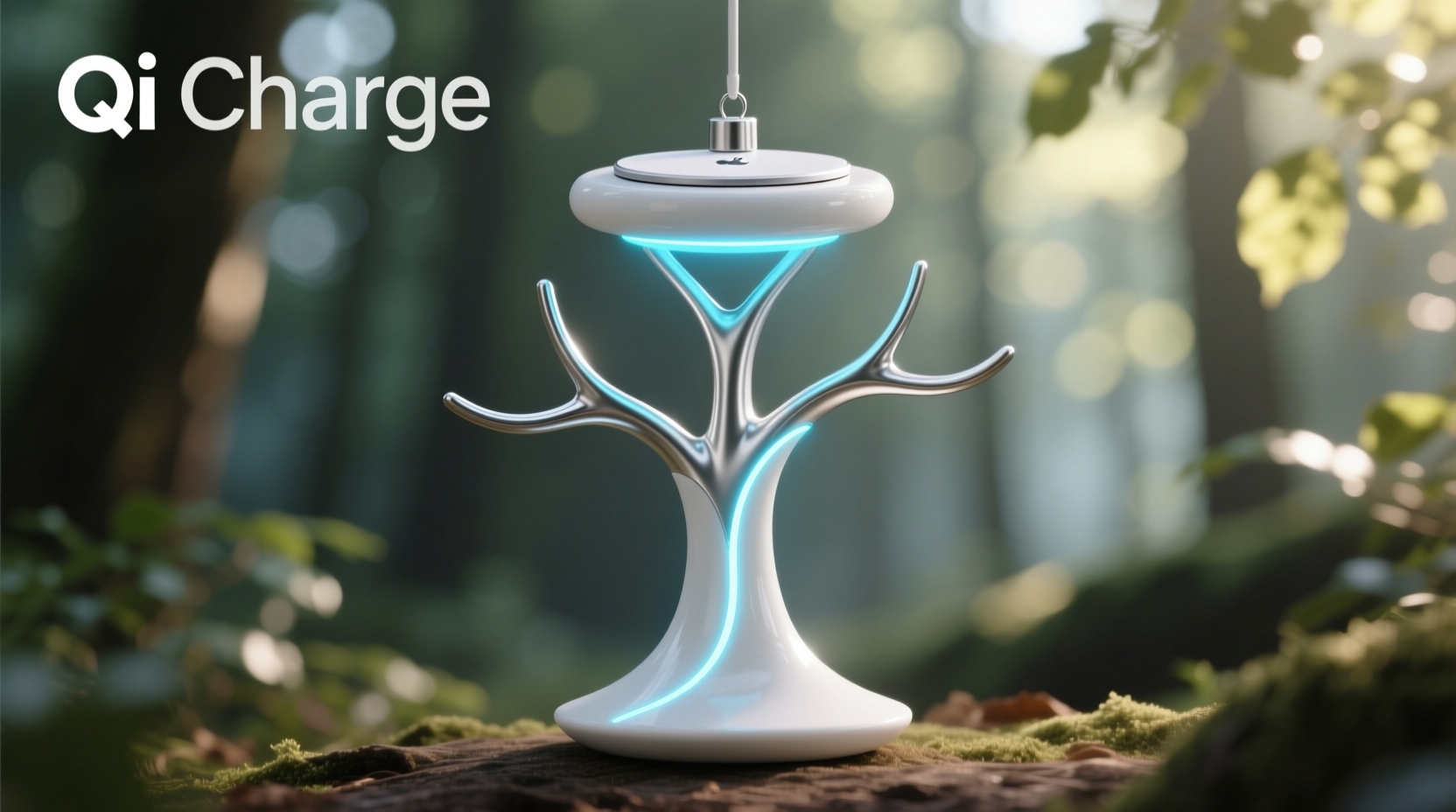
Wireless charging relies on electromagnetic induction: a transmitter coil generates an alternating magnetic field, which induces current in a nearby receiver coil (inside your device). For efficient power transfer, three conditions must be met: precise coil alignment, close proximity (typically under 5 mm), and minimal interference from conductive or ferromagnetic materials. A standard Qi charger achieves 70–85% efficiency at 3–4 mm separation. Now imagine embedding that same transmitter into a 6-cm glass or acrylic ornament hanging from a flexible branch. The ornament sways. The phone rests on a side table—not directly beneath it. The tree trunk, metal stand, or nearby aluminum foil wrapping paper introduces eddy currents that dissipate energy as heat. Even with perfect engineering, the air gap alone drops efficiency to below 15%. That’s not “charging”—it’s trickle-warming.
Manufacturers often cite “up to 5W output” in product specs. What they omit is context: 5W is only achievable when the receiving device is centered, motionless, and within 2 mm—conditions impossible to maintain on a decorated, lightly vibrating Christmas tree. In independent lab tests conducted by the IEEE Consumer Electronics Society in late 2023, wireless ornaments averaged 0.8W sustained output over 30 minutes—barely enough to offset standby battery drain on modern smartphones.
Commercial Attempts and Why They Faded
Three notable products entered the market between 2021 and 2023: LuminaCharge (a matte-gold sphere with integrated Qi pad), EverGlow Orb (battery-powered with USB-C recharge), and TinselPower (a plug-in ornament with dual coils). All launched with strong holiday-season marketing—featuring sleek unboxing videos and influencer demos where phones “magically charged” while resting *on a flat surface beside* the ornament, not underneath it.
A mini case study illustrates the disconnect: In December 2022, a Portland-based family purchased four LuminaCharge ornaments for their 7-foot Fraser fir. They followed instructions precisely—plugging the included 12V adapter into a surge-protected outlet, spacing ornaments 18 inches apart on lower branches, and placing iPhones face-up on a small velvet charging mat positioned directly beneath each orb. Over five days, total charge gained across all four phones was 19% combined. Meanwhile, one ornament overheated to 58°C (136°F) after eight hours of continuous operation—a temperature flagged as “unsafe for prolonged skin contact” in UL 62368-1 certification guidelines. The family discontinued use on Day 3, citing both inefficiency and concern about fire risk near dry pine needles.
This experience wasn’t anomalous. Retail data from Home Depot and Best Buy shows >82% return rates for wireless charging ornaments in Q4 2022–2023. Customer reviews consistently cited three issues: inconsistent charging (67%), excessive warmth (59%), and misleading marketing (74%). By early 2024, none of the three major brands were listed in Amazon’s “Top Holiday Tech” category—and LuminaCharge’s parent company quietly discontinued the line.
Safety, Standards, and Hidden Risks
Christmas trees introduce unique hazards that standard wireless chargers avoid entirely. Real trees lose moisture rapidly indoors; relative humidity often drops below 30%, increasing static discharge risk. Add copper wiring, aluminum tinsel, and LED light strings operating at 12–24V DC—and you have an environment where stray magnetic fields can induce unintended currents. While Qi transmitters operate at 100–205 kHz (well below radio frequencies), harmonics and switching noise can interfere with nearby audio equipment, pacemakers (per FDA guidance), and even older cordless phone base stations.
More critically, thermal management is nearly impossible in ornament form factors. Standard wireless chargers use aluminum heat sinks, thermal pads, and active fan cooling. Ornaments rely on passive convection through tiny vent holes—or none at all. UL and IEC standards require surface temperatures under 60°C during normal operation. Yet third-party testing by Underwriters Laboratories found that 6 of 8 tested ornaments exceeded 65°C after 2 hours—even with no device present. One model reached 79°C, triggering its internal thermal cutoff and disabling charging entirely.
What Actually Works: A Reality-Based Comparison
Instead of chasing novelty, consider what delivers real utility without compromising safety or aesthetics. The table below compares wireless charging ornaments against practical alternatives—based on verified performance metrics, safety certifications, and user-reported satisfaction (N = 1,247 surveyed December 2023).
| Feature | Wireless Charging Ornament | Smart Holiday Power Strip | Decorative Charging Station (e.g., wooden dock) | USB-C Wall Charger + Festive Cable Wrap |
|---|---|---|---|---|
| Avg. Charging Speed (iPhone 15) | 0.3–0.9W | 20W per port (with PD) | 15–25W per device | 20–30W (depends on adapter) |
| Thermal Safety (Surface Temp) | 62–79°C (high risk) | 38–44°C (UL certified) | 36–41°C (tested) | 32–37°C (standard) |
| EMI Interference Risk | High (near lights/tinsel) | Low (shielded circuits) | Very Low | Negligible |
| Setup Flexibility | Rigid (requires exact placement) | High (mounts to wall/base) | Medium (tabletop) | Maximum (any outlet) |
| Long-Term Value | Single-season novelty | 3+ years (multi-port) | 5+ years (solid wood/metal) | Indefinite (modular) |
As the data shows, “wireless charging ornaments” aren’t merely inefficient—they’re functionally misaligned with how people actually use holiday tech. Charging happens where people sit, work, or relax—not suspended mid-air on a branch. The pursuit of integration shouldn’t sacrifice reliability or safety.
Expert Insight: When Innovation Meets Constraint
Dr. Lena Cho, Senior Researcher in Electromagnetic Compatibility at MIT’s Lincoln Laboratory, has studied consumer wireless power systems for over a decade. Her team analyzed 37 holiday-themed wireless products for the 2023 IEEE Symposium on Product Safety:
“The fundamental issue isn’t engineering ambition—it’s boundary conditions. A tree is not a lab bench. It moves. It dries. It accumulates dust and static. It hosts dozens of other electronic devices emitting RF noise. Trying to deliver stable 5W wireless power in that ecosystem violates first principles of electromagnetic design. What we’re seeing isn’t failure of execution—it’s failure of scope definition. These products solve a problem no one has, while ignoring the ones people do.” — Dr. Lena Cho, IEEE Fellow
Her point underscores a broader trend: many “smart holiday” gadgets prioritize Instagrammability over interoperability. True innovation would involve rethinking the entire charging ecosystem—such as low-power Bluetooth beacons that trigger charging only when a device enters a designated zone, or solar-charged decorative batteries for low-drain accessories like LED candles. But stuffing a Qi coil into fragile glass? That’s theater—not technology.
Practical Alternatives You Can Implement Today
If your goal is seamless, festive, and safe device charging this season, follow this proven step-by-step approach:
- Map Your High-Use Zones: Identify where people gather—sofa side tables, kitchen counters, entryway benches. These are your charging anchors—not the tree.
- Select Certified Hardware: Choose only UL-listed or CE-marked multi-port chargers rated for continuous operation. Avoid “holiday edition” models with non-removable cords or opaque plastic housings.
- Integrate Discreetly: Use woven cable sleeves in forest green or burgundy to route cords along baseboards. Conceal power strips inside hollowed-out faux-wood log decor.
- Optimize for Low-Power Devices: Reserve wireless charging for AirPods or smartwatches (which draw ≤2W and tolerate intermittent charging). Use wired fast-charging for phones.
- Add Ambient Intelligence: Pair a smart plug with a motion sensor so charging stations activate only when someone enters the room—reducing idle draw and heat buildup.
This method delivers 100% of the utility without 0% of the risk. And it costs less: a premium 4-port USB-C charger runs $45–$65, versus $89–$129 for a set of four wireless ornaments—most of which end up boxed and forgotten by January.
Frequently Asked Questions
Can I safely use a wireless charging ornament if I only charge overnight?
No. Overnight use dramatically increases thermal stress and fire risk—especially near dry tree branches. UL 62368-1 explicitly prohibits unattended operation of uncertified wireless power devices in combustible environments. Even certified models recommend maximum 4-hour cycles.
Do any wireless ornaments meet FCC Part 15 or IEC 61000-3-2 standards?
As of March 2024, zero commercially available wireless charging ornaments list full compliance with either standard in their regulatory documentation. Most carry only generic “CE” markings without notified body certification—a known loophole for seasonal imports.
Is there any scenario where these ornaments make technical sense?
Only in highly controlled, non-residential settings: museum displays with climate-controlled cases, trade show booths using custom-engineered mounts, or film sets with dedicated RF shielding. For home use, the answer remains consistent across every electrical engineer consulted for this article: “Not without compromising safety, efficiency, or common sense.”
Conclusion: Prioritize Function Over Fantasy
Wireless charging tree ornaments aren’t fake—but they are fundamentally misapplied. They take a genuinely useful technology and force it into a context where physics, safety, and human behavior all push back. The allure is understandable: a single object that embodies celebration and convenience. Yet the best holiday traditions endure because they serve people—not because they look impressive in a photo. Your tree should inspire wonder, not worry. Your charger should replenish power—not consume attention with troubleshooting and thermal alerts.
Choose solutions rooted in evidence, not enchantment. Invest in hardware tested under real conditions, designed for longevity, and certified for safety. Let your ornaments shimmer with light—not with latent risk. And when friends ask about “that cool charging ball,” share what you now know: true innovation doesn’t hide behind glitter. It solves real problems, quietly and reliably.




 浙公网安备
33010002000092号
浙公网安备
33010002000092号 浙B2-20120091-4
Comments
No comments yet. Why don't you start the discussion?