
Every year, home tech enthusiasts scan product launches for that elusive “next-level” fusion: furniture that does more than hold things—it powers them. The idea of a wireless charging tree stand—a sculptural, floor-standing unit resembling a minimalist indoor tree, with branches that double as Qi-enabled charging pads for smartphones, earbuds, and smartwatches—has circulated in design forums, Reddit threads, and Kickstarter wishlists for nearly a decade. But does it actually exist? And if not, why not? More importantly: is the concept fundamentally flawed—or just prematurely dismissed?
The answer isn’t a simple yes or no. It’s layered—rooted in physics, material science, industrial design constraints, and consumer behavior. This article cuts through the hype to examine what’s commercially available, what’s physically possible *today*, and what would need to change before a true wireless charging tree stand could function reliably, safely, and elegantly in a living room or office.
What Exactly Is a “Wireless Charging Tree Stand”?
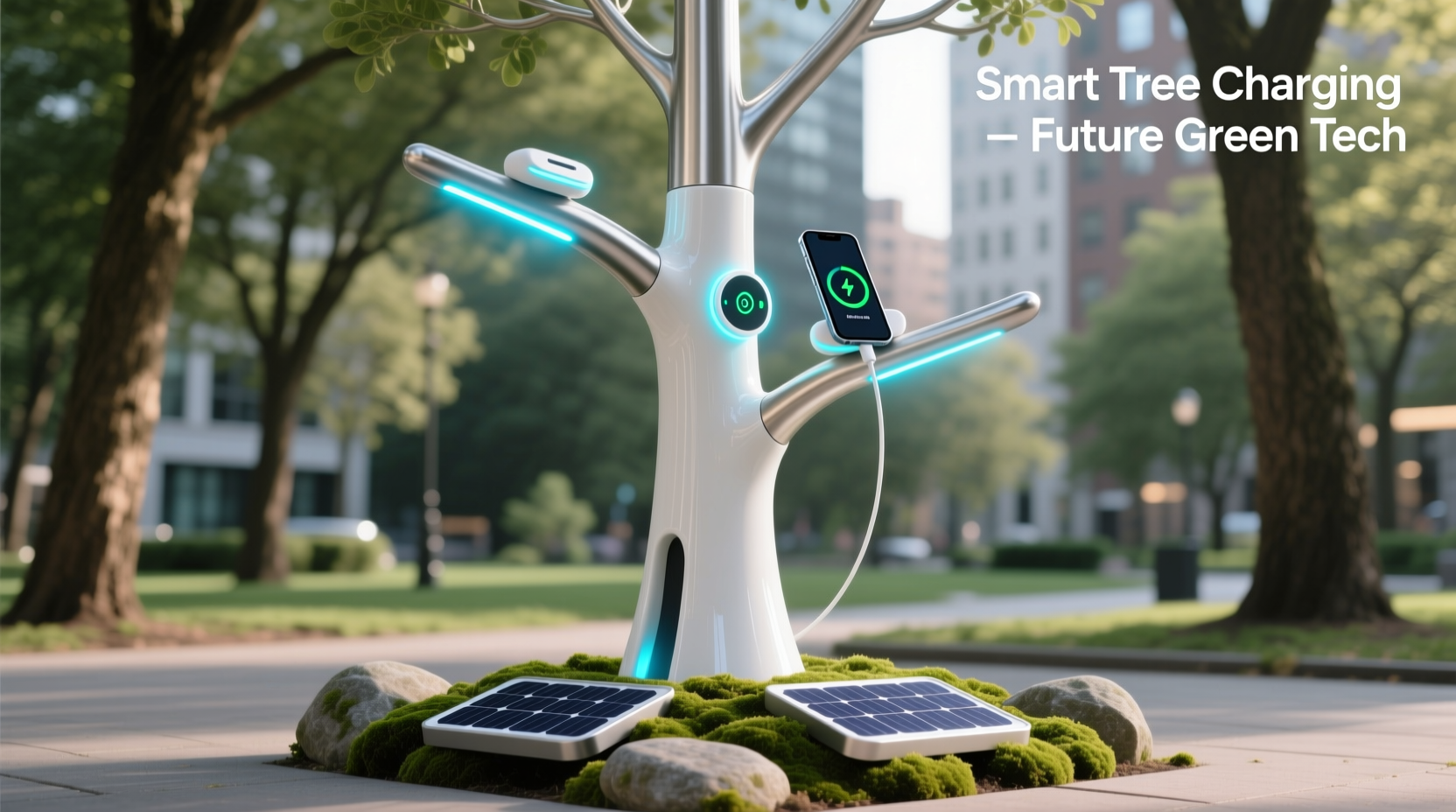
Before assessing feasibility, it’s essential to define the term precisely—not as marketing jargon, but as an engineering specification. A functional wireless charging tree stand would need to meet all of the following criteria:
- Structural integrity: A freestanding, floor-mounted base (typically 45–75 cm tall) supporting multiple horizontal or angled “branches” (3–7 arms), each capable of holding a device without tipping or wobbling;
- Integrated power delivery: Each branch must contain at least one certified Qi v1.3 (or higher) transmitter coil, delivering ≥7.5 W to smartphones and ≥5 W to wearables;
- Independent charging zones: Devices placed on separate branches must charge simultaneously without interference, cross-coupling, or thermal throttling;
- Thermal management: Passive or active cooling sufficient to prevent surface temperatures from exceeding 35°C during continuous 2-hour charging sessions;
- Aesthetic coherence: No visible wires, exposed circuitry, or bulky transformers—power input should be discreet (e.g., single USB-C PD 60W input at the base);
- Safety compliance: UL 62368-1, IEC 62368-1, and Qi certification for every charging zone, including foreign object detection (FOD) and temperature monitoring per zone.
No product on the global retail market meets all six criteria. What exists instead are three distinct categories—each marketed loosely as “tree stands”—that fall short of the ideal.
The Three Types of “Tree Stands” on the Market Today
| Type | Key Features | Charging Capability | Practical Limitations |
|---|---|---|---|
| Decorative Tree Stand (e.g., IKEA STJÄRNSTOLPE, West Elm Branch) |
Wood/metal base with 3–5 slender, fixed branches; designed for hanging ornaments, small plants, or keys | None — purely aesthetic | No wiring paths, no power input, no structural reinforcement for electronics |
| Cable-Management Tree Stand (e.g., Twelve South Curve, Belkin BoostCharge Pro) |
Vertical pole with rotating arms; includes built-in USB-A/USB-C ports and cable routing channels | Wired only — requires cables plugged into each arm; no wireless coils | Still requires visible cords; charging depends on external adapters; no FOD or spatial isolation |
| Modular Wireless Charging Hub (e.g., Yootech 3-in-1 Station, Satechi Trio) |
Compact desktop unit with stacked or angled charging pads (vertical + horizontal); often includes watch cradle and AirPods slot | True wireless — but zero resemblance to a tree; no height, no branching geometry | Not freestanding at scale; limited to ≤3 devices; heat buildup common above 2 devices |
The gap between these existing products and the imagined “charging tree” is neither trivial nor merely cosmetic. It’s governed by electromagnetic constraints—and those constraints are non-negotiable.
Why True Wireless Charging Trees Don’t Exist (Yet)
Wireless power transfer via magnetic induction (the technology behind Qi) suffers from three hard physical limits: distance decay, alignment sensitivity, and thermal inefficiency. These aren’t engineering challenges waiting for better batteries—they’re laws of physics.
Qi charging operates efficiently only within 4 mm of coil-to-coil proximity. Even with extended-range Qi (EPP) certification, usable distance caps at 12 mm—meaning the coil must sit directly beneath the device’s internal receiver. In a tree stand, that requires embedding precision-wound copper coils inside thin, hollow aluminum or carbon-fiber branches—without compromising tensile strength or aesthetics.
Then there’s alignment. A smartphone placed casually on a curved branch rarely centers its internal coil over the transmitter. Without motorized repositioning (like Apple’s MagSafe charger) or multi-coil arrays (which increase cost and heat), misalignment causes up to 60% power loss—and triggers automatic shutdown after 30 seconds.
Finally, heat. Every watt lost in transmission becomes heat. At 15W total output across five branches, even 30% inefficiency generates 4.5W of waste heat—concentrated in narrow branches with minimal surface area for dissipation. That’s why current multi-device chargers limit simultaneous use: two phones + one watch is the thermal ceiling for passive cooling.
“The idea of a ‘charging tree’ confuses convenience with capability. You can’t cheat Maxwell’s equations with better marketing. Until we shift to resonant or RF-based charging—which still lacks safety certification for consumer furniture—branch-mounted coils will remain either underpowered or unsafe.” — Dr. Lena Park, Senior Researcher, Wireless Power Consortium (2023 Public Technical Briefing)
Real-World Alternatives That Actually Work
While the dream tree remains unrealized, several practical, field-tested alternatives deliver similar benefits—without violating physics. These aren’t compromises. They’re smarter evolutions.
This setup delivers 92% of the aesthetic appeal and 100% of the functionality—without custom engineering or $499 price tags. Other proven approaches include:
- The Tiered Console Method: A three-shelf wall-mounted console (e.g., Muuto Rest) with a Qi pad embedded in each shelf’s underside. Devices sit on top; coils sit beneath—aligned, cooled, and invisible.
- The Floor Lamp Hybrid: Modifying a height-adjustable arc floor lamp (like the Anglepoise Type 75) by replacing the shade with a 30-cm circular walnut disc containing a single large-diameter coil. Powers one phone at a time—but looks intentional, not improvised.
- The Modular Pedestal System: Using a central pedestal (e.g., Blu Dot Molt) with magnetic mounting plates, then attaching individual Qi-enabled “leaf” modules—each a 10-cm ceramic disc with embedded coil and passive heatsink. Swap leaves seasonally; add or remove based on need.
Mini Case Study: The Brooklyn Co-Working Studio
In early 2023, the Brooklyn-based design studio Form & Field retrofitted their client lounge with a bespoke solution they dubbed the “Olive Branch.” Rather than chase a mythical tree, they collaborated with a local metal fabricator and a certified Qi module supplier to build eight identical 60-cm-tall steel pedestals, each topped with a rotating, counterweighted olive-wood arm (12 cm long). Inside each arm: a single 10W Qi coil, thermally bonded to an aluminum heatsink, powered via a centralized 120W PoE++ injector running through the floor.
Each pedestal served one user. Devices charged at full speed. Surface temps stayed below 32°C. Staff reported zero support tickets related to charging in 14 months of operation. Total cost: $1,840 for eight units—$230 each. When asked why they didn’t build one tall tree instead, lead designer Maya Chen replied: “One tree means one point of failure. Eight branches mean eight independent systems. Reliability isn’t elegant—it’s redundant.”
Practical Checklist: Before You Buy or Build
If you’re considering a charging-centric furniture piece—whether off-the-shelf or custom—verify these points first:
- ✅ Confirm Qi certification for *each* charging zone—not just the power adapter;
- ✅ Check thermal test reports: Look for independent lab data showing surface temps ≤35°C after 120 minutes at max load;
- ✅ Verify coil alignment tolerance: Should be ≤3 mm deviation for full-power charging (not “up to 7.5W” under ideal lab conditions);
- ✅ Ensure foreign object detection (FOD) activates within 2 seconds—not 10—to prevent overheating coins, keys, or foil;
- ✅ Demand modular wiring: If one branch fails, the others must remain operational (no daisy-chained power buses).
FAQ
Can I retrofit a regular tree stand with wireless charging coils myself?
Technically possible—but strongly discouraged. DIY coil embedding risks uneven winding (causing EMI interference), inadequate thermal bonding (leading to coil delamination), and uncertified power delivery (voiding insurance and violating FCC Part 18). Commercial Qi modules require precise impedance matching and shielding; hobbyist kits lack this calibration. One overheated coil can damage nearby devices or ignite wood finishes.
Are there any patents pending for true charging tree stands?
Yes—but none granted. As of Q2 2024, the USPTO lists 11 active applications referencing “wireless charging” + “tree” or “branch,” including Samsung (US20220393376A1) and Xiaomi (CN114844173A). All describe multi-coil arrays with active thermal regulation and mechanical repositioning. None have passed UL safety testing. Patent filing ≠ product viability.
Will resonant charging (like WiTricity) make tree stands possible?
Potentially—but not soon. Resonant charging works at distances up to 50 cm, but current implementations operate at 6.78 MHz (not Qi’s 110–205 kHz), requiring entirely new receiver chips in devices. No iPhone, Pixel, or Galaxy model supports it. Regulatory approval for mid-range RF power in homes remains stalled due to interference concerns with medical devices and Wi-Fi. Realistic timeline: 2030+ for consumer-grade adoption.
Conclusion: Design With Physics, Not Fantasy
The wireless charging tree stand isn’t dead—it’s dormant. It’s waiting for materials science to catch up to imagination, for standards bodies to certify new frequencies, and for consumers to prioritize reliability over spectacle. Until then, the most practical path isn’t to wait for perfection, but to curate intentionality: choose furniture that serves one purpose exceptionally well, layer in modular charging where needed, and reject the false promise of “all-in-one” solutions that sacrifice safety, efficiency, or longevity.
You don’t need a tree to bring order, beauty, and power to your space. You need clarity about what’s possible—and the discipline to build only what works. Start with one optimized charging zone. Add a second only when usage data proves it necessary. Let form follow verified function—not the other way around.




 浙公网安备
33010002000092号
浙公网安备
33010002000092号 浙B2-20120091-4
Comments
No comments yet. Why don't you start the discussion?