
Every day, millions of people reach for their phones, tablets, or smartwatches—and just as routinely, they plug in or place them on a charging pad. But with both wireless and wired charging now standard across modern devices, a critical question arises: which method is truly better for everyday use? While convenience often steers users toward wireless options, factors like charging speed, device longevity, energy efficiency, and safety must not be overlooked. Understanding the real differences between these two technologies empowers users to make informed decisions that align with their lifestyle, device needs, and long-term usage goals.
How Wireless and Wired Charging Work
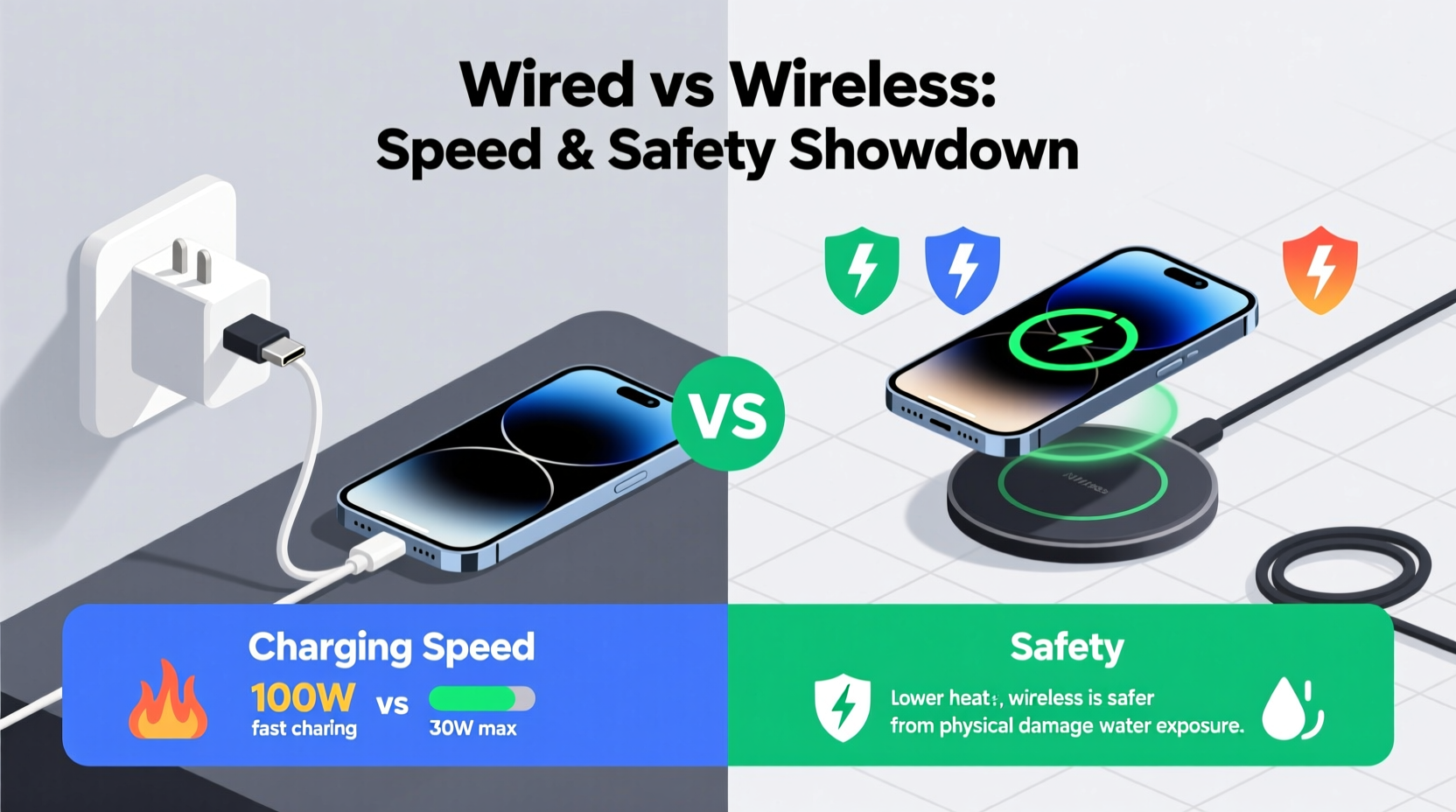
At their core, both methods deliver electrical energy to recharge a device’s battery, but they do so in fundamentally different ways.
Wired charging uses a physical connection—typically a USB cable—to transfer power from a wall adapter, computer port, or power bank directly into the device. The electricity flows through conductive metal wires, enabling high-efficiency energy transfer with minimal loss. Most modern smartphones support fast charging protocols such as USB Power Delivery (USB-PD) or Qualcomm Quick Charge, allowing rapid top-ups when paired with compatible chargers.
Wireless charging, on the other hand, relies on electromagnetic induction. A transmitter coil in the charging pad generates an alternating magnetic field, which induces an electric current in a receiver coil inside the device. This current is then converted into usable power to charge the battery. The most common standard is Qi (pronounced “chee”), supported by Apple, Samsung, Google, and many others.
Because wireless charging doesn’t require plugging in, it reduces wear on charging ports and offers greater convenience—especially in cars, nightstands, or public spaces. However, this convenience comes at a cost: efficiency losses due to heat generation and alignment sensitivity.
Speed Comparison: Which Charges Faster?
When comparing raw charging speed, wired charging consistently outperforms wireless options. Modern wired systems can deliver up to 100W or more (on laptops and some Android phones), while mainstream wireless chargers are typically capped at 15W, even under ideal conditions.
For example, a flagship smartphone like the iPhone 15 Pro Max supports up to 27W wired charging, enabling a 0–50% charge in about 30 minutes. In contrast, its Qi wireless charging maxes out at 7.5W unless using Apple’s MagSafe system, which reaches up to 15W—but only with precise alignment and increased heat output.
Similarly, Samsung Galaxy devices support up to 45W wired fast charging but only 15W wirelessly. That means going from 20% to full might take under 40 minutes with a cable, but over 90 minutes on a wireless pad.
The gap widens further when considering older or third-party wireless chargers. Many budget models operate at just 5W or 7.5W, resulting in painfully slow charging times—sometimes longer than a full workday for a complete cycle.
“Wired charging remains the gold standard for speed and reliability. Until wireless tech improves thermal management and efficiency, cables will win for performance-critical users.” — Dr. Lena Torres, Electrical Engineer & Mobile Power Systems Researcher
Safety and Device Longevity: What You Need to Know
Safety concerns around charging often focus on overheating, battery degradation, and fire risk. Both methods are generally safe when using certified hardware, but each has distinct risks.
Wired charging is inherently more stable because it involves direct conduction with minimal energy loss. High-quality cables and chargers include built-in safeguards against overcurrent, overvoltage, and short circuits. However, damaged or counterfeit cables can pose serious hazards. Frayed wires, poor insulation, or incompatible voltage outputs have been linked to fires and device damage.
Wireless charging introduces additional variables. Because energy transfer occurs through the air via magnetic fields, inefficiencies result in heat buildup—especially if the phone case is thick or misaligned. Prolonged exposure to elevated temperatures accelerates lithium-ion battery degradation, reducing overall lifespan. Studies show that consistent charging above 35°C (95°F) can reduce battery capacity by up to 20% over a year.
Moreover, foreign objects like keys or coins placed between the phone and charger can cause localized heating, potentially damaging the device or creating fire hazards. While modern Qi-certified pads include foreign object detection (FOD), cheaper models may lack this feature.
Battery longevity is another concern. Lithium-ion batteries degrade faster when subjected to frequent full charges and high heat. Wireless charging often encourages \"top-up\" behavior throughout the day, leading to more charge cycles and cumulative stress. In contrast, wired charging allows users to control timing—such as charging overnight at lower currents—which can be gentler on the battery.
Do’s and Don’ts for Safe Daily Charging
| Action | Wired Charging | Wireless Charging |
|---|---|---|
| Use manufacturer-approved accessories | ✅ Highly recommended | ✅ Essential for safety |
| Charge under pillow or blanket | ❌ Never safe | ❌ Increases overheating risk |
| Leave device charging unattended overnight | ⚠️ Acceptable with quality gear | ⚠️ Riskier due to heat buildup |
| Use while charging | ✅ Generally safe | ⚠️ Can increase temperature significantly |
| Remove thick cases during charging | ✅ Helps with heat dissipation | ✅ Strongly advised |
Real-World Usage: Who Benefits From Each Method?
The choice between wireless and wired isn’t just technical—it’s also behavioral. Different lifestyles favor different approaches.
Consider Sarah, a marketing executive who commutes daily and works remotely. She keeps a wireless charger on her desk, one in her car, and another by her bed. Her routine involves placing her phone down frequently, and she values the seamless experience of just setting it down to charge. However, she notices her phone feels warm by evening and finds herself carrying a power bank on weekends when she travels. After six months, her battery health drops to 88%, likely due to constant partial charging and thermal stress.
In contrast, David, a freelance photographer, relies on maximum uptime during shoots. He uses a 65W GaN (Gallium Nitride) charger to fully replenish his phone and tablet in under 30 minutes between assignments. He avoids wireless charging entirely, citing inefficiency and bulkiness. His devices last longer per charge, and after a year, his battery health remains above 95%.
This illustrates a broader trend: wireless charging excels in convenience-driven environments where speed is secondary, such as homes, offices, or vehicles. Wired charging dominates in scenarios requiring speed, reliability, and sustained performance—like travel, outdoor work, or emergency situations.
Step-by-Step Guide: Optimizing Your Charging Strategy
- Evaluate your daily routine: Do you need quick bursts of power or passive all-day topping?
- Invest in quality hardware: Use MFi-certified (Apple) or Qi-certified (wireless) chargers and avoid no-name brands.
- Limit heat exposure: Remove cases during charging, especially wireless; avoid direct sunlight or hot surfaces.
- Prefer partial discharges: Keep battery between 20%–80% when possible to extend lifespan.
- Use wired for heavy usage: When preparing for long outings or needing fast recharge, always go wired.
- Reserve wireless for convenience zones: Nightstand, office desk, or car mount—places where you regularly set your phone down.
Frequently Asked Questions
Is wireless charging bad for my phone’s battery?
Not inherently, but it can contribute to faster battery aging due to heat generation. If you use wireless charging frequently and notice your phone getting hot, consider switching to wired charging occasionally or limiting overnight use. Modern phones have thermal management systems, but prolonged exposure to elevated temperatures still degrades lithium-ion cells over time.
Can I use any wireless charger with my phone?
Most modern smartphones support the Qi standard, so basic compatibility is widespread. However, faster charging rates (like 15W) may require specific models—such as Apple’s MagSafe or Samsung’s Adaptive Fast Charging. Using a non-certified or low-power pad may result in slower speeds or intermittent charging. Always check your device’s manual for supported wattage and features like foreign object detection.
Does wired charging damage the charging port over time?
Yes, repeated plugging and unplugging can wear out the port, especially if forceful or misaligned insertion occurs. Dust, lint, and debris can also interfere with connectivity. To minimize wear, avoid yanking the cable out by the cord and clean the port gently with a soft brush periodically. Devices with robust build quality (e.g., IP68-rated phones) tend to have more durable ports.
Final Verdict: Balancing Speed, Safety, and Lifestyle
So, which is better: wireless or wired charging? The answer depends on what you prioritize.
If speed, efficiency, and long-term battery health are your top concerns, wired charging wins decisively. It delivers more power, generates less heat, and minimizes energy waste. For travelers, professionals, and anyone who depends on their device staying powered throughout the day, a high-quality cable and fast charger remain unmatched.
On the other hand, wireless charging offers unparalleled convenience. The ability to simply place your phone on a pad without fumbling for a connector makes it ideal for home or office use. As wireless standards evolve—such as upcoming extended-range and multi-device charging solutions—the gap may narrow. But for now, it’s best viewed as a supplement, not a replacement.
The smartest approach is hybrid: use wired charging for rapid top-ups and when battery preservation matters most, and reserve wireless charging for low-stress, everyday moments where ease trumps speed.
“The future isn’t about choosing one over the other—it’s about using the right tool at the right time.” — Rajiv Mehta, Senior Analyst at TechInsight Group
Take Action Today
Review your current charging habits. Are you relying too heavily on convenience at the expense of performance? Upgrade your setup with a single high-wattage wired charger for emergencies and fast turns, and keep one trusted wireless pad in your most-used space. Monitor your battery health monthly, stay mindful of heat, and choose quality over cost. Small changes today can extend your device’s life by years and keep you powered when it matters most.




 浙公网安备
33010002000092号
浙公网安备
33010002000092号 浙B2-20120091-4
Comments
No comments yet. Why don't you start the discussion?