
As holiday decorating trends evolve, homeowners are increasingly faced with a new choice: go classic with strings of twinkling lights or embrace modern convenience with wireless Christmas projectors. These compact devices promise dazzling light displays with minimal effort—just place, aim, and switch on. But do they deliver the same festive magic as decades-old string lights? Or are they little more than seasonal novelties that fade after one winter?
This comparison dives deep into both options, examining not only visual impact but also practicality, cost-effectiveness, longevity, and ease of use. Whether you're decorating a small apartment balcony or a sprawling suburban home, understanding the strengths and limitations of each method can help you make an informed decision—one that balances charm, convenience, and value.
How Wireless Christmas Projectors Work
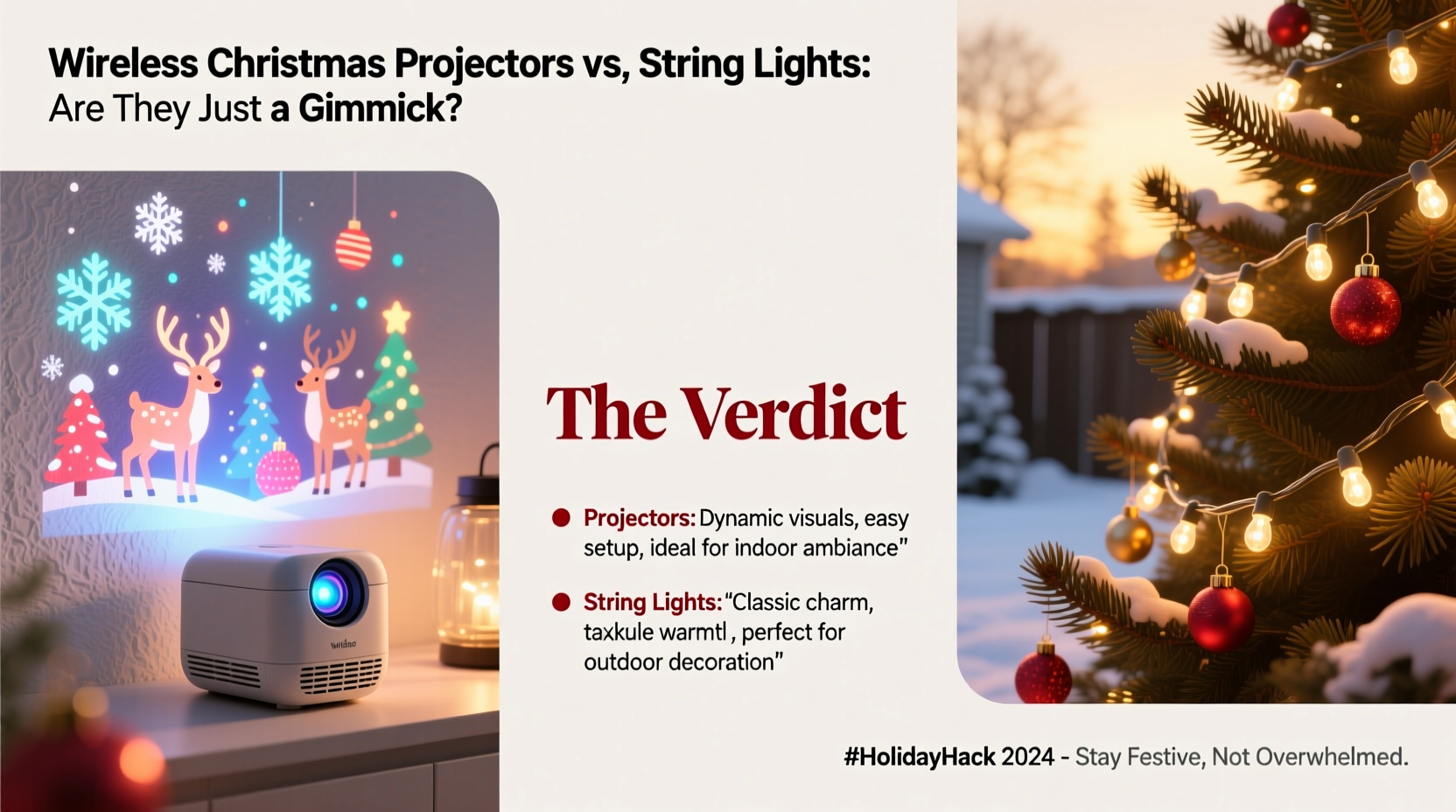
Wireless Christmas projectors use LED technology combined with rotating lenses or digital patterns to cast animated light displays onto walls, fences, or snow-covered lawns. Most models run on rechargeable batteries or standard AA/AAA cells, eliminating the need for extension cords or outdoor outlets. They typically feature multiple display modes—snowfall, falling stars, Santa sleighs, reindeer in flight—and some even sync to music via built-in speakers or Bluetooth.
The appeal lies in simplicity. A single unit can cover up to 500 square feet depending on ambient light and surface texture. Unlike string lights, which require meticulous draping and securing, projectors take minutes to set up. Just position the device on a stable surface, point it at your desired projection surface, and power it on.
However, this convenience comes with trade-offs. Projected images lack physical presence—they don’t glow from within like real bulbs. In bright urban environments or areas with significant ambient light pollution, the effect can appear washed out. Additionally, weather resistance varies widely; while many units claim to be “weatherproof,” prolonged exposure to rain or snow often leads to malfunctions.
The Enduring Appeal of String Lights
String lights have been a holiday staple for over a century. From early incandescent bulbs to today’s energy-efficient LEDs, their evolution has focused on safety, durability, and brightness. Modern strands are often rated for indoor and outdoor use, with many featuring shatterproof bulbs, UV-resistant coating, and waterproof connectors.
What sets string lights apart is their three-dimensional quality. When wrapped around trees, railings, or rooflines, they create depth and warmth that projected images simply can’t replicate. The soft flicker of warm white LEDs mimics candlelight, adding coziness to winter nights. Colored strands offer bold statements, especially when layered creatively across porches and windows.
Installation remains the primary drawback. Hanging hundreds of feet of lights requires time, tools (ladders, clips, timers), and often a second person. Poorly secured strands can sag or tangle in wind. And despite improvements in durability, exposure to harsh winters still degrades wires and sockets over time—typically limiting lifespan to 3–7 seasons unless carefully stored.
“Lighting creates emotion. Physical lights interact with space—they catch in icicles, reflect off windows, dance in the breeze. Projection is flat by comparison.” — Daniel Reyes, Lighting Designer & Holiday Display Consultant
Direct Comparison: Projectors vs String Lights
| Feature | Wireless Projectors | String Lights |
|---|---|---|
| Setup Time | Under 5 minutes | 30 minutes to several hours |
| Coverage Area | Up to 500 sq ft per unit | Limited by strand length (typically 25–100 ft) |
| Brightness & Visibility | Moderate; affected by ambient light | High; consistent glow regardless of surroundings |
| Durability | Low to moderate (plastic housing, battery dependency) | High (especially commercial-grade LED strands) |
| Reusability | 1–3 seasons on average | 3–7+ seasons with proper storage |
| Energy Source | Batteries or USB power | Outlet-powered (some solar options available) |
| Weather Resistance | Varies; many fail in sustained moisture | Most outdoor-rated strands withstand snow/rain |
| Ambiance Quality | Flat, cinematic effect | Warm, dimensional glow |
| Cost (Initial) | $30–$80 per unit | $15–$50 per strand (multiple needed) |
| Long-Term Value | Poor (replacement every few years) | Good to excellent |
While projectors win on speed and simplicity, string lights dominate in durability, ambiance, and long-term investment. One homeowner might find joy in rotating seasonal projections—switching from snowflakes to reindeer annually—while another values the heirloom-like tradition of unpacking the same trusted strands year after year.
When Projectors Shine (and When They Don’t)
Projectors aren't universally inferior—they excel in specific scenarios where traditional lighting falls short:
- Renters or apartment dwellers who can’t modify exteriors benefit from cord-free, non-invasive setups.
- Temporary displays, such as pop-up markets or community events, gain flexibility without permanent installations.
- Indoor accents, like projecting stars onto ceilings or nursery walls, add whimsy without clutter.
- Last-minute decorators appreciate plug-and-play readiness when time is tight.
But they falter under certain conditions:
- In **windy locations**, lightweight projectors can tip over or shift alignment.
- On **uneven or dark surfaces**, clarity diminishes significantly.
- During **prolonged use**, battery drain forces frequent replacements or recharging—sometimes mid-display.
- For **large homes**, multiple projectors are needed, increasing cost and complexity.
A Real Example: Two Homes, Two Choices
Consider two neighbors preparing for the same holiday season. Sarah lives in a ground-floor condo with strict HOA rules against exterior modifications. She opts for a wireless projector, placing it on her patio table and aiming it at the beige wall beside her door. Within minutes, shimmering snowflakes cascade down the surface. Her display draws compliments at the neighborhood potluck, and she appreciates never climbing a ladder again.
Across the street, Mark owns a two-story colonial with wide eaves and mature evergreens. He spends a Saturday afternoon installing 1,200 warm-white LED mini lights along rooflines, tree trunks, and walkway posts. His display glows steadily through December, visible from blocks away. Neighbors slow down to admire the craftsmanship. While he stores his lights meticulously each January, he views the ritual as part of the season’s meaning.
Neither approach is objectively better. Their choices reflect lifestyle, constraints, and personal aesthetics. Yet if Mark tried relying solely on a projector, his large façade would remain mostly dark. And if Sarah attempted string lights, she’d risk violating lease terms. Context determines suitability.
Step-by-Step Guide: Choosing What Works for You
Follow this decision framework to determine whether a projector, string lights, or a hybrid solution fits your needs:
- Assess Your Space: Measure exterior wall area, note surface color/texture, and identify accessible power sources.
- Evaluate Constraints: Are you renting? Limited by height access? Concerned about storage?
- Define Your Goal: Do you want subtle ambiance, bold visibility, or interactive effects (e.g., music sync)?
- Budget for Longevity: Calculate total cost over 3 years. A $60 projector replaced annually costs $180—more than premium lights lasting five seasons.
- Test Before Committing: Rent or borrow both types during the holidays to see how they perform in your actual environment.
- Consider Combining Both: Use projectors for dynamic backdrops and string lights for focal points like trees or entryways.
This structured approach prevents impulse buys based on novelty alone. Many consumers purchase projectors expecting theater-quality visuals, only to discover limitations once deployed outdoors.
Frequently Asked Questions
Can wireless projectors work in rainy climates?
Most manufacturers claim weather resistance, but real-world performance varies. Light drizzle may not interfere, but heavy rain or melting snow can seep into seams, causing shorts or lens fogging. Always check IP ratings—look for at least IPX4 (splash resistant). Even then, covering the unit with a clear hood improves reliability.
Do string lights really last longer than projectors?
Yes, generally. High-quality LED string lights resist corrosion, maintain brightness over thousands of hours, and survive multiple storage cycles. In contrast, projector components—especially plastic gears in rotating mechanisms and battery contacts—are prone to wear. Consumer reports show failure rates exceeding 40% after two seasons for budget models.
Are there energy-efficient alternatives to both?
Solar-powered string lights offer a sustainable middle ground. They charge during daylight and illuminate automatically at dusk. While initial brightness may be lower than grid-powered options, advances in photovoltaic efficiency have made them viable for moderate displays. Some projectors now include solar charging bases, though these remain rare and slow to replenish power.
Checklist: Make the Right Choice This Season
- ☐ Measure your display area and note surface characteristics
- ☐ Confirm whether you can use outdoor outlets or need battery-only solutions
- ☐ Set a realistic budget including replacement costs over 3 years
- ☐ Read verified owner reviews focusing on durability and night visibility
- ☐ Test placement at dusk to evaluate real-world impact
- ☐ Consider combining technologies for layered visual interest
- ☐ Plan storage strategy—protect lenses and organize cords
By approaching decoration as a design challenge rather than a shopping task, you ensure results that align with both expectations and reality.
Final Verdict: Gimmick or Genuine Option?
Calling wireless Christmas projectors a \"gimmick\" oversimplifies their role. They’re not replacements for string lights—but they aren’t meaningless novelties either. For the right user, in the right setting, they provide legitimate value: fast setup, portability, and dynamic effects impossible with static bulbs.
Yet their limitations are real. Fragile construction, inconsistent performance, and lack of tactile warmth mean they rarely satisfy those seeking authentic holiday atmosphere. Most enthusiasts end up supplementing—or replacing—with traditional lighting after one or two seasons.
The truth is, neither option dominates across all categories. The best choice depends on your priorities: convenience versus continuity, innovation versus tradition, short-term ease versus long-term investment.
“The most memorable displays aren’t defined by technology, but by intention. It’s not what you use—it’s why you turn it on.” — Lena Patel, Urban Holiday Festival Curator
Take Action This Season
Don’t default to last year’s method without reconsidering your goals. If you’ve relied on string lights for years but dread installation, explore high-end projectors designed for durability. If you’ve been disappointed by faint projections, invest in a single strand of commercial-grade LEDs to anchor your display.
Experiment thoughtfully. Try one new technique this December. Document what works—and what doesn’t—for next year’s plan. Share your findings online or with neighbors; the holiday community thrives on shared insight.




 浙公网安备
33010002000092号
浙公网安备
33010002000092号 浙B2-20120091-4
Comments
No comments yet. Why don't you start the discussion?