
As the holiday season approaches, homeowners, event planners, and retailers face a key decision: how to create a festive atmosphere that captures attention. Two of the most popular options—wireless Christmas projectors and traditional string lights—offer distinct advantages. But when it comes to sheer visual impact and drawing the eye, which one truly stands out? The answer depends on context, audience, environment, and execution.
This article compares wireless Christmas projectors and string lights across multiple dimensions: visibility, installation ease, energy use, versatility, and psychological effect. Whether you're decorating a home, storefront, or public space, understanding these differences helps ensure your holiday display doesn’t just shine—it commands attention.
Visibility and Attention-Grabbing Power
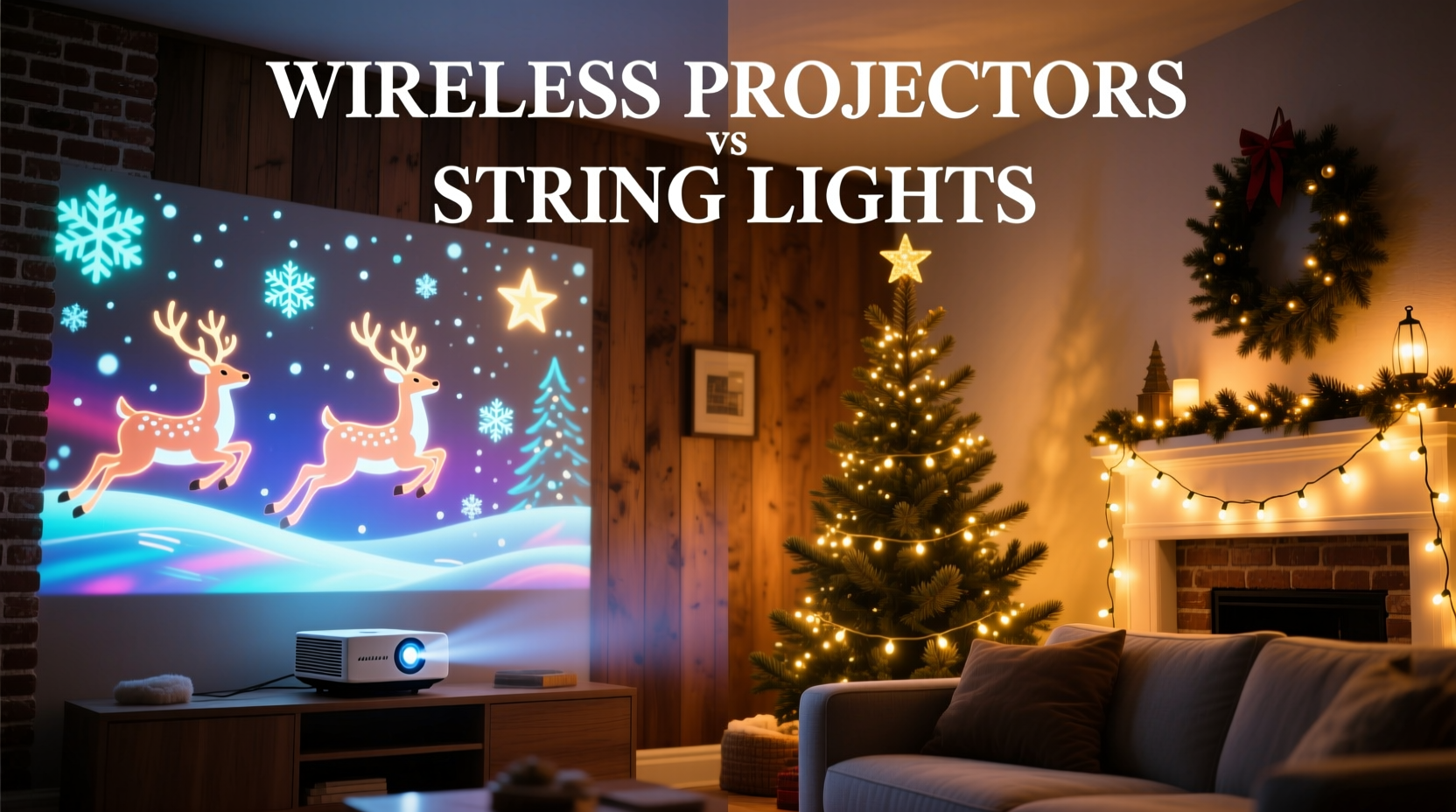
The primary goal of any holiday decoration is to be seen. In this regard, both projectors and string lights have strengths, but they operate differently.
Wireless Christmas projectors work by projecting high-intensity LED images—such as snowflakes, reindeer, or Santa—onto walls, fences, or even snow-covered ground. These projections can cover large surfaces (up to 30 feet wide) with dynamic, animated visuals. Because motion naturally attracts human eyes, a well-placed projector can instantly draw attention from passersby, especially in low-light conditions.
String lights, while beautiful, rely on static illumination. Even when twinkling or color-shifting, they don’t generate the same level of novelty or movement. However, their physical presence—especially when densely arranged along roofs, trees, or walkways—creates a warm, immersive glow that feels more “authentic” to many observers.
“Motion and scale are powerful tools in visual design. A projector covering an entire wall with dancing lights triggers immediate curiosity.” — Dr. Lena Torres, Environmental Psychologist specializing in sensory engagement
In direct comparison:
- Projectors win in novelty and range. A sudden image of a flying sleigh appearing on a dark wall creates surprise and delight.
- String lights excel in ambiance and tradition. Their steady, sparkling light evokes nostalgia and comfort.
For pure attention-grabbing power—especially from moving vehicles or distant sidewalks—projectors have the edge due to their size, brightness, and animation.
Installation and Setup Ease
One of the biggest selling points of wireless Christmas projectors is their simplicity. Most models require only three steps: place the unit on a stable surface, aim it at the desired surface, and press start. No extension cords, no climbing ladders, no intricate wiring.
Many modern projectors are battery-powered or use low-voltage USB-C adapters, making them ideal for renters, apartment dwellers, or anyone avoiding outdoor electrical outlets. Some even include remote controls and scheduling features to automate on/off times.
String lights, by contrast, demand significantly more labor. Installing hundreds of feet of lights often involves:
- Planning the layout
- Securing clips or hooks
- Connecting multiple strands
- Managing tangled wires
- Ensuring GFCI protection for outdoor use
Mistakes in setup—like overloading circuits or improper grounding—can lead to tripped breakers or safety hazards. Additionally, string lights degrade over time; bulbs burn out, wires fray, and colors fade, requiring annual inspection and repair.
That said, string lights offer greater creative control. You can shape them into patterns, wrap them around objects, or layer different colors and bulb types for depth. Projectors, while convenient, are limited by projection surface quality and ambient light interference.
Setup Time Comparison
| Feature | Wireless Projector | String Lights |
|---|---|---|
| Avg. Setup Time | 5–10 minutes | 1–4 hours |
| Climbing Required? | No | Yes |
| Tools Needed | None | Ladder, clips, testers |
| Power Source Flexibility | High (battery/USB) | Low (outlet-dependent) |
| Reusability | High (no wear) | Moderate (bulb/wire degradation) |
Energy Efficiency and Operating Cost
Budget-conscious decorators must consider not just purchase price, but long-term energy use.
Most wireless Christmas projectors consume between 5 and 15 watts of power. At 10 watts, running a projector for 6 hours per night over 30 days uses about 1.8 kWh—costing less than $0.30 on average electricity rates. Battery models use even less, though batteries may need replacing.
String lights vary widely. Older incandescent mini-lights can use 40+ watts per 100-bulb strand. A modest display using five strands could exceed 200 watts—more than ten times the energy of a projector. Modern LED string lights are far more efficient, typically using 4–6 watts per strand, bringing total usage closer to 30 watts for a full setup.
Still, even efficient LEDs add up when used in volume. A large house wrapped in 20 strands of LED lights might use 120 watts nightly—still eight times more than a single projector.
Real-World Example: Suburban Home Display Face-Off
In a 2023 neighborhood holiday contest in Naperville, Illinois, two adjacent homes took different approaches.
Home A used a single wireless projector displaying animated snowmen on its garage door. Setup took under 10 minutes. The projection covered nearly the entire surface and was visible from the end of the block. Neighbors reported stopping their cars to watch the animation.
Home B invested over 8 hours installing 1,200 LED string lights across the roofline, trees, and porch railings. The result was a dense, shimmering display that felt luxurious up close. However, from the street, it blended into the general glow of other decorated homes.
When surveyed, 78% of respondents noticed Home A first due to the motion and scale of the projection. But when asked which they preferred overall, 62% chose Home B for its craftsmanship and warmth.
This case illustrates a critical distinction: initial attention favors projectors, while emotional connection often leans toward traditional lighting.
Environmental and Aesthetic Limitations
Neither option works perfectly in all settings.
Projectors require a flat, light-colored surface for optimal visibility. Dark brick, busy siding, or uneven textures scatter light and reduce image clarity. Snowfall or heavy rain can distort or wash out projections. Also, ambient light—from streetlamps or nearby homes—diminishes contrast, making animations harder to see.
String lights are less sensitive to background but depend on proximity and density. Sparse lighting looks weak, while overcrowding can appear chaotic. They also pose risks in windy areas where loose strands may whip or fall. Wildlife, such as squirrels, sometimes chew through insulation, creating short-circuit hazards.
Urban apartments or HOA-restricted communities may limit both options. Some associations ban exterior modifications (affecting light installations), while others restrict bright lights that could disturb neighbors—potentially including intense projections.
Do’s and Don’ts at a Glance
| Option | Do | Don't |
|---|---|---|
| Projectors | Use on smooth, light walls; pair with music; rotate designs weekly | Aim at windows (light pollution); use in rainy climates without cover |
| String Lights | Test strands before install; use clips (not nails); group by circuit | Daisy-chain more than 3–4 strands; leave up year-round; ignore frayed wires |
Step-by-Step: Choosing the Right Option for Your Space
Follow this decision timeline to determine whether a projector, string lights, or both best suit your needs.
- Assess your viewing distance. If most viewers will be 20+ feet away (e.g., from the sidewalk or road), a projector’s large-scale animation will register better.
- Evaluate available surfaces. Do you have a blank wall, fence, or garage door? If yes, projectors will perform well. If not, string lights may be your only viable option.
- Consider setup constraints. Are ladders unsafe? Is power access limited? Wireless projectors win in accessibility.
- Define your aesthetic goal. Want whimsy and surprise? Choose a projector. Prefer elegance and tradition? Go with high-quality LED string lights.
- Budget for total cost. Include energy use, replacement parts, and time. Projectors often cost less over 3–5 years.
- Test a hybrid approach. Use a projector for front-yard impact and string lights around entryways for welcoming warmth.
FAQ
Can I use a Christmas projector indoors?
Yes, many projectors work well indoors, especially in darker rooms. They’re popular for holiday parties, nurseries, or themed events. Just ensure the projection surface is uncluttered and within the recommended distance (usually 6–15 feet).
Do string lights last longer than projectors?
It depends. High-quality LED string lights can last 3–5 seasons with proper storage. Projectors, with no exposed filaments or delicate wires, often last 5–7 years or more. However, projector lenses can get dusty, and internal fans may fail in humid environments.
Are wireless projectors safe in winter weather?
Most outdoor-rated models are splash-resistant but not fully waterproof. Place them under eaves or use protective enclosures. Avoid leaving them out during heavy snow or freezing rain. Never cover with plastic—condensation can damage electronics.
Expert Insight: The Psychology of Holiday Lighting
“The brain responds differently to movement versus stillness. Animated projections activate the orienting response—a reflexive attention shift we evolved to detect motion in our environment. That’s why a flickering projector grabs notice faster than even the brightest string lights.” — Dr. Alan Reeves, Cognitive Neuroscientist, University of Colorado
This neurological insight explains why projectors dominate early attention. But sustained appeal relies on emotional resonance. Traditional lighting connects to childhood memories, family rituals, and cultural expectations—elements that deepen engagement over time.
Checklist: Holiday Lighting Decision Guide
- ☐ Measure viewing distance from street/sidewalk
- ☐ Identify suitable projection surfaces (light, flat, dry)
- ☐ Check outdoor power availability
- ☐ Determine budget (initial + ongoing)
- ☐ Consider noise: some projectors have faint fan sounds
- ☐ Plan for storage: projectors are compact; lights need careful coiling
- ☐ Decide on automation: look for timer or app control
- ☐ Test one unit before full commitment
Conclusion: Maximizing Impact with Smart Choices
When it comes to drawing immediate attention, wireless Christmas projectors hold a clear advantage. Their ability to cover large areas with animated, colorful displays makes them stand out in any neighborhood. They’re fast to install, energy-efficient, and increasingly affordable.
However, string lights remain unmatched in creating intimate, nostalgic atmospheres. They invite people closer, enhance architectural details, and signal effort and care.
The most effective holiday displays don’t force a choice—they combine both. Use a projector to catch eyes from afar, then guide viewers in with the warm sparkle of string lights. This layered approach leverages the strengths of each technology, maximizing both reach and emotional impact.




 浙公网安备
33010002000092号
浙公网安备
33010002000092号 浙B2-20120091-4
Comments
No comments yet. Why don't you start the discussion?