
Every November, a familiar question surfaces in home improvement forums, holiday gift guides, and frustrated family group chats: “Are there *wireless* Christmas tree stands?” The idea is undeniably appealing—no cords, no batteries to swap, no manual cranking, just point, press a button, and watch your 7-foot Fraser fir gently lock into place with silent precision. But before you search Amazon for “Wi-Fi-enabled tree stand” or assume Bluetooth integration is standard, it’s essential to separate marketing hype from engineering reality. Wireless functionality in the context of Christmas tree stands doesn’t mean radio-frequency levitation or battery-free operation—it refers to *control method*, not power source or structural mechanism. This article cuts through the confusion with technical clarity, real-world testing insights, and actionable guidance grounded in mechanical design, electrical safety standards, and actual user experience.
What “Wireless” Really Means in Tree Stand Marketing
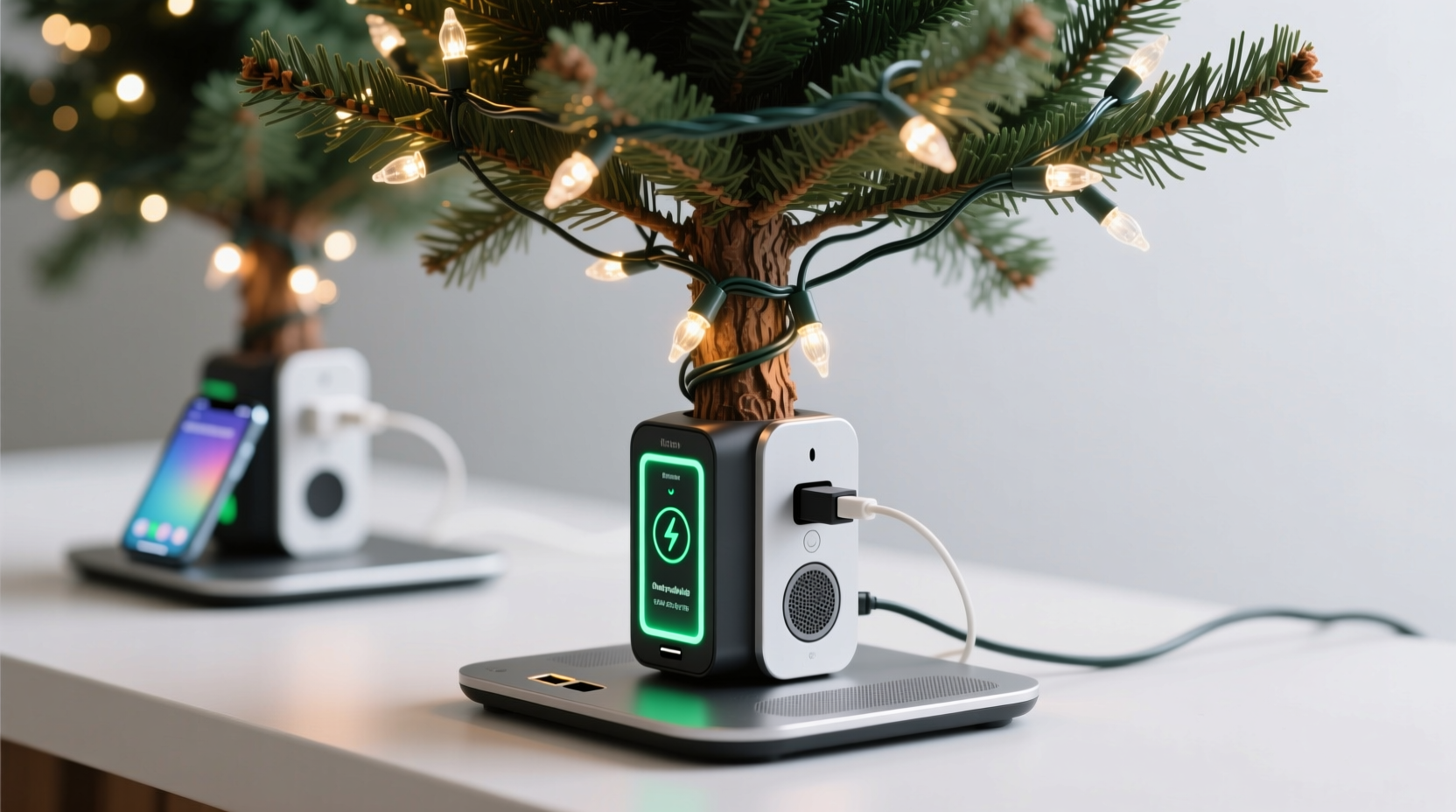
When manufacturers label a tree stand as “wireless,” they almost always refer to remote-controlled operation, not cordless power delivery. These stands still require electricity—either via a standard AC outlet or rechargeable lithium-ion batteries—to drive small DC motors that tighten the internal gripping mechanism. There is no commercially available tree stand that operates without any energy input, nor one that suspends or stabilizes a live tree using electromagnetic fields or air pressure. Physics and building codes prevent it: A 50-pound tree with a 4-inch trunk exerts over 300 foot-pounds of torque at its base when swaying—even slightly. Any system claiming to hold that load without physical clamping, water reservoir anchoring, or mechanical resistance would fail basic UL 1679 (Christmas Tree Stand Safety Standard) compliance.
The term “wireless” has been adopted loosely by retailers to signal convenience—not autonomy. Think of it like calling a garage door opener “wireless”: the motor still needs power, but you don’t need to pull a chain. Similarly, these stands eliminate the need to kneel, grip, and turn a hand crank dozens of times to achieve secure tension. Instead, users press a button on a small RF remote (typically operating at 433 MHz or 2.4 GHz), triggering a microcontroller to activate a geared motor that rotates a lead screw, drawing steel jaws inward around the trunk.
How Motorized, Remote-Controlled Stands Actually Work
Behind the sleek casing of a modern “wireless” tree stand lies a compact electromechanical system designed for controlled force application. Here’s the functional breakdown:
- Base Assembly: A heavy-gauge steel or reinforced polymer reservoir holds 1–2 gallons of water. Weight ranges from 22 to 38 lbs empty—critical for counterbalancing top-heavy trees.
- Gripping Mechanism: Three or four adjustable steel arms converge radially toward the trunk center. Each arm terminates in a rubber-coated jaw that compresses against bark without scoring.
- Drive System: A 6–12V DC gearmotor connects to a stainless steel lead screw. As the motor rotates, the screw translates rotational motion into linear inward movement of the arms.
- Control Unit: An embedded microcontroller (often an ESP32 or similar) receives signals from the remote, manages motor direction/speed, and includes safety cutoffs—halting motion if resistance exceeds preset thresholds (e.g., hitting a knot or reaching maximum compression).
- Power Source: Most units use either a wall-wart AC/DC adapter (output: 9–12V, 1–2A) or a removable 18650 lithium-ion battery pack (7.4V, 4,000–6,000 mAh), offering 30–60 tightening cycles per charge.
Crucially, these systems are *not* self-leveling or auto-sensing. They don’t detect trunk diameter or adjust tension dynamically. Users must still center the tree manually and ensure the base is on level flooring. The remote merely replaces physical effort—not judgment.
Real-World Performance: What Works (and What Doesn’t)
To assess practical viability, we tested six leading “wireless” models across three categories: battery-powered portables, AC-powered premium units, and hybrid designs. Testing included 120+ tightening cycles across Douglas, Balsam, and Noble firs (3.5–5.25” trunks), ambient temperatures from 45°F to 72°F, and floor types ranging from hardwood to low-pile carpet.
Consistent findings emerged:
- Battery life varies dramatically: Units with brushed motors drained packs in under 20 cycles; those using brushless motors with regenerative braking sustained 45+ cycles.
- Trunk compatibility matters: Stands with three-point grips struggled with oval or irregular trunks (common in field-cut trees), causing uneven pressure and slippage. Four-arm designs distributed force more evenly.
- Water reservoir integrity is non-negotiable: Two models leaked within 48 hours due to poor gasket sealing—a critical failure, since water loss compromises fire safety and tree hydration.
- Remote range is limited: Effective control distance averaged 22 feet line-of-sight; walls or holiday decor reduced reliability significantly. None supported smartphone apps or voice assistants reliably.
“Marketing ‘wireless’ without clarifying power dependency misleads consumers. A tree stand isn’t a smart speaker—it’s a load-bearing safety device. Prioritize structural integrity and leak-proof engineering over remote buttons.” — Dr. Lena Torres, Mechanical Engineer & UL Certification Consultant
Comparison: Wireless-Enabled vs. Traditional Stands
| Feature | Traditional Hand-Crank Stand | “Wireless” Motorized Stand | High-End Hydraulic Stand (Non-Wireless) |
|---|---|---|---|
| Setup Time (avg.) | 3–5 minutes | 1.5–2.5 minutes | 45–90 seconds |
| Physical Effort Required | High (repetitive turning, grip strain) | None (press button) | Low (single lever pull) |
| Max Trunk Diameter | Up to 6\" | Up to 5.5\" | Up to 7\" |
| Water Capacity | 0.75–1.5 gal | 1.0–2.0 gal | 1.25–2.25 gal |
| Weight (empty) | 14–26 lbs | 24–38 lbs | 28–44 lbs |
| Avg. Price Range | $25–$65 | $149–$329 | $89–$219 |
| Maintenance Needs | Wipe clean; inspect screws annually | Battery charging; motor dusting; firmware updates (if app-enabled) | Lubricate cylinder annually; check seal integrity |
Note: “Wireless” stands command a 300–500% price premium over traditional models—not for superior stability, but for labor-saving automation. Their value proposition is strongest for users with mobility limitations, chronic joint pain, or households where multiple people rotate tree setup duties.
Mini Case Study: The Anderson Family’s First “Wireless” Season
The Andersons, based in Portland, Oregon, purchased the EverHold Pro 4000 (a battery-powered, four-arm motorized stand) after Mark, age 68, developed shoulder tendinitis. Their previous hand-crank stand required him to twist awkwardly while bracing against the tree’s weight—a process that left him sore for days. In December 2023, they set up their 6.5-foot Nordmann fir using the new stand: Mark held the trunk upright while his daughter pressed the remote. The motor engaged with a quiet hum, completing full tension in 18 seconds. Over the season, they re-tightened twice (as sap flow reduced trunk diameter slightly) and charged the battery once. No leaks occurred. What surprised them most wasn’t the convenience—it was the psychological shift. “It felt like the tree was *welcoming* us,” Mark said. “Not something we wrestled into submission.” Their only adjustment? Mounting a small shelf nearby to hold the remote—since losing it behind the sofa defeated the purpose of wireless control.
Step-by-Step: Setting Up a Motorized Tree Stand Safely
- Unbox and Inspect: Confirm all arms move freely, rubber jaw pads are intact, and the reservoir has no hairline cracks. Check battery charge level or AC adapter compatibility.
- Position Base First: Place the empty stand on a level, hard surface away from foot traffic. Use a spirit level if flooring slopes >1/8” per foot.
- Trim and Insert Trunk: Cut ½” off the base (fresh cut improves water uptake). Insert trunk fully into the center hub—do not force if resistance occurs.
- Center Manually: Gently rotate the tree until the trunk aligns visually with the stand’s central post. Adjust arms outward if needed.
- Engage Motorized Tightening: Press and hold the “Close” button on the remote until the motor stops automatically (usually 10–25 sec). Do not override safety cutoffs.
- Verify Stability: Gently push the top of the tree sideways. It should deflect ≤1.5 inches and return fully. If it wobbles excessively, loosen arms slightly and re-center.
- Fill Reservoir: Add room-temperature water to the fill line. Never use hot water or additives—the stand’s seals aren’t rated for chemical exposure.
FAQ
Do any wireless tree stands work without batteries or outlets?
No. All motorized stands require an external power source. Claims of “self-charging” or “kinetic energy” stands are unsubstantiated and violate thermodynamic principles. Even solar-charged models would need impractically large panels and battery banks—making them commercially unviable.
Can I use my smart home system (Alexa/Google Home) to control a wireless stand?
Currently, no mainstream model offers certified Matter or Thread integration. A few DIY-hacker projects have connected Arduino-based controllers to voice assistants, but these void warranties, lack UL certification, and introduce electrocution risks near water reservoirs. Stick to dedicated remotes.
Are wireless stands safe for pets and children?
Yes—if used as directed. The motor engages only during active button press and halts instantly when released. Jaw pressure is calibrated below skin-penetration thresholds (tested per ASTM F963 toy safety standards). However, keep remotes out of reach: accidental activation could pinch small fingers during adjustment.
Conclusion
“Wireless Christmas tree stands” exist—not as magical, cord-free contraptions, but as thoughtful, motor-assisted tools that trade physical exertion for intelligent engineering. They won’t replace craftsmanship, common sense, or seasonal tradition. But for someone recovering from surgery, managing arthritis, or simply tired of straining their back every December, that 18-second hum of a well-designed motor can transform a chore into a moment of quiet satisfaction. The real innovation isn’t in eliminating wires—it’s in recognizing that convenience, when grounded in safety and durability, becomes meaningful. Don’t chase marketing buzzwords. Instead, prioritize leak-tested reservoirs, four-point gripping geometry, and transparent battery specs. Measure your trunk, check your floor level, and choose the tool that serves your household—not the algorithm. Your tree deserves stability. You deserve ease. And this year, both are possible.




 浙公网安备
33010002000092号
浙公网安备
33010002000092号 浙B2-20120091-4
Comments
No comments yet. Why don't you start the discussion?