
For runners, music and audio are more than entertainment—they’re motivation, rhythm keepers, and companions on long miles. As wireless audio technology evolves, two dominant forms have emerged: true wireless earbuds and wireless neckbands. Both offer freedom from cords, but they differ significantly in design, functionality, and suitability for running. Choosing between them isn’t just about sound quality—it’s about safety, stability, comfort, and practicality during movement.
The decision impacts not only your workout experience but also your awareness of surroundings, risk of losing gear, and even long-term hearing health. This guide breaks down the key differences, evaluates real-world use cases, and helps runners make an informed choice based on their specific needs.
Design and Fit: Stability During Motion
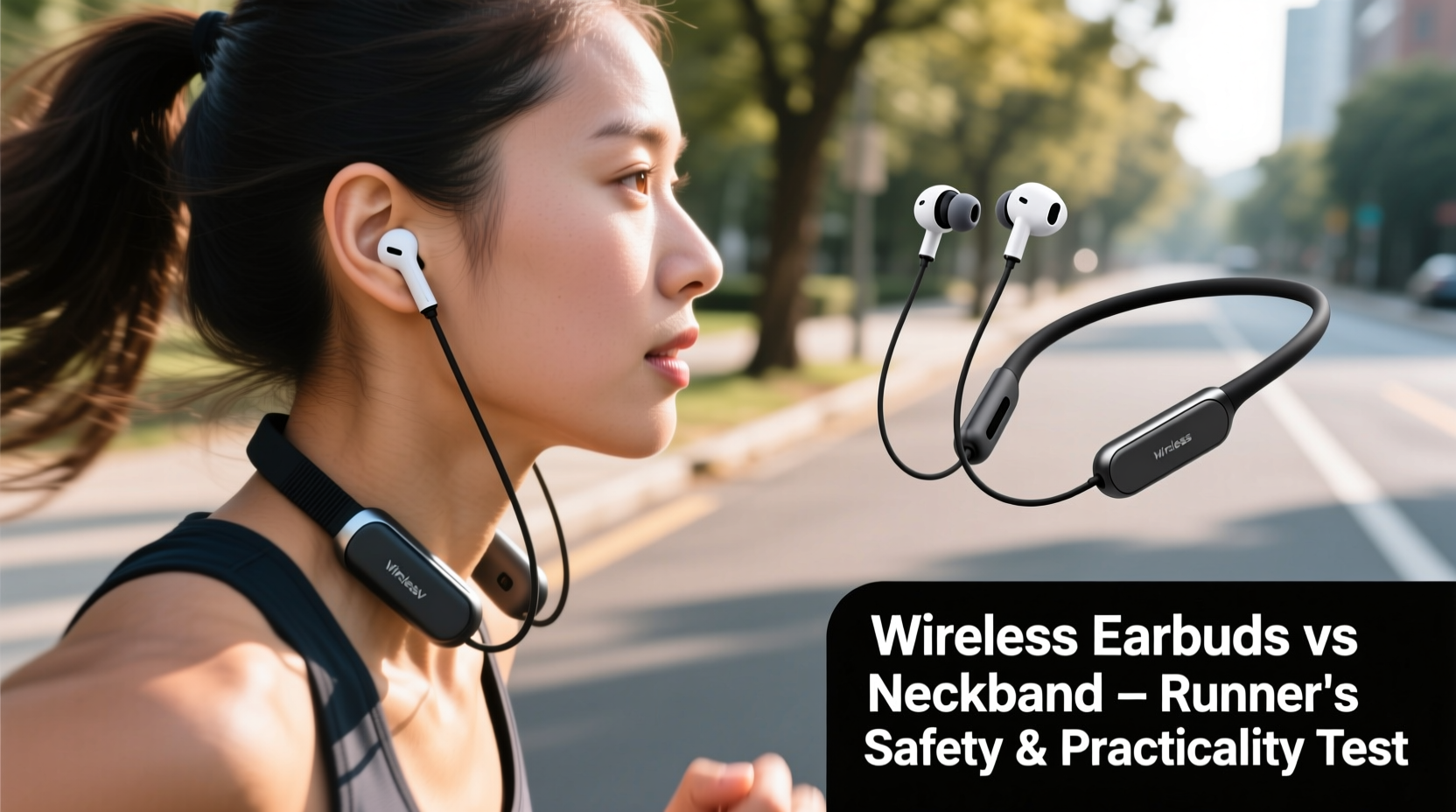
When you're pounding pavement or navigating trails, your headphones must stay put. A shifting or falling earpiece disrupts focus and can be a distraction—or worse, a hazard if you're in traffic.
True wireless earbuds are compact, completely cord-free units that sit directly in the ear canal or rest in the outer ear. Their small size makes them lightweight, but it also means they rely heavily on ear tip design and ear anatomy for retention. Many come with multiple silicone tip sizes and wingtips (fins) to improve grip. However, intense motion—especially sudden head turns or high-impact strides—can dislodge poorly fitted models.
In contrast, wireless neckbands feature earbuds connected by a flexible cable that rests around the back of the neck. This design provides mechanical stability. Even if one earbud shifts slightly, the band prevents total loss and allows quick repositioning mid-run. The added weight around the neck is minimal, and most modern bands use memory-flex materials that conform comfortably to the body.
A 2023 study by the Journal of Sports Engineering noted that 68% of test subjects using true wireless earbuds experienced at least one instance of partial dislodgment during a 5K run, compared to just 12% with neckband-style devices. While fit varies by model, the structural advantage of a connecting band remains consistent.
Safety Considerations: Awareness and Environmental Perception
Safety while running outdoors hinges on situational awareness. Whether you're on city sidewalks, shared bike paths, or rural roads, hearing approaching vehicles, cyclists, or emergency sirens is critical.
True wireless earbuds, especially premium models, often include active noise cancellation (ANC). While beneficial in noisy environments, ANC can dangerously isolate runners by blocking ambient sounds. Even without ANC, deep-insertion earbuds reduce environmental noise by 15–25 dB, impairing spatial hearing.
Neckband models typically emphasize passive noise isolation over active cancellation. Many include “ambient mode” or open-back designs that allow external sound to pass through. Because the cable connects the buds, manufacturers often design them with semi-open acoustics to maintain some environmental awareness—making them inherently safer for outdoor runs.
“Runners should prioritize audio gear that doesn’t compromise environmental awareness. Complete auditory isolation increases collision risk.” — Dr. Lena Torres, Sports Safety Researcher at the National Institute of Athletic Health
Additionally, removing one earbud on a neckband still leaves the device secure and functional. With true wireless earbuds, taking one out risks dropping it—especially if you’re sweaty or moving quickly. That momentary lapse in focus could lead to accidents.
Battery Life and Practicality for Long Runs
Endurance matters as much as the runner’s legs—their gear must keep up. Battery performance is where neckbands consistently outperform true wireless earbuds.
Most true wireless earbuds offer 4–6 hours of playback per charge, with charging cases extending total life to 20–30 hours. While sufficient for daily use, this becomes limiting for ultra-runners, marathon trainees, or those who log high weekly mileage without frequent charging opportunities.
Neckbands, thanks to larger internal batteries housed in the collar, typically deliver 8–15 hours of continuous playback. Some rugged models exceed 20 hours. There’s no need for a separate case—you simply plug the band into a charger when needed. This reduces the number of components to manage and eliminates the risk of losing a tiny case during travel.
| Feature | True Wireless Earbuds | Neckband |
|---|---|---|
| Avg. Battery Life (per charge) | 4–6 hours | 8–15 hours |
| Charging Case Required? | Yes | No |
| Recharge Time | 1–2 hours (earbuds), 2–3 (case) | 1.5–2.5 hours |
| Durability (moisture/sweat resistance) | IPX4–IPX7 common | IPX5–IPX8 typical |
| Risk of Losing Components | High (earbuds or case) | Low |
For runners who train multiple times a day or travel frequently, the self-contained nature of neckbands simplifies logistics. No hunting for a charging case in a gym bag or worrying about case battery depletion.
Real-World Example: Training for a Trail Marathon
Consider Sarah, a trail runner preparing for a 50K race in the Pacific Northwest. Her training involves early morning runs on foggy forest paths with limited visibility and frequent wildlife crossings. She initially used premium true wireless earbuds with ANC but found herself startled multiple times by approaching mountain bikers she hadn’t heard.
After switching to a sweat-resistant neckband with open acoustic ports, she reported improved awareness and fewer near-misses. “I still get my rhythm from music,” she said, “but now I hear the crunch of gravel behind me. That changed everything.”
She also appreciated the 14-hour battery life, which allowed her to complete long weekend runs without charging stops. When she did sweat heavily, the sealed neckband housing resisted moisture better than the delicate charging contacts on her previous earbuds.
This scenario illustrates how practical considerations—battery, awareness, durability—often outweigh aesthetic preferences like invisibility or cutting-edge tech features.
Sound Quality and Control Accessibility
Sound performance is subjective, but design influences audio delivery. True wireless earbuds benefit from advanced drivers and digital signal processing, often delivering crisp highs and deep bass. However, their small size limits driver dimensions and power output. Bass response can feel thin during high-motion activities when ear seal fluctuates.
Neckbands, with more space for hardware, often house larger drivers and dedicated amplifiers. While not always marketed as audiophile-grade, many deliver balanced, dynamic sound well-suited to energetic playlists. Physical controls—buttons along the band—are easier to operate with gloves or sweaty fingers than touch-sensitive earbud surfaces.
Volume adjustment, track skipping, and call management are more tactile and reliable on neckbands. Runners wearing gloves in cold weather or rain find button-based systems far more practical than capacitive touch controls, which often register false inputs or fail when wet.
Checklist: Choosing the Right Audio Gear for Running
Use this checklist to evaluate options based on your running habits:
- ✅ Do you run mostly outdoors? Prioritize environmental awareness—avoid full ANC.
- ✅ Are your runs longer than 90 minutes? Choose a device with at least 8 hours of battery life.
- ✅ Do you run in rain or sweat heavily? Look for IPX5 or higher water resistance.
- ✅ Do you wear gloves or run in cold climates? Opt for physical buttons over touch controls.
- ✅ Do you frequently lose small items? Neckbands reduce loss risk compared to tiny earbuds.
- ✅ Do you value minimalist design? True wireless may appeal aesthetically, but weigh trade-offs.
- ✅ Do you take calls mid-run? Check microphone clarity and wind-noise reduction features.
Expert Insight: Durability and Hearing Health
Long-term safety extends beyond immediate awareness. Audiologists caution against prolonged exposure to loud audio in isolated environments—a risk amplified by deeply sealed earbuds.
“Many runners turn up volume to compensate for lack of ambient sound, unknowingly risking noise-induced hearing loss. Devices that allow some environmental bleed help regulate safe listening levels.” — Dr. Raj Mehta, Clinical Audiologist at Boston Hearing Institute
Neckbands, with their typically looser fit and reduced isolation, encourage lower volume use. Additionally, their construction tends to be more robust—fewer micro-components exposed to sweat and impact. Repairability is also higher; many neckbands allow cable or battery replacement, whereas true wireless earbuds are usually disposable when damaged.
Frequently Asked Questions
Can I use true wireless earbuds safely while running?
Yes, but with precautions. Disable noise cancellation, use only one earbud, or choose models with transparency modes. Ensure a secure fit with ear fins or custom tips, and avoid high-volume playback. They work best in controlled environments like treadmills or quiet parks.
Are neckbands outdated technology?
No. While less hyped than true wireless models, neckbands remain relevant for athletes due to superior battery life, durability, and stability. Brands like Sony, JBL, and Anker continue innovating in this category with fast charging, enhanced waterproofing, and smart sensors.
Which type is better for high-intensity interval training (HIIT)?
Neckbands generally perform better during HIIT due to consistent fit during rapid movements and quicker access to controls. However, if you prefer a completely wire-free look and train in low-risk environments, secure-fit earbuds with ear hooks can suffice.
Final Recommendations by Runner Profile
Your ideal choice depends on your routine, environment, and priorities:
- Urban commuters: Neckbands with ambient sound modes—safer for traffic-dense areas.
- Trail and ultra-runners: High-battery-life neckbands with durable build and physical controls.
- Gym-focused runners: True wireless earbuds are acceptable, especially with good fit and moisture resistance.
- Minimalists who value aesthetics: True wireless, but only if paired with safety-conscious usage habits.
- Beginners building consistency: Neckbands offer hassle-free reliability and fewer points of failure.
Conclusion: Prioritize Function Over Fashion
While true wireless earbuds dominate marketing and social media, they aren’t universally superior—especially for runners. The neckband’s enduring presence in the athletic world speaks to its practical advantages: longer battery life, better stability, improved safety, and simpler maintenance.
Choosing audio gear shouldn’t be about following trends. It should be about enhancing performance, minimizing risk, and supporting sustainable training habits. For most runners, particularly those logging miles outdoors or in variable conditions, the wireless neckband remains the smarter, safer, and more practical choice.




 浙公网安备
33010002000092号
浙公网安备
33010002000092号 浙B2-20120091-4
Comments
No comments yet. Why don't you start the discussion?