
For runners who train in urban environments, traffic-heavy zones, or bustling parks, audio clarity isn’t just about enjoyment—it’s a matter of safety and performance. The right headphones can block out the chaos of horns, sirens, and chatter while delivering crisp music or coaching cues that keep you motivated. But when choosing between wireless earbuds and over-ear headphones, the decision hinges on more than personal preference. It involves understanding how each type performs under real-world conditions, especially when noise is constant and movement is relentless.
This guide examines both options through the lens of acoustic performance, fit, comfort, situational awareness, and practicality for runners navigating noisy surroundings. We’ll break down technical differences, analyze user experiences, and offer actionable advice to help you make an informed choice based on your specific needs.
Sound Isolation and Noise Control: The Core Challenge
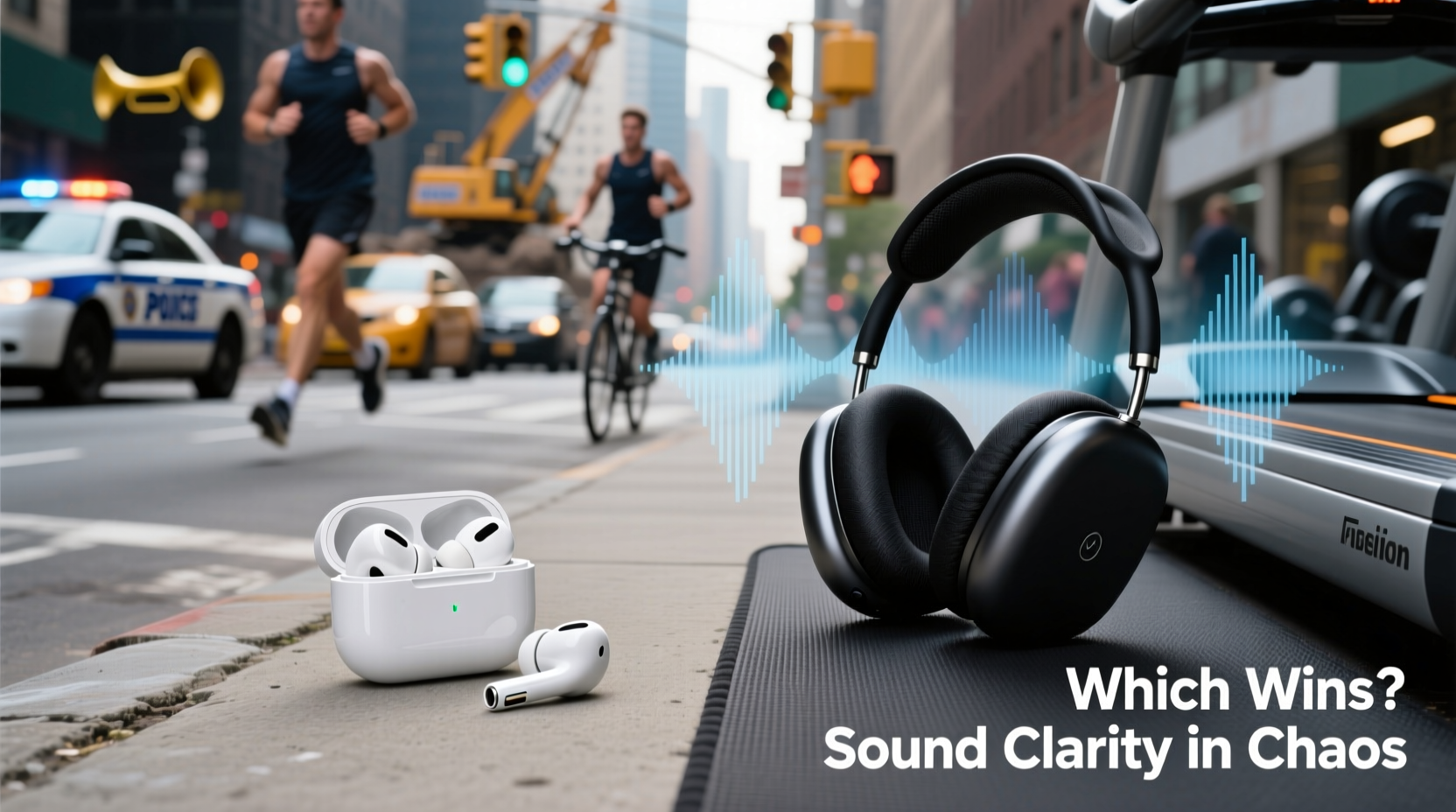
In loud environments—city streets, subways, or construction zones—external noise competes with your audio. Without effective isolation or active noise cancellation (ANC), even high-fidelity sound becomes muddled. The key difference between earbuds and over-ear models lies in their physical design and how they interact with ambient sound.
Over-ear headphones typically provide superior passive noise isolation because they fully enclose the ears, creating a seal that blocks mid-to-low frequency sounds like engine rumble or distant traffic. When combined with ANC technology, many over-ear models significantly reduce background noise across a broad spectrum. This makes them ideal for immersive listening in consistently loud settings.
Wireless earbuds, on the other hand, sit inside or at the entrance of the ear canal. While some in-ear models create a tight seal using silicone or foam tips—offering impressive passive isolation—their smaller size limits surface area coverage. However, advancements in ANC have narrowed the gap. Premium true wireless earbuds now feature hybrid ANC systems that use microphones both outside and inside the earbud to sample and cancel noise dynamically.
Despite improvements, over-ears still generally outperform earbuds in sustained noise reduction. Yet, for runners, performance must be weighed against mobility and environmental awareness.
Fit, Stability, and Environmental Awareness
Noise control matters, but so does staying aware of your surroundings. In busy areas, complete sound blocking can be dangerous—missing a cyclist’s warning bell or a car horn could lead to accidents. Many runners prefer a balance: enough audio immersion to stay focused, but sufficient ambient sound leakage to remain alert.
Earbuds often excel here. Because they don’t fully cover the outer ear, they naturally allow more environmental sound to enter. Some models include “transparency mode,” which uses external mics to pipe in ambient noise when activated. This feature enables quick toggling between immersive listening and full situational awareness—ideal for crossing streets or navigating crowded sidewalks.
Over-ear headphones, particularly those with strong ANC, can create a sensory bubble that disconnects users from their environment. While this enhances music quality, it increases risk during outdoor runs. Additionally, their larger footprint makes them more prone to shifting during high-motion activity. Sweat, wind, and repeated head movements can cause slippage, especially with lightweight frames not designed specifically for sports.
“Runners need gear that supports both performance and safety. Total noise isolation may seem appealing, but auditory awareness is a critical layer of protection.” — Dr. Lena Torres, Sports Audiologist and Hearing Safety Researcher
Comparative Analysis: Key Features Side-by-Side
| Feature | Wireless Earbuds | Over-Ear Headphones |
|---|---|---|
| Noise Isolation (Passive) | Moderate to High (depends on ear tip seal) | High (full ear coverage) |
| Active Noise Cancellation | Available in premium models; improving rapidly | More mature tech; broader frequency cancellation |
| Fitness Stability | Excellent (designed for motion; wingtips/hooks) | Poor to Moderate (bulkier; prone to shift) |
| Situational Awareness | Good (natural sound leak + transparency modes) | Limited (especially with ANC on) |
| Battery Life | 4–8 hours (with charging case extending usage) | 15–30+ hours (larger batteries) |
| Portability | Excellent (compact, pocketable) | Fair (foldable designs help; bulkier) |
| Sweat & Weather Resistance | Common (IPX4 or higher in sport models) | Rare (most lack robust water resistance) |
The table illustrates a clear trade-off: over-ear headphones win in raw sound quality and battery endurance, while earbuds dominate in portability, stability, and safety-conscious design.
Real Runner Scenario: Training in a Busy Metro Area
Consider Maria, a long-distance runner training in downtown Chicago. Her route includes bike lanes, crosswalks, elevated trains, and heavy foot traffic. She initially used over-ear ANC headphones for her morning runs, drawn by their rich bass and immersive sound. However, she found herself frequently startled by bikes approaching from behind and struggled to hear traffic signals. After two close calls, she switched to wireless earbuds with transparency mode.
She now uses a pair of sport-grade earbuds with IP67 rating, secure-fit fins, and adaptive ANC. During straight stretches, she activates noise cancellation to focus on tempo. As she approaches intersections, she taps the earbud to switch into transparency mode, instantly hearing honks, voices, and vehicle engines. The change improved not only her safety but also her consistency—she no longer interrupts her run to remove headphones.
Maria’s experience reflects a growing trend among urban runners: prioritizing functional audio over audiophile perfection. For her, the ability to adapt to changing acoustic environments outweighs marginal gains in sound depth.
Step-by-Step Guide: Choosing the Right Option for Your Run
Selecting the best audio gear depends on your environment, priorities, and physiology. Follow this sequence to make a confident decision:
- Assess Your Running Environment
Determine whether you primarily run in quiet parks, suburban neighborhoods, or high-noise urban zones. The louder and more unpredictable the setting, the greater the need for environmental awareness. - Evaluate Your Need for Noise Blocking
If constant low-frequency drone (e.g., highway traffic) distracts you, prioritize strong passive isolation or ANC. If intermittent sounds are the issue, consider dynamic controls like transparency mode. - Test Fit and Comfort Under Motion
Try potential models during short jogs or brisk walks. Pay attention to slippage, pressure points, and ear fatigue. Earbuds with stabilizing wings or over-ears with snug headbands perform better in motion. - Check for Sweat and Weather Resistance
Look for IPX4 or higher ratings if you run in rain or sweat heavily. Most over-ear headphones lack meaningful water resistance, putting them at a disadvantage for intense workouts. - Balance Sound Quality With Practicality
Ask yourself: Do I want concert-like immersion, or do I value safety and convenience more? If you're logging miles in complex environments, lean toward earbuds with smart audio switching.
Expert Recommendations and Common Pitfalls
Audiophiles often assume bigger drivers mean better sound—but in dynamic, noisy conditions, driver size is less important than effective sealing and signal processing. Small earbud drivers have advanced dramatically, with multi-driver setups and digital tuning compensating for physical limitations.
One common mistake is assuming all ANC is equal. Budget models may only cancel steady hums (like AC units), failing against sudden or mid-range noises (car horns, voices). Look for “adaptive” or “dynamic” ANC that adjusts to changing environments.
- Don’t ignore fit variability. Ears differ widely; what seals perfectly for one person may leak for another. Always try multiple ear tip types.
- Avoid bulky over-ears for speed work. Their weight and wind resistance become noticeable during sprints or interval training.
- Don’t sacrifice connectivity. Bluetooth 5.2 or later ensures stable pairing and lower latency, reducing dropouts during movement.
FAQ: Common Questions Answered
Can wireless earbuds really compete with over-ears in sound quality?
For general running use, yes—especially with modern high-end models. While over-ears still offer wider soundstages and deeper bass due to larger drivers, many premium earbuds now deliver balanced, detailed audio tailored for mobile listening. For most runners, the difference is negligible compared to the benefits of portability and safety.
Are over-ear headphones unsafe for outdoor running?
They can be, particularly in densely populated or traffic-heavy areas. Strong ANC and full ear coverage reduce your ability to detect nearby hazards. If you choose over-ears, consider using only one cup or disabling ANC in unpredictable zones. Alternatively, select open-back models that allow ambient sound, though these sacrifice noise blocking.
Do I need ANC for running in noisy areas?
It depends on your goals. If external noise disrupts your focus or pace, ANC helps maintain rhythm. However, constant ANC can dull your senses. A better approach is adaptive ANC or transparency mode, allowing you to toggle between immersion and awareness as needed.
Final Verdict: What Works Best for Noisy Runs?
While over-ear headphones technically offer superior sound reproduction and longer battery life, wireless earbuds are the more practical and safer choice for running in noisy environments. Their compact design, secure fit, resistance to sweat, and integration of transparency modes make them uniquely suited to the demands of active, urban runners.
Modern high-performance earbuds have closed much of the audio quality gap, delivering rich, well-tuned sound even in challenging conditions. When paired with proper ear tips and intelligent ANC, they provide targeted noise control without cutting off the world entirely.
Ultimately, the best sound isn’t just about fidelity—it’s about functionality. For runners who move through chaotic spaces, the ability to hear music clearly while remaining alert to surroundings is paramount. In this context, wireless earbuds aren’t just convenient—they’re the smarter, safer, and more effective solution.




 浙公网安备
33010002000092号
浙公网安备
33010002000092号 浙B2-20120091-4
Comments
No comments yet. Why don't you start the discussion?