
Choosing wireless earbuds in today’s market means navigating a sea of features, price points, and marketing claims. One of the most prominent differentiators—and one that often commands a significant price increase—is active noise cancellation (ANC). But for many buyers, the question remains: is ANC truly worth the extra cost? The answer isn’t always straightforward. It depends on lifestyle, usage patterns, and personal priorities. To help you make an informed decision, we’ll break down how ANC works, compare its benefits against non-ANC models, analyze trade-offs like battery life and sound quality, and evaluate whether the premium justifies the experience.
How Active Noise Cancellation Works
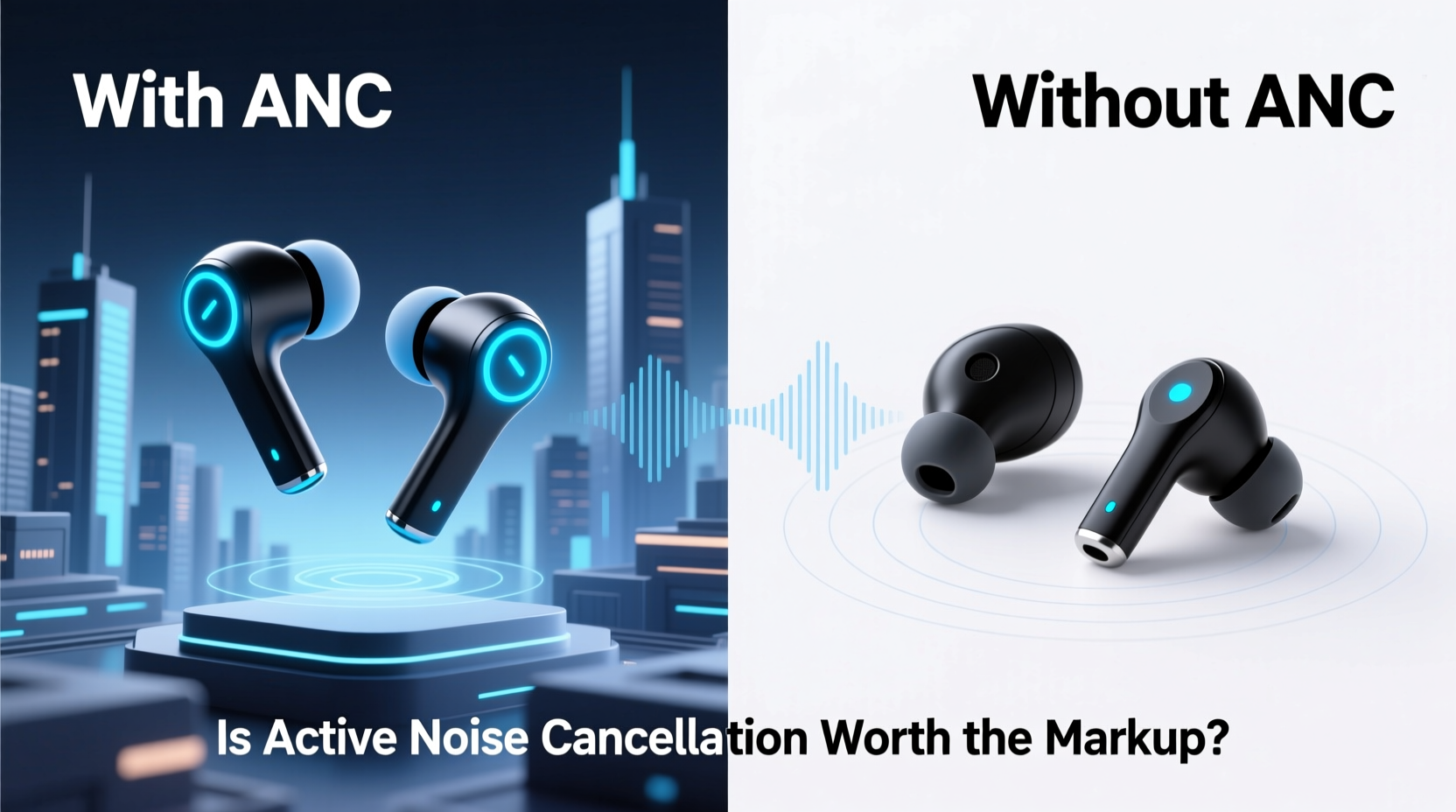
Active noise cancellation doesn’t simply block sound—it actively fights it. Unlike passive isolation, which relies solely on physical barriers (like earbud tips sealing your ear canal), ANC uses microphones to detect external noise and generates inverse sound waves to cancel it out. This process, known as destructive interference, effectively neutralizes low-frequency ambient sounds such as airplane engines, traffic rumble, or HVAC systems.
There are two main types of ANC:
- Feedforward ANC: Uses outward-facing microphones to capture noise before it reaches your ear. Less effective at adapting in real time but simpler to implement.
- Feedback ANC: Uses inward-facing microphones near the driver to monitor what’s actually reaching your ear, allowing for dynamic adjustments. More effective but more complex.
High-end models often combine both in a hybrid system, delivering superior noise suppression across a broader range of frequencies. However, ANC is most effective on consistent, low-pitched sounds. Sudden noises—like a door slamming or someone speaking nearby—are harder to cancel and may still be heard.
“ANC excels in predictable acoustic environments. It’s not magic, but it’s engineering at its most practical.” — Dr. Lena Tran, Audio Acoustics Researcher, MIT Media Lab
Performance Comparison: ANC vs Non-ANC Earbuds
To understand whether ANC is worth the markup, it helps to compare real-world performance across key areas. Below is a breakdown of how ANC and non-ANC earbuds stack up under typical use conditions.
| Feature | With ANC | Without ANC |
|---|---|---|
| Noise Reduction | Excellent for low-frequency ambient noise; reduces fatigue in noisy environments | Relies on fit and seal; minimal reduction beyond physical barrier |
| Sound Quality | Slight coloration possible; some models boost bass when ANC is on | Often more natural tonal balance; no processing artifacts |
| Battery Life | Reduced by 20–40% when ANC is active | Longer playback time due to lower power draw |
| Price Range | $150–$350+ | $50–$150 |
| Use Case Fit | Frequent travelers, commuters, open-office workers | Casual listeners, gym users, budget-conscious buyers |
The data shows a clear divide: ANC adds measurable value in specific contexts but comes with compromises. If you spend hours daily in transit or work in a loud environment, the benefit of reduced auditory stress can justify the cost. For others, especially those who primarily use earbuds at home or during workouts, the difference may be negligible.
When ANC Adds Real Value—And When It Doesn’t
Not all users benefit equally from noise cancellation. The value of ANC is highly situational. Consider these scenarios:
Frequent Travelers and Commuters
For anyone regularly flying, riding subways, or driving in heavy traffic, ANC is transformative. Airplane cabins, for instance, produce a constant 75–85 dB hum that fatigues the ears over time. ANC can reduce this by 15–25 dB, making long flights significantly more comfortable. Commuters benefit similarly from reduced exposure to train rumbles and engine noise.
Open-Office Workers
Modern workplaces often feature open layouts with constant background chatter, keyboard clatter, and phone rings. ANC earbuds create a personal acoustic bubble, improving focus and reducing cognitive load. In studies, knowledge workers using ANC reported higher concentration levels and fewer distractions during deep work sessions.
Home and Gym Users
If you mostly use earbuds while exercising, cooking, or relaxing at home, ANC offers little advantage. In fact, turning it on might be counterproductive—many gym-goers prefer to stay aware of their surroundings for safety. At home, where ambient noise is typically lower, the improvement is subtle and often not worth the battery drain.
Audio Purists and Casual Listeners
Some audiophiles avoid ANC because early implementations introduced audio artifacts like hissing, phase distortion, or unnatural resonance. While modern processors have minimized these issues, purists still argue that passive-only designs deliver cleaner, more transparent sound. Casual listeners, meanwhile, may never notice the difference—especially if they’re used to listening at higher volumes anyway.
Real-World Example: The Daily Commuter’s Dilemma
Take Sarah, a software engineer living in Chicago. Her daily routine includes a 45-minute train ride each way, working in a bustling open-plan office, and occasional weekend flights for family visits. She initially bought budget earbuds ($79) without ANC and found herself constantly cranking up the volume to drown out noise—leading to ear fatigue and diminished sound clarity.
After upgrading to a pair with hybrid ANC ($229), her experience changed dramatically. On the train, she could listen at 50% volume and still hear every detail in her music. In the office, she activated ANC during coding sprints and noticed fewer interruptions from nearby conversations. Even on a recent flight, she completed a six-hour journey without the usual post-travel exhaustion.
Sarah’s case illustrates how context determines value. For her, the $150 markup paid for itself in comfort, productivity, and hearing health. But for someone with a quieter routine, that same investment might go underutilized.
Battery Life and Practical Trade-Offs
One of the most tangible costs of ANC is reduced battery life. Most models lose about a third of their runtime when ANC is enabled. For example:
- A non-ANC model offering 8 hours becomes 6 hours with ANC active.
- Charging case capacity is also affected—fewer total charges over the day.
This matters most for travelers or those without easy access to charging. Some manufacturers offer transparency modes or adaptive ANC to mitigate this. Adaptive systems automatically adjust cancellation strength based on environment, preserving power when full ANC isn’t needed.
Another consideration is fit and comfort. ANC earbuds often require a tighter seal to function properly, which can cause ear fatigue over long periods. Some users report a slight “pressure” sensation—a phenomenon sometimes called “eardrum suck”—especially during altitude changes.
Step-by-Step: Choosing the Right Type for Your Needs
- Assess your primary usage environment: Do you commute, travel, or work in noisy spaces? If yes, ANC is likely beneficial.
- Evaluate your listening habits: Do you prefer immersive audio or staying aware of surroundings? ANC isolates; non-ANC allows environmental awareness.
- Test battery requirements: If you need all-day playback without recharging, consider whether ANC’s drain is acceptable.
- Set a realistic budget: Determine how much you’re willing to pay for convenience versus core audio performance.
- Try before you buy (if possible): Many electronics stores offer demo units. Test both ANC and non-ANC models side by side.
FAQ: Common Questions About ANC Earbuds
Does ANC damage your hearing?
No, ANC does not damage hearing. In fact, it can protect your hearing by reducing the need to play audio at unsafe volumes in loud environments. However, prolonged use at high volumes—even with ANC—can still cause harm.
Can I use ANC earbuds without playing audio?
Yes. Many users wear ANC earbuds silently to create a quiet space for reading, meditating, or sleeping. This is especially useful on planes or in noisy households.
Do all ANC earbuds perform the same?
No. Performance varies widely based on microphone placement, processing algorithms, and fit. Premium brands like Sony, Bose, and Apple consistently rank highest in independent tests, while budget ANC models may offer only marginal improvements.
Checklist: Is ANC Worth It for You?
- Do I spend more than 10 hours per week in noisy environments? ✅ / ❌
- Do I frequently travel by air or public transit? ✅ / ❌
- Am I sensitive to background noise when trying to focus? ✅ / ❌
- Do I prioritize battery life over noise reduction? ✅ / ❌
- Is my budget flexible above $150? ✅ / ❌
If you answered “yes” to three or more of the first three questions, ANC is likely worth the investment.
Conclusion: Making the Smart Choice
Active noise cancellation isn’t a universal upgrade—it’s a specialized tool. For the right user, it delivers tangible benefits in comfort, focus, and auditory well-being. For others, it’s an expensive feature that adds little value. The markup on ANC earbuds reflects real engineering, not just branding, but that doesn’t mean everyone should pay it.
The smart approach is intentional purchasing. Evaluate your lifestyle, test options when possible, and resist the allure of features you won’t use. Whether you choose ANC or go without, prioritize fit, sound quality, and reliability. After all, the best earbuds are the ones you’ll actually want to wear—every day.




 浙公网安备
33010002000092号
浙公网安备
33010002000092号 浙B2-20120091-4
Comments
No comments yet. Why don't you start the discussion?