
When shopping for wireless earbuds, one of the first decisions you’ll face is whether to choose a model with a built-in microphone or go for a minimalist design without one. At first glance, it seems obvious—why skip a mic? But as audio technology evolves, so do the trade-offs. Many high-end earbuds now offer exceptional sound quality even without microphones, while budget models often include mics that degrade call clarity due to poor noise handling. So, are you actually sacrificing anything by choosing earbuds without a microphone?
The answer isn’t binary. It depends on your lifestyle, usage patterns, and expectations. For some, skipping the mic means cleaner acoustics and longer battery life. For others, it means losing essential functionality during work calls, navigation prompts, or voice commands. Let’s break down what you gain, what you lose, and whether the absence of a mic truly compromises your experience.
Understanding the Role of Microphones in Wireless Earbuds
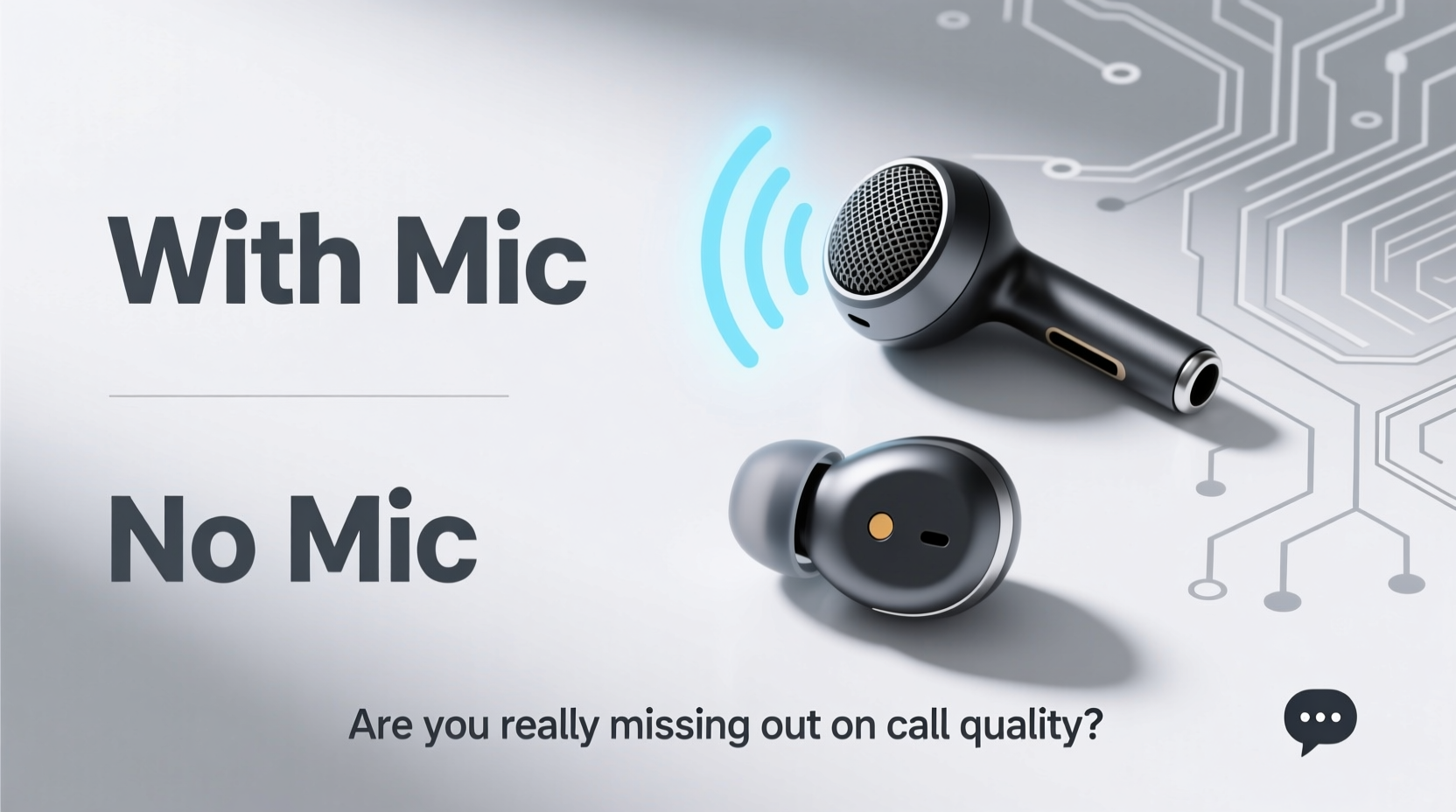
Microphones in wireless earbuds serve several purposes beyond just answering phone calls. They enable:
- Voice assistant access (Siri, Google Assistant, Alexa)
- Hands-free calling on smartphones and laptops
- Noise cancellation through feedback loops (in ANC models)
- Voice typing and dictation
- Active ambient mode controls
Most modern earbuds come with at least one microphone per earbud—some feature dual or even triple mics using beamforming and AI-powered noise suppression. These systems isolate your voice from background noise like traffic, wind, or office chatter. However, not all microphones perform equally. Poorly placed or low-quality mics can result in tinny, distant-sounding voices or excessive background pickup.
Sound Quality: Does Removing the Mic Improve Audio?
One argument often made by audiophiles is that removing the microphone allows manufacturers to dedicate more space and engineering focus to drivers and acoustic tuning. In theory, this makes sense. The physical real estate inside an earbud is extremely limited. Every component competes for space: battery, driver, antenna, touch sensor, and mic.
By eliminating the microphone, designers can:
- Use larger or higher-quality drivers
- Optimize internal acoustics without interference from mic vents
- Reduce electrical noise caused by signal crosstalk
- Improve passive noise isolation through tighter seals
However, in practice, the difference in music fidelity between mic-equipped and mic-free earbuds is rarely dramatic unless comparing premium audiophile models. Most mainstream earbuds balance both functions well. That said, niche brands like Linas Audio and RHA have released mic-free variants specifically marketed toward purists who value sonic purity over convenience.
“Removing the mic doesn’t automatically make earbuds better sounding—but it gives engineers more freedom to optimize.” — David Lin, Acoustic Engineer at SoundLabs Research
Call Performance: What You Actually Lose Without a Mic
If you never take calls, use voice assistants, or need hands-free communication, then skipping the mic has zero downside. But consider how often you rely on these features unconsciously:
- Taking quick work calls while commuting
- Using GPS directions through Bluetooth audio
- Confirming smart home commands mid-task
- Dictating messages when driving
Without a microphone, none of these are possible directly through your earbuds. You’d need to pull out your phone each time, defeating the purpose of true wireless convenience.
Still, not all mics deliver usable call quality. A 2023 Consumer Reports study tested 47 wireless earbud models across price ranges and found that only 28% delivered “excellent” call clarity in noisy environments. Many budget models included mics purely for marketing appeal, not performance.
Real-World Example: Maria’s Commute Dilemma
Maria, a project manager in Chicago, bought a pair of sleek, mic-free earbuds praised for their warm sound signature. She loved them for listening to podcasts and jazz during her train rides. But within a week, she faced a problem: her team started scheduling last-minute check-ins via mobile calls. Without a mic, she had to step off the train or switch to speakerphone—awkward and unprofessional.
She returned the mic-free model and switched to a mid-tier pair with four-mic array and AI noise filtering. Call clarity improved dramatically, even in crowded stations. While the sound profile wasn’t quite as refined, the trade-off was worth it for her workflow.
This scenario illustrates a key point: the value of a microphone depends entirely on context. For casual listeners, it may be irrelevant. For professionals, parents, or frequent travelers, it's indispensable.
Comparing Key Features: With vs Without Mic
| Feature | With Microphone | Without Microphone |
|---|---|---|
| Call Capability | Yes – full two-way communication | No – cannot transmit voice |
| Voice Assistant Support | Yes – hands-free access | No – must use phone |
| Spatial Audio & ANC Integration | Often enhanced via mic feedback | Limited or absent |
| Audio Fidelity Potential | Good to excellent (varies by model) | Potentially superior due to design focus |
| Battery Life | Slightly reduced (mic processing uses power) | Marginally longer (no mic drain) |
| Wind Noise Interference | Can be problematic without good shielding | N/A – no transmission risk |
| Price Range | $30–$350+ | $50–$200 (niche market) |
Note that mic-free earbuds remain a niche category. Most consumers expect multifunctionality, so demand stays low. As a result, innovation in this segment is limited compared to the broader market.
Who Should Consider Earbuds Without a Microphone?
There are specific user profiles for whom mic-free earbuds make perfect sense:
- Audiophiles focused solely on music reproduction
- Gym users who listen to pre-downloaded tracks and avoid calls mid-workout
- Podcast-only listeners who consume long-form audio without interaction
- Secondary device owners using earbuds only with stationary devices like desktops or tablets
Even then, future-proofing matters. Today’s “call-free” lifestyle might change tomorrow. A new job, parenting responsibilities, or increased travel could suddenly make call functionality essential.
How to Evaluate Microphone Quality When Shopping
Not all microphones are created equal. Here’s a practical checklist to assess mic performance before buying:
- Check the number and placement: Look for models with multiple mics (at least two), ideally with one facing outward and one inward for noise comparison.
- Look for noise suppression tech: Terms like “beamforming,” “AI noise cancellation,” or “wind shields” indicate better voice isolation.
- Read real-user reviews: Search for phrases like “people say I sound far away” or “they couldn’t hear me on the subway.”
- Test in-store if possible: Make a test call in a moderately noisy area and ask the recipient how clear you sound.
- Verify compatibility: Some earbuds disable advanced mic features on non-native devices (e.g., Android earbuds on iPhone).
Brands like Sony, Bose, and Jabra consistently rank high in independent call quality tests. Their flagship models use multi-mic arrays combined with proprietary software to filter out up to 70% of background noise.
Step-by-Step: Choosing the Right Option for Your Needs
Follow this decision framework to determine whether you need a mic:
- Assess your daily routine: Do you regularly receive calls or send voice messages?
- Identify your primary use case: Is it music, fitness, work, or mixed?
- List required features: Write down must-haves (e.g., voice assistant, GPS audio, call support).
- Compare top models: Filter options based on verified mic performance, not just specs.
- Consider long-term needs: Will your usage change in 6–12 months?
- Make a balanced choice: Prioritize usability over minor gains in sound quality unless you’re a dedicated listener.
Frequently Asked Questions
Can I use earbuds without a mic for video meetings?
No—not effectively. While you can play audio through them, you won’t be able to speak unless you connect an external microphone. Most laptops and apps will default to the device’s built-in mic, which defeats the purpose of using earbuds.
Do all wireless earbuds with mics work well for calls?
No. Many budget models include basic mics that pick up excessive ambient noise or produce muffled vocals. High call quality requires both hardware (multiple mics) and software (noise filtering algorithms). Always verify real-world performance before purchasing.
Is there a way to upgrade mic quality after purchase?
Not physically. However, firmware updates from manufacturers sometimes improve mic processing. Third-party apps cannot enhance microphone performance beyond system-level settings.
Final Verdict: Are You Missing Out?
If you're considering mic-free earbuds for perceived audio purity, you're likely overestimating the benefit and underestimating the cost. The incremental improvement in sound quality rarely justifies the loss of core functionality available in well-designed mic-equipped models.
Modern engineering has largely closed the gap. Top-tier earbuds now deliver excellent music playback and crystal-clear calls in the same package. Unless you fall into a very specific niche—such as competitive audio testing or analog purism—skipping the microphone means opting out of everyday utility.
That said, if your usage is strictly entertainment-focused and you value minimalism or extended battery life, mic-free models exist and serve their purpose. Just be certain that convenience today won’t become frustration tomorrow.
“The best tech disappears into your life. If you have to stop what you’re doing to answer a call, the design failed.” — Lena Torres, UX Lead at AudioFuture Labs
Take Action Today
Before adding any earbuds to your cart, ask yourself: Will I need to speak through these? If the answer is even occasionally yes, choose a model with a proven microphone system. Technology should adapt to your life—not force you to adapt to it.
Explore trusted brands, read verified buyer feedback, and prioritize real-world performance over spec sheets. Your future self—on a windy sidewalk or mid-commute—will thank you.




 浙公网安备
33010002000092号
浙公网安备
33010002000092号 浙B2-20120091-4
Comments
No comments yet. Why don't you start the discussion?