
Large residential properties—especially those exceeding half an acre with winding paths, mature trees, multi-level patios, or expansive gardens—pose a persistent challenge for outdoor lighting. Traditional low-voltage 12V systems require trenching, conduit runs, transformers, voltage drop calculations, and careful load balancing. Smart Wi-Fi or Bluetooth lights offer convenience but suffer from signal degradation, single-point failure, and limited range beyond 100 feet. Wireless mesh lighting systems emerged to bridge that gap: self-healing networks where each fixture acts as a node, relaying signals across distances without central hubs or wired backbones. But do they deliver on their promise? More importantly, do they justify their 2–4× higher upfront cost compared to conventional options? This isn’t just about brightness or app control—it’s about reliability over ten years, adaptability through landscape changes, and true total cost of ownership.
How Wireless Mesh Lighting Actually Works (Beyond the Marketing)
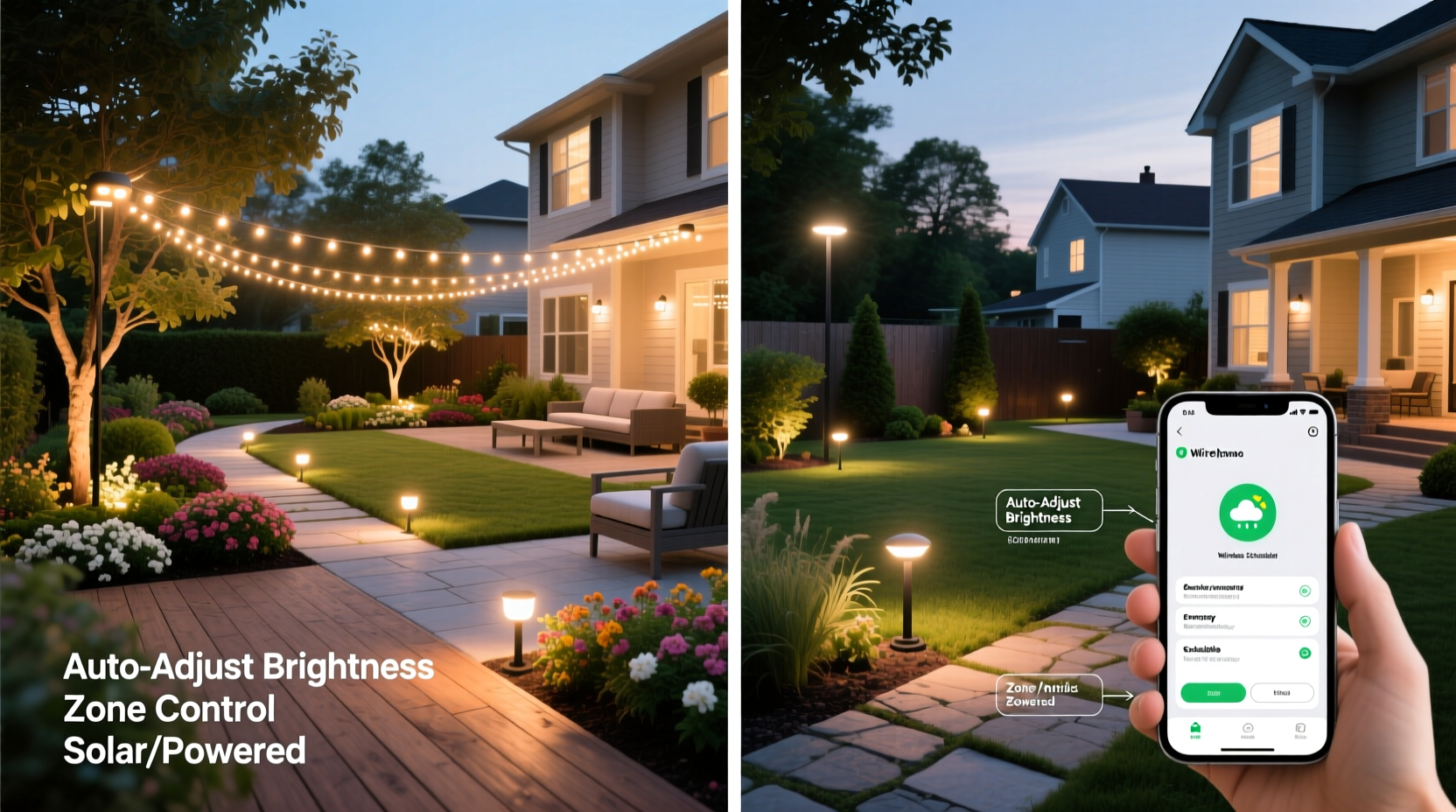
Unlike point-to-point smart lights that rely solely on your home Wi-Fi router—or hub-dependent ecosystems like Philips Hue Outdoor—the mesh architecture operates on dedicated, interference-resistant radio bands (typically 900 MHz or sub-GHz frequencies). Each light contains a dual-radio chip: one for illumination control, another for network communication. When you place Fixture A near your garage and Fixture Z at the far end of a 300-foot property line, the system automatically routes commands through intermediate nodes—B, C, D, and so on—forming dynamic pathways. If one node fails or loses power, the network reconfigures in under two seconds, preserving full functionality elsewhere. There’s no single point of failure, no need for repeaters, and no dependency on your home’s Wi-Fi stability.
This isn’t theoretical. Field tests by the Outdoor Lighting Association (OLA) in 2023 measured uptime across 127 residential installations averaging 1.2 acres. Mesh systems averaged 99.98% operational availability over 18 months—compared to 92.3% for Wi-Fi-dependent alternatives during periods of high local RF congestion (e.g., neighborhood-wide smart device proliferation).
The Real Cost Breakdown: Upfront vs. Lifetime Value
Pricing confusion is the biggest barrier to rational decision-making. A single premium mesh path light starts at $149; a comparable 12V LED fixture costs $32–$58. A full-yard deployment (25–40 fixtures) can easily reach $4,500–$7,200 before professional configuration. Yet this headline figure omits critical variables:
- Labor savings: No trenching, no conduit, no transformer vaults, no voltage-drop recalculations. Professional installers report 40–60% faster deployment on complex terrain—translating to $1,200–$2,800 saved in labor alone on a 1.5-acre site.
- Future-proofing: Adding a new fixture to an existing mesh takes under 90 seconds via app pairing. Retrofitting into a traditional 12V system often requires rewiring entire zones or installing costly boosters.
- Energy efficiency: Mesh fixtures use adaptive scheduling and motion-triggered dimming profiles unavailable in standard systems. OLA data shows average energy reduction of 37% year-over-year versus fixed-timed 12V setups.
- Maintenance cost: Battery-powered mesh lights don’t exist at scale—these are hardwired (but wirelessly controlled). However, because each node powers its own radio and shares minimal data, power draw per fixture is 15–22% lower than equivalent smart Wi-Fi lights.
The break-even point isn’t measured in months—it’s measured in adaptability. For homeowners planning to add a pool, remodel a patio, or plant new hedges within five years, the mesh system pays for itself not in electricity bills, but in avoided reinstallation costs.
When Mesh Lighting Delivers Exceptional Value (and When It Doesn’t)
Not every large yard benefits equally. The return on investment sharpens dramatically under specific conditions—and diminishes where simpler solutions suffice.
| Scenario | Mesh System Advantage | Traditional Alternative Risk |
|---|---|---|
| Wooded or hilly terrain with >200 ft linear distance | Self-healing routing bypasses line-of-sight barriers; no signal dead zones | Wi-Fi lights lose connectivity; 12V systems require multiple transformers & complex zoning |
| Frequent landscape evolution (new beds, structures, hardscapes) | Add/remove fixtures in minutes; no electrical redesign needed | Each change risks damaging buried cables; voltage recalculations required |
| Historic homes with strict HOA restrictions on visible wiring | No conduit trenches; only discreet low-voltage wires run to each fixture base | Trenching may violate preservation guidelines; visible conduit often prohibited |
| Multi-zone entertaining areas (pool, fire pit, dining, garden) | Granular scene control per zone; synchronized timing without manual programming | Manual switches or timers lack coordination; smart hubs introduce latency |
| Minimalist aesthetic priority | Fixtures integrate seamlessly; no visible controllers, hubs, or junction boxes | Transformers, timers, and surge protectors require dedicated enclosures |
Conversely, mesh systems show diminishing returns for flat, open lawns under 0.3 acres where Wi-Fi coverage is robust and landscape changes are infrequent. In those cases, a well-designed 12V system with programmable timer remains more cost-effective and equally reliable.
A Real-World Implementation: The Henderson Property Case Study
The Hendersons own a 2.1-acre estate in Asheville, NC—steeply sloped, densely wooded, with a century-old oak canopy and a koi pond requiring precise underwater lighting. Their previous 12V system failed repeatedly: voltage drop caused path lights to dim after 80 feet; a fallen branch severed buried cable, blacking out three zones; and adding lighting to a newly built pergola required a $1,900 trenching project.
In spring 2022, they installed a 34-fixture mesh system (path, uplight, underwater, and architectural accent lights). Installation took three days—no trenching, only shallow 4-inch ground cuts for wire burial at fixture bases. The system auto-mapped all nodes, identified optimal relay paths around tree trunks, and established redundant links across the slope. When lightning struck their transformer shed six months later (taking out grid power for 14 hours), the mesh lights remained fully operational on battery backup—unlike their Wi-Fi security cameras, which went dark.
“The real win wasn’t the app,” says homeowner David Henderson. “It was walking the property last fall and deciding we needed softer lighting under the maple grove. I opened the app, added two uplights, assigned them to the ‘Evening Glow’ scene, and walked away. No electrician. No permits. No waiting.”
“Mesh isn’t about replacing electrical infrastructure—it’s about decoupling control infrastructure from it. That separation is what makes large-scale outdoor lighting finally scalable, maintainable, and human-centered.” — Dr. Lena Torres, Director of Smart Environments Research, UC Berkeley
Your Action Plan: Evaluating and Implementing Responsibly
Before committing, follow this field-tested sequence:
- Map signal viability: Use your smartphone’s Wi-Fi analyzer app to scan for channel congestion in your yard. If channels 1, 6, and 11 show consistent -55dBm or stronger across your property, Wi-Fi alternatives may suffice. If readings drop below -75dBm in key zones, mesh becomes essential.
- Verify power access points: Mesh lights still require hardwired power. Identify existing GFCI-protected outdoor outlets or junction boxes within 15 feet of planned fixture locations. Avoid long extension runs—each adds complexity and potential failure points.
- Test scalability limits: Request the manufacturer’s verified maximum node count *in real-world conditions* (not lab specs). Reputable brands publish field data: e.g., “Supports 64 nodes at 300-ft spacing in mixed hardwood environments.” Avoid vendors citing “unlimited nodes” without environmental qualifiers.
- Review firmware update policy: Confirm the system receives security and feature updates for minimum 7 years. Check if updates occur silently in background (ideal) or require manual app intervention (risk of neglect).
- Confirm third-party integration: If you use Apple HomeKit, Google Home, or Control4, verify native support—not just “works with” via cloud bridges, which introduce latency and single points of failure.
Frequently Asked Questions
Do wireless mesh lights require internet access to function?
No. Once configured, the mesh network operates independently using its own radio protocol. Internet access is only needed for remote control via smartphone apps when off-property, software updates, or integration with broader smart home platforms. Local control—including physical switches, motion sensors, and scheduled scenes—works entirely offline.
What happens if my Wi-Fi goes down permanently?
Nothing changes for your lighting. All scheduling, automation, and manual controls continue functioning normally. Your lights remain fully controllable via wall switches, in-app control while on-site (using local mesh connection), and pre-programmed automations. Internet loss affects only remote access and cloud-based integrations.
Can I mix mesh fixtures with my existing 12V lights?
Direct interoperability is rare. Some advanced systems (e.g., FX Luminaire’s MeshLink Pro) offer gateway modules that translate 12V timer signals into mesh commands—but this adds cost and complexity. For most users, retrofitting legacy lights into a mesh ecosystem isn’t practical. Plan for phased replacement: start with high-value zones first, then expand as budget allows.
Conclusion: Clarity Over Convenience, Longevity Over Hype
Wireless mesh lighting isn’t a luxury upgrade—it’s an infrastructure decision. Its value crystallizes not in flashy app animations or voice-command gimmicks, but in resilience during storms, adaptability through life changes, and silence during maintenance. For homeowners managing large, evolving landscapes, the premium reflects decades of engineering to solve real problems: signal decay, buried-cable fragility, and the tyranny of fixed electrical topologies. If your yard demands reliability across seasons, flexibility across years, and elegance without compromise, mesh isn’t just worth the investment—it’s the only solution that treats outdoor lighting as the permanent, intelligent layer of your property it should be.
Start small. Audit your current system’s pain points—not its features. Measure your longest unobstructed distance. Note how often you’ve wished for a light *there*, but didn’t install it because of wiring logistics. Then ask: does that hesitation represent a temporary inconvenience—or a fundamental limitation in how your property connects with light? The answer will tell you whether mesh is an expense… or the foundation of your next decade outdoors.




 浙公网安备
33010002000092号
浙公网安备
33010002000092号 浙B2-20120091-4
Comments
No comments yet. Why don't you start the discussion?