
Synchronized light shows—whether for holiday displays, stage performances, or public art installations—demand precision, timing, and unwavering connectivity. As these productions grow in scale and complexity, traditional Wi-Fi or point-to-point wireless systems often fall short. Enter the wireless mesh network: a decentralized communication architecture that’s increasingly being adopted to ensure seamless coordination across hundreds or even thousands of lighting nodes. But does it actually improve reliability? The answer isn’t just yes—it’s nuanced, and understanding why requires a closer look at how mesh networks operate in high-stakes environments.
Understanding Wireless Mesh Networks in Lighting Systems
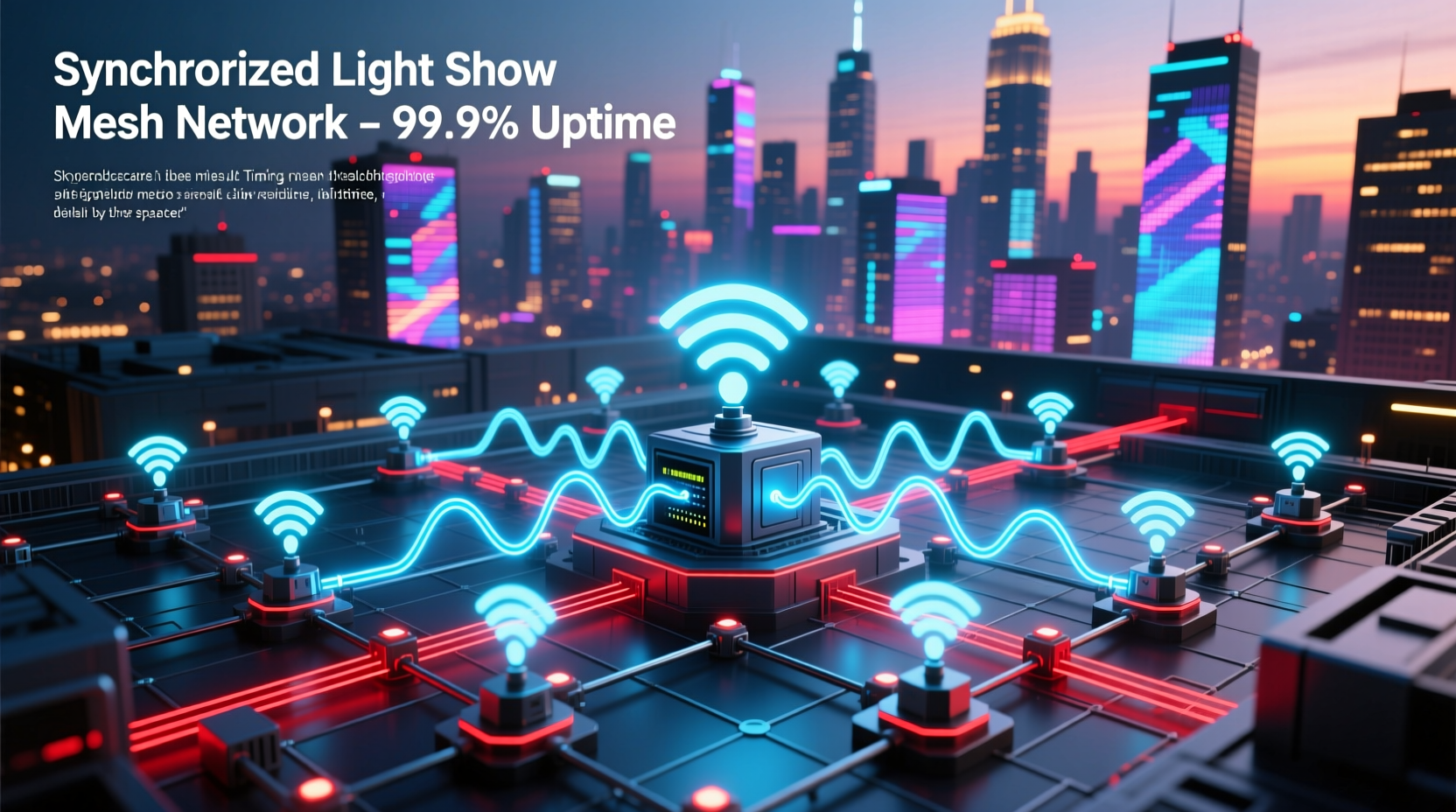
In a typical synchronized light show, multiple devices—such as LED controllers, DMX interfaces, and master timing units—must communicate in real time. Any delay, packet loss, or disconnection can result in flickering, desynchronization, or complete failure of visual sequences. Traditional wireless setups rely on a central access point (like a router), creating a star topology where all devices connect directly to one hub. This creates a single point of failure: if the router goes down or signal strength drops, the entire system suffers.
A wireless mesh network, by contrast, operates on a peer-to-peer model. Each node in the network can act as both a receiver and a relay. If Device A cannot reach the main controller directly, it can pass data through Devices B or C, which have stronger connections. This redundancy ensures continuous communication paths even when individual links degrade.
For light shows deployed across large yards, parks, or multi-building facades, this flexibility is invaluable. Mesh networks dynamically reroute traffic around obstacles like trees, walls, or interference sources. They also scale more efficiently—adding new lights doesn’t overload a central hub but instead contributes to the network’s overall robustness.
How Mesh Networking Enhances Reliability
Reliability in synchronized lighting hinges on three key factors: latency, fault tolerance, and scalability. Wireless mesh networks address each more effectively than conventional topologies.
Low Latency Through Adaptive Routing
One concern with mesh networks has historically been increased latency due to multi-hop transmission. However, modern mesh protocols such as IEEE 802.11s, Zigbee, or proprietary systems used in professional lighting gear employ intelligent routing algorithms. These detect the fastest available path in real time, minimizing delays to under 10 milliseconds—well within acceptable thresholds for audio-visual synchronization.
Unlike static networks, mesh systems continuously assess link quality and switch routes preemptively before failures occur. This proactive adjustment prevents the \"dropouts\" common in congested Wi-Fi channels during peak usage times (e.g., neighborhood holiday events).
Fault Tolerance Built Into the Architecture
Imagine a string of 200 smart lights running along a driveway, controlled via a single Wi-Fi bridge. If the fifth light loses connection due to moisture or power fluctuation, every subsequent unit may go dark—or worse, behave unpredictably. In a mesh configuration, however, neighboring units automatically detect the break and reconfigure the path, bypassing the failed node entirely.
This self-healing capability is particularly crucial for outdoor installations subject to environmental stressors: wind, rain, temperature swings, and electromagnetic interference from nearby appliances or power lines.
Scalability Without Performance Degradation
As shows expand—from a backyard display to a community-wide spectacle—network load increases exponentially. Centralized systems struggle under this strain, leading to buffer overflow and command lag. Mesh networks distribute the load organically. Each added node strengthens coverage and provides additional routing options, turning growth into an advantage rather than a liability.
“Mesh networking transforms reliability from a fragile dependency on infrastructure into a resilient property of the system itself.” — Dr. Lena Tran, Senior Researcher in Distributed IoT Systems, MIT Media Lab
Real-World Application: A Holiday Light Display Case Study
Consider the case of the Thompson family in suburban Colorado, who transformed their annual holiday light show into a city-recognized event attracting over 10,000 visitors per season. Initially using standard Wi-Fi extenders to control 150 nodes spread across two levels of their home and front yard, they experienced frequent dropouts during peak hours, especially when neighbors’ networks interfered.
In 2022, they upgraded to a Zigbee-based mesh system integrated with Shelly RGBW controllers and a central Raspberry Pi running custom Python scripts. Each lighting node joined the mesh, forming redundant communication paths. Even when snow accumulated on rooftop units, causing temporary disconnections, adjacent ground-level fixtures rerouted commands seamlessly.
The result? Zero synchronization errors during the six-week run, despite variable weather and heavy local RF traffic. More importantly, setup time decreased by 40% because adding new zones no longer required recalibrating router placement or channel selection.
This example illustrates not just technical superiority but operational efficiency—a critical consideration for anyone managing recurring or seasonal installations.
Implementation Checklist for Reliable Mesh-Based Light Shows
Deploying a reliable mesh network isn’t plug-and-play; careful planning ensures optimal performance. Follow this checklist before launch:
- Assess Physical Layout: Map out all device locations and identify potential obstructions (metal roofs, dense foliage).
- Select Compatible Hardware: Use mesh-capable controllers (e.g., ESP32-based modules, LumenRadio chips) that support low-latency protocols.
- Ensure Power Stability: Voltage fluctuations can disrupt radio modules. Use regulated power supplies and surge protectors.
- Test Hop Distance: Verify that signal strength remains above -85 dBm between adjacent nodes.
- Implement Time Synchronization: Use NTP or GPS timing inputs to align all nodes to a master clock, preventing drift.
- Monitor Network Health: Deploy tools like Z-Wave analyzers or MQTT dashboards to track node status in real time.
- Plan for Redundancy: Include at least two gateway points connecting to the main controller to avoid isolation.
Comparative Analysis: Mesh vs. Traditional Wireless Setups
| Feature | Wireless Mesh Network | Traditional Wi-Fi Setup |
|---|---|---|
| Single Point of Failure | No – decentralized routing | Yes – dependent on central router |
| Signal Resilience | High – adaptive pathfinding | Moderate – prone to dead zones |
| Latency (Avg.) | 5–15 ms (optimized) | 10–50 ms (variable) |
| Scalability | Excellent – grows with addition of nodes | Limited – degrades with congestion |
| Setup Complexity | Moderate – requires topology planning | Low – simple pairing |
| Maintenance Needs | Low – self-healing capabilities | High – manual intervention often needed |
| Cost Efficiency (Long-Term) | High – reduced downtime and repairs | Lower upfront, higher long-term cost |
While mesh networks require slightly more initial effort, their long-term advantages in reliability are clear. For mission-critical applications like public performances or commercial displays, the investment pays off in consistent operation and audience satisfaction.
Step-by-Step Guide to Building a Mesh Network for Light Control
Creating a dependable mesh-based system involves more than buying compatible hardware. Follow this sequence to build a robust foundation:
- Define Show Scope: Determine the number of lighting zones, animation types, and total node count.
- Choose Protocol: Select between Zigbee, Thread, Bluetooth Mesh, or proprietary RF (e.g., LumenRadio CRMX). Prioritize sub-GHz frequencies (like 868/915 MHz) for better wall penetration.
- Design Topology: Sketch a map showing node positions. Ensure each has at least two neighbors within strong signal range.
- Install Gateway: Connect a central controller (e.g., Raspberry Pi with USB dongle) to your sequencing software (like xLights or Falcon Player).
- Commission Nodes: Pair each lighting controller to the mesh, assigning unique IDs and verifying connectivity.
- Test Under Load: Run full sequences while monitoring packet delivery rates and timing accuracy.
- Deploy Monitoring: Set up alerts for offline nodes or abnormal latency spikes using open-source tools like Grafana + Mosquitto.
- Document Configuration: Record firmware versions, encryption keys, and physical layouts for future maintenance.
This structured approach minimizes surprises during live operation and allows for rapid recovery if issues arise.
Frequently Asked Questions
Can I mix different brands of mesh-enabled lighting controllers?
Only if they use the same underlying protocol. For example, Zigbee-certified devices from different manufacturers can typically coexist, provided they operate on the same frequency band and application profile. However, mixing Zigbee with Bluetooth Mesh or proprietary systems will require a bridge or gateway translation layer.
Do mesh networks consume more power?
Routing nodes do use slightly more energy since they transmit and receive constantly. However, most modern controllers enter low-power modes when idle. For battery-powered decorative elements, designate them as “end devices” that only wake to receive commands, preserving energy without sacrificing reliability.
Is encryption supported in consumer-grade mesh lighting systems?
Yes—most reputable mesh platforms include AES-128 or similar encryption to prevent unauthorized access or signal hijacking. Always enable security features during setup, especially for public installations vulnerable to interference.
Conclusion: Why Mesh Is the Future of Synchronized Lighting
The shift toward wireless mesh networks in synchronized light shows isn't merely technological trend-chasing—it's a necessary evolution driven by real-world demands for stability, precision, and scalability. Whether orchestrating a modest driveway display or a municipal festival, the ability to maintain flawless timing across hundreds of nodes separates amateur efforts from professional-caliber experiences.
By eliminating single points of failure, adapting to changing conditions, and growing stronger with scale, mesh networks deliver unmatched reliability. They empower creators to focus on artistry rather than troubleshooting dropped signals or rewiring dead zones.




 浙公网安备
33010002000092号
浙公网安备
33010002000092号 浙B2-20120091-4
Comments
No comments yet. Why don't you start the discussion?