
As homes grow smarter, the demand for seamless, responsive lighting systems increases—especially when managing hundreds of smart bulbs across multiple rooms, floors, or even commercial spaces. Whether you're designing a luxury residence, retrofitting an office, or building a large-scale hospitality environment, choosing the right communication backbone is critical. The decision often comes down to two dominant architectures: a centralized single-hub setup versus a decentralized wireless mesh network. Each has strengths and limitations, but when syncing hundreds of smart lights, the differences become magnified in practice.
The core challenge lies not just in turning lights on and off, but in ensuring synchronized behavior, low latency, reliable command delivery, and resilience against interference or device failure. A poorly chosen system can result in flickering responses, dropped commands, or entire zones going offline during peak use. Understanding how each network type handles scale, redundancy, and signal propagation is essential before investing in hardware.
How Smart Lights Communicate: The Basics
Smart lighting systems rely on wireless protocols to transmit commands between a control interface (like an app or voice assistant) and individual bulbs or fixtures. Common protocols include Wi-Fi, Zigbee, Z-Wave, Thread, and Bluetooth Mesh. While Wi-Fi and Z-Wave typically depend on a central hub, Zigbee and Thread are designed for mesh networking.
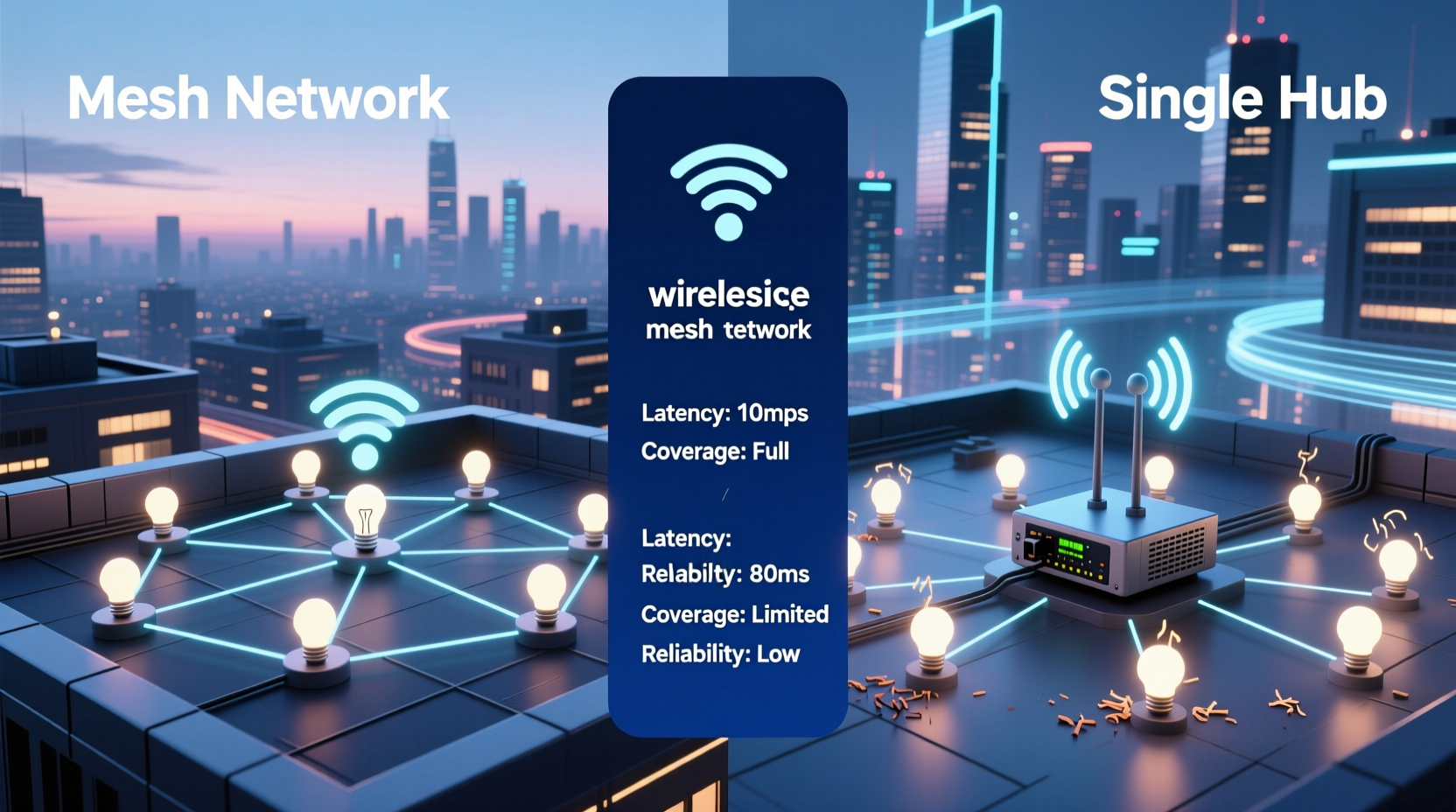
In a single-hub system, every smart light connects directly to a central gateway. This hub acts as the brain, receiving user inputs and broadcasting instructions over a specific frequency band. If a bulb is too far from the hub or blocked by walls, it may lose connection or respond slowly. In contrast, a mesh network allows devices to relay signals to one another. Each compatible light or repeater extends the network’s reach, creating multiple pathways for data to travel.
This fundamental difference affects everything from installation complexity to long-term stability—especially at scale. When dealing with dozens or hundreds of nodes, the architecture determines whether your system hums quietly in the background or becomes a source of daily frustration.
Single Hub Systems: Simplicity at a Cost
Single-hub setups are popular among consumers due to their plug-and-play nature. Brands like Philips Hue (with its Bridge), Samsung SmartThings (Hub edition), and many Wi-Fi-based ecosystems operate this way. You install the hub, pair devices through an app, and manage everything via cloud or local control.
For small to medium homes—say, under 50 smart devices—this model works well. Setup is straightforward, firmware updates are centralized, and troubleshooting usually involves restarting one device: the hub. However, scaling beyond that threshold exposes structural weaknesses.
First, bandwidth becomes a bottleneck. Most hubs communicate over 2.4 GHz bands shared with Wi-Fi, baby monitors, and microwaves. With hundreds of lights sending status updates, responding to triggers, and syncing animations, congestion leads to lag. Second, range limitations mean distant bulbs must maintain a direct line of sight or strong signal path to the hub. Thick walls, metal framing, or large open spaces can break connectivity.
Worse still, the hub represents a single point of failure. If it crashes, loses power, or disconnects from the network, all connected lights become unresponsive—even if they’re powered and within radio range of other devices. Some systems offer limited local fallback, but full functionality typically requires the hub to be online.
Mesh Networks: Built for Scale and Resilience
A wireless mesh network operates differently. Instead of relying on a single access point, each compatible device can act as both endpoint and relay. When a command is sent—such as “Set all living room lights to warm white”—it hops from node to node until it reaches its destination. This multi-path routing ensures redundancy; if one path fails, traffic reroutes automatically.
Protocols like Zigbee 3.0 and Thread are engineered for this purpose. They support thousands of nodes in theory, though practical limits depend on implementation and interference. More importantly, they distribute the communication load. No single device bears the burden of speaking to every bulb simultaneously. As more lights join the network, coverage actually improves because each new node potentially strengthens the mesh.
Latency remains low because messages take efficient routes based on real-time signal quality. Many mesh systems also support border routers that connect to your home IP network, enabling local control without constant cloud dependency—a key advantage for privacy and speed.
Consider a 300-light installation spanning three floors. In a mesh configuration, basement lights can communicate through first-floor fixtures, which in turn link to second-floor repeaters. Even if the primary router is upstairs, signals propagate reliably downward. Devices self-organize into clusters, dynamically adjusting paths as environmental conditions change—like someone closing a metal door or running a high-power appliance.
“Mesh networks fundamentally shift reliability from hardware concentration to distributed intelligence. For large-scale lighting, that’s not just beneficial—it’s necessary.” — Dr. Lena Park, Senior IoT Architect at OpenHome Labs
Comparing Performance Across Key Factors
| Factor | Single Hub System | Wireless Mesh Network |
|---|---|---|
| Scalability | Limited to ~50–100 devices depending on protocol and hub model | Supports hundreds to thousands of nodes with proper design |
| Latency | Increases with device count; bottlenecks at hub | Low and consistent due to distributed routing |
| Reliability | Vulnerable to single point of failure (the hub) | High; self-healing paths maintain connectivity |
| Installation Complexity | Simple initial setup, but placement-critical | Moderate; requires understanding of node spacing and routing |
| Maintenance | Centralized updates, easier monitoring | Distributed management; may require specialized tools |
| Interference Resistance | Lower; crowded 2.4GHz band, no alternate paths | Higher; adaptive frequency hopping and redundant routes |
The trade-offs are clear: simplicity versus robustness. For users prioritizing ease of setup and minimal technical overhead, a single hub suffices for modest installations. But when syncing hundreds of lights—particularly in environments where timing precision matters, such as entertainment sync, circadian lighting routines, or architectural accenting—mesh networks provide superior performance and future-proofing.
Real-World Example: Lighting a Historic Estate
A homeowner in upstate New York undertook a whole-property smart lighting upgrade across a 12,000-square-foot historic estate with stone walls, uneven floors, and inconsistent wiring. The initial plan used a premium single-hub Zigbee system supporting up to 80 devices. After installing 75 lights, delays became noticeable—commands took 3–5 seconds to register, and some exterior fixtures failed to respond entirely.
Further investigation revealed signal attenuation caused by thick masonry and distance. Adding range extenders helped slightly, but the hub remained overloaded. The team switched mid-project to a Thread-based mesh system using Matter-compatible fixtures. Every ceiling light and wall sconce acted as a repeater. Over the next six weeks, they added 220 more lights without degradation in responsiveness.
Today, all 300+ lights sync instantly to sunrise/sunset schedules, motion triggers, and music-reactive scenes. During a winter storm that knocked out internet access, local automation continued uninterrupted thanks to decentralized execution. The owner reported that guest experiences improved dramatically—no more walking into dark hallways or waiting for chandeliers to brighten.
Step-by-Step: Planning a Large-Scale Lighting Network
Whether you choose hub-based or mesh depends on your goals, but careful planning is non-negotiable at scale. Follow these steps to ensure success:
- Assess Total Device Count: Count every bulb, switch, and sensor. Include future expansions. If exceeding 75 devices, strongly consider mesh.
- Evaluate Building Materials: Concrete, brick, metal studs, and energy-efficient glass block signals. These favor mesh topologies with multiple relay options.
- Choose Protocol Wisely: Prefer Zigbee or Thread over Wi-Fi for large deployments. Avoid Bluetooth unless using Bluetooth Mesh with sufficient repeaters.
- Map Physical Layout: Sketch floor plans showing fixture locations. Identify potential dead zones and plan for repeater placement.
- Test Before Full Rollout: Install 10–15 devices in diverse areas. Run stress tests: simultaneous on/off, color transitions, group changes. Monitor response time and dropouts.
- Implement Gradually: Add devices in phases. Reassess network health after each batch. Use diagnostic tools (e.g., Zigbee2MQTT, Home Assistant logs) to monitor routing tables.
- Document Configuration: Record device IDs, groups, and firmware versions. Note which units serve as critical relays.
Checklist: Choosing the Right Architecture
- ☐ Number of smart lights exceeds 75
- ☐ Property spans multiple floors or wings
- ☐ Walls contain dense materials (stone, concrete, metal)
- ☐ Need precise synchronization (e.g., music visualizations, film nights)
- ☐ Desire offline operation during internet outages
- ☐ Willing to invest in slightly more complex setup for long-term reliability
If three or more apply, a wireless mesh network is the better choice. For smaller, simpler setups with fewer constraints, a single hub may still suffice.
Frequently Asked Questions
Can I mix mesh and hub-based devices?
Yes, but with caveats. Many smart home platforms (like Home Assistant or Apple Home) can integrate both types through bridges or gateways. However, doing so may introduce latency inconsistencies and complicate troubleshooting. It's best to standardize on one primary protocol per zone.
Do mesh networks consume more power?
Not significantly. While mesh nodes do relay signals, modern protocols like Thread use ultra-low-power sleep cycles. Most smart bulbs already draw power continuously when installed, so the incremental impact is negligible. Always-on repeaters should be placed on permanent circuits, not dimmable switches.
Is Wi-Fi suitable for hundreds of smart lights?
Rarely. Standard Wi-Fi lacks the density support and interference resilience needed for large-scale lighting. Each bulb consumes an IP address and competes for bandwidth. Enterprise-grade Wi-Fi 6 with QoS settings can help, but dedicated IoT protocols remain more efficient and stable.
Conclusion: Build for the Future, Not Just Today
Syncing hundreds of smart lights isn’t just about convenience—it’s about creating an environment where technology disappears into the background. A single hub might get you started, but it will struggle as demands grow. A wireless mesh network, by contrast, scales gracefully, adapts to challenges, and delivers the seamless experience modern smart homes require.
The upfront effort of designing a robust mesh layout pays dividends in reliability, speed, and peace of mind. As interoperability standards like Matter mature, mesh-based systems are becoming easier to deploy and manage than ever before. Don’t let short-term simplicity compromise long-term performance.




 浙公网安备
33010002000092号
浙公网安备
33010002000092号 浙B2-20120091-4
Comments
No comments yet. Why don't you start the discussion?