
When securing your home or business, night vision is a critical feature. After dark, visibility drops—and so does protection—unless your security camera can deliver clear, reliable footage in low-light conditions. With the rise of wireless technology, many assume that modern wireless cameras outperform their wired counterparts. But when it comes to night vision quality, the reality is more nuanced. Power supply, infrared (IR) illumination, data transmission, and environmental stability all play pivotal roles. This article examines how wireless and wired security cameras compare in night vision performance, breaking down technical specifications, real-world use cases, and long-term reliability.
Understanding Night Vision in Security Cameras
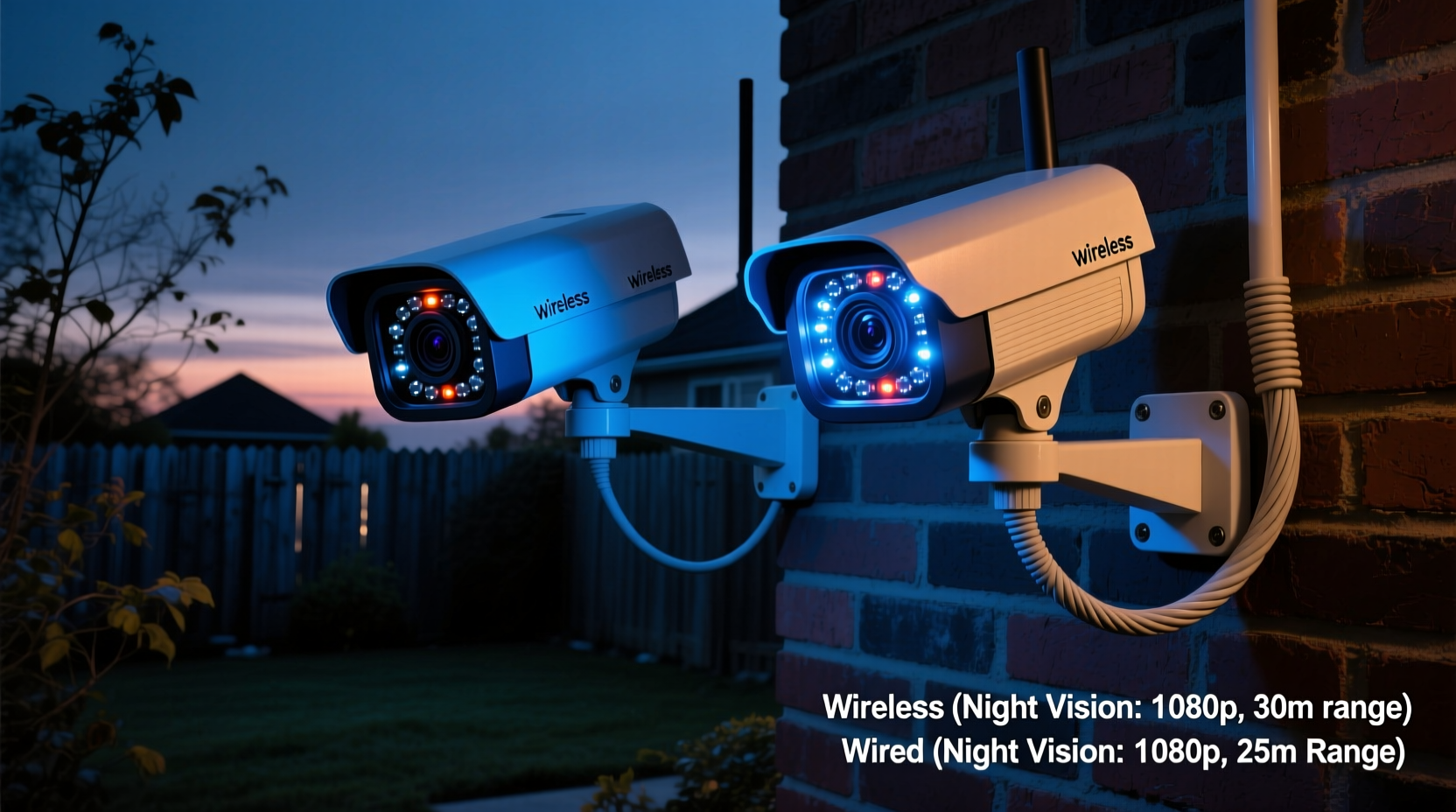
Night vision in security cameras typically relies on infrared (IR) technology. When ambient light falls below a certain threshold, IR LEDs around the camera lens activate, illuminating the scene with invisible infrared light. The camera’s image sensor detects this light and converts it into a monochrome video feed. The effectiveness of this system depends on several factors:
- IR LED strength and range: Measured in meters, this determines how far the camera can \"see\" at night.
- Sensor sensitivity: Larger sensors with higher lux ratings perform better in near-darkness.
- Lens quality: A high-quality lens minimizes distortion and maximizes light capture.
- Power consistency: Stable power ensures consistent IR output and sensor performance.
While both wireless and wired cameras use similar IR technology, the method of power delivery and signal transmission significantly impacts performance—especially during extended nighttime operation.
Wired Cameras: Stability and Performance Advantages
Wired security cameras are typically powered via Power over Ethernet (PoE), which delivers both electricity and data through a single cable. This integration provides notable advantages for night vision:
First, PoE ensures a constant, uninterrupted power supply. Unlike battery-powered wireless models, wired cameras don’t suffer from voltage drops that can dim IR LEDs or reduce sensor sensitivity over time. Consistent power means full-strength infrared illumination throughout the night, regardless of weather or usage duration.
Second, because data is transmitted over Ethernet, there's no risk of signal interference or bandwidth congestion. This allows for higher-resolution video streaming—even at night—without compression artifacts that degrade image clarity. Many wired cameras support 4K resolution with HDR, preserving detail in shadows and highlights.
Additionally, wired systems are less vulnerable to environmental disruptions. Wireless signals can weaken due to walls, metal structures, or electromagnetic interference, especially at night when other devices may be in use. Wired connections eliminate these variables, ensuring stable video transmission even in challenging conditions.
“Wired cameras offer superior night vision consistency because they’re not subject to the power fluctuations and signal loss that plague wireless systems.” — David Lin, Senior Surveillance Engineer at SecureView Technologies
Wireless Cameras: Convenience vs. Limitations
Wireless security cameras have gained popularity for their ease of installation and flexibility. Most connect via Wi-Fi and are powered by batteries or indoor outlets. While convenient, these design choices introduce constraints that affect night vision quality.
Battery-powered wireless cameras often implement power-saving modes to extend life. One common strategy is reducing IR LED brightness or limiting recording duration during nighttime. Some models only record on motion detection, meaning continuous low-light monitoring isn't possible. Even when active, fluctuating battery voltage can cause inconsistent IR output, leading to patchy or flickering night footage.
Wi-Fi transmission also poses challenges. Streaming high-resolution video at night requires significant bandwidth. In environments with weak or congested Wi-Fi signals, the camera may automatically lower video quality, resulting in grainy, pixelated images. This is particularly problematic when trying to identify faces or license plates in darkness.
That said, newer wireless models with local storage, dual-band Wi-Fi, and solar charging options have improved performance. High-end models like the Arlo Pro 5 or Google Nest Cam (wired power variant) deliver strong night vision by combining powerful IR arrays with advanced image processing. However, these benefits often come at a premium price and still rely on consistent external power to maintain peak performance.
Comparative Analysis: Key Differences at a Glance
| Feature | Wired Camera | Wireless Camera |
|---|---|---|
| Power Source | PoE or direct wiring – stable and continuous | Battery or outlet – prone to depletion or interruption |
| IR Illumination Consistency | Full power throughout the night | May dim or cycle off to save power |
| Data Transmission | Reliable Ethernet connection | Subject to Wi-Fi interference and congestion |
| Night Video Resolution | Consistently high (up to 4K) | Often reduced due to bandwidth limits |
| Installation Complexity | Higher – requires cabling | Low – plug-and-play setup |
| Long-Term Reliability | High – minimal maintenance | Moderate – battery replacement needed |
This comparison shows that while wireless cameras offer convenience, wired systems generally provide more dependable and higher-quality night vision. The trade-off is primarily in installation effort versus long-term performance.
Real-World Example: Home Security in a Rural Area
Consider a homeowner in a rural area with limited street lighting and frequent wildlife activity. They installed two cameras: a wired Reolink PoE model at the front gate and a battery-powered wireless Ring Stick Up Cam at the backyard shed.
Over several weeks, the wired camera consistently captured clear, detailed footage of deer, raccoons, and occasional visitors up to 25 meters away. The IR illumination remained steady, and video streamed without lag to the NVR (Network Video Recorder).
In contrast, the wireless camera struggled. On cold nights, the battery drained faster, causing the IR lights to pulse intermittently. Motion-triggered recordings often started too late, missing crucial moments. During periods of heavy rain, Wi-Fi signal dropped, resulting in lost footage. While usable, the night vision quality was noticeably inferior—grainier, with shorter effective range.
This case illustrates how environmental demands amplify the limitations of wireless systems, especially when continuous, high-fidelity monitoring is required.
Optimizing Night Vision: A Step-by-Step Guide
Whether you choose wired or wireless, follow these steps to maximize night vision performance:
- Assess your power options: If using wireless, ensure access to a reliable power source or consider solar charging to maintain battery levels.
- Position cameras strategically: Mount units to minimize obstructions and avoid pointing directly at reflective surfaces like windows or metal roofs.
- Check IR range specifications: Select a camera with an IR range that exceeds your coverage needs by at least 20%.
- Reduce background interference: Trim foliage and remove objects that might reflect IR light or trigger false motion alerts.
- Test at night: Conduct regular nighttime reviews of footage to identify blind spots or degradation in image quality.
- Update firmware regularly: Manufacturers often release improvements to low-light algorithms and IR management.
Checklist: Choosing the Right Camera for Night Vision
- ✅ Does the camera have a minimum IR range of 25–30 meters?
- ✅ Is it powered by PoE or a continuous power source?
- ✅ Does it use a large image sensor (e.g., 1/2.8” or larger)?
- ✅ Does it support HDR or WDR (Wide Dynamic Range) for balanced lighting?
- ✅ Is the lens rated for low-light clarity (f/1.0–f/1.6 aperture)?
- ✅ Does it store footage locally or to a secure NVR/cloud with encryption?
- ✅ Has it been tested in real-world low-light conditions?
Frequently Asked Questions
Do wireless cameras have worse night vision than wired ones?
Generally, yes—especially battery-powered models. While some high-end wireless cameras offer excellent night vision, they depend on consistent power and strong Wi-Fi. Wired cameras maintain superior stability and image quality over time due to uninterrupted power and data transmission.
Can I improve the night vision of my wireless camera?
Yes. Use models with external power adapters instead of batteries, ensure strong Wi-Fi coverage with mesh extenders, and clean the IR lens regularly. Adding supplemental IR illuminators can also enhance visibility beyond the camera’s native range.
What is the best IR range for home security cameras?
For most residential applications, an IR range of 20–30 meters is sufficient. Larger properties or commercial sites may require cameras with 40+ meter ranges or additional units for full coverage.
Conclusion: Prioritize Performance Where It Matters Most
The choice between wireless and wired security cameras ultimately hinges on your priorities. If quick installation and mobility are paramount, wireless systems offer undeniable appeal. But when it comes to night vision quality—the very feature that ensures safety in darkness—wired cameras hold a distinct advantage. Their stable power delivery, robust data transmission, and consistent infrared performance make them the preferred option for reliable, high-definition nighttime surveillance.
Technology continues to narrow the gap, with hybrid models and solar-enhanced wireless systems improving every year. Yet, for mission-critical applications where image clarity and uptime cannot be compromised, wired remains the gold standard. Evaluate your environment, power availability, and security needs carefully. Investing in a well-designed wired system today can prevent costly oversights tomorrow.




 浙公网安备
33010002000092号
浙公网安备
33010002000092号 浙B2-20120091-4
Comments
No comments yet. Why don't you start the discussion?