
For gamers deciding between Xbox and PlayStation ecosystems, the choice isn’t just about hardware or exclusive consoles—it’s increasingly defined by subscription services. Xbox Game Pass and PlayStation Plus are both powerful gateways to vast libraries of games, but they operate on fundamentally different models. One emphasizes breadth, first-party access, and day-one releases; the other leans into curated premium experiences and online multiplayer. The real question isn't just which is cheaper or more convenient—it's which one actually gives you better games.
This isn’t a debate settled by marketing slogans. It comes down to what kind of gamer you are, how you play, and what \"better\" means to you—whether it’s AAA exclusives, indie gems, backward compatibility, or online functionality. Let’s break down both services with an honest, in-depth look at their libraries, features, and long-term value.
Core Differences in Service Models
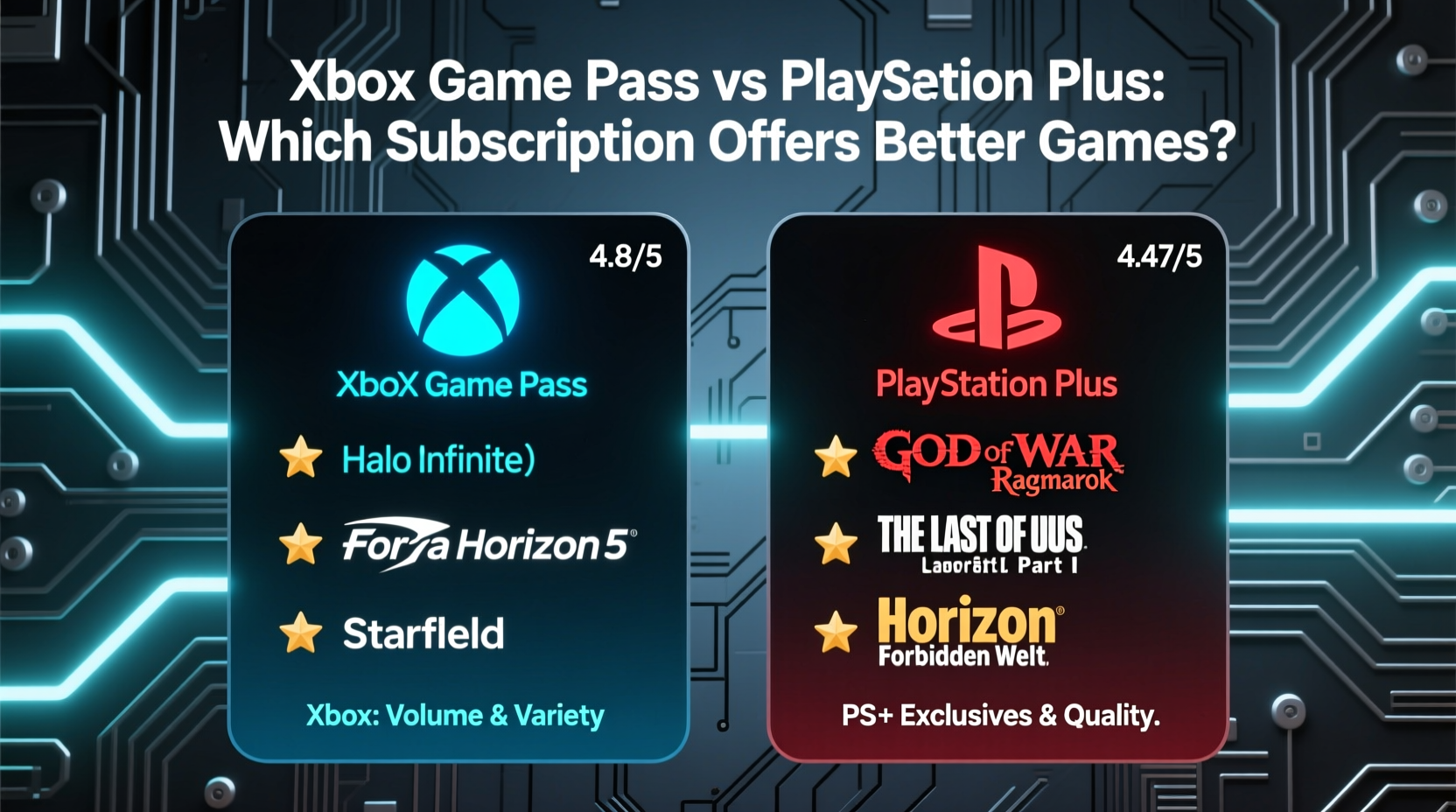
The most critical distinction between Xbox Game Pass and PlayStation Plus lies in their foundational design.
Xbox Game Pass operates on a Netflix-style model: pay a monthly fee and gain access to a rotating catalog of hundreds of titles. This includes Microsoft’s first-party studios (like Halo, Forza, and Starfield), third-party blockbusters often available on day one (such as *Hi-Fi Rush* and *Sea of Thieves*), and a deep bench of indie darlings. Crucially, Game Pass Ultimate subscribers also get cloud gaming and EA Play included.
PlayStation Plus, meanwhile, has restructured into three tiers—Essential, Extra, and Premium—and functions more like a hybrid between online multiplayer access and a game library. While Essential retains the legacy PS+ perk of free monthly games, Extra and Premium offer curated back catalogs spanning PS4, PS5, and even classic PS1/PS2/PSP titles via streaming (on Premium). However, Sony rarely adds its major first-party exclusives on day one. Games like *God of War Ragnarök*, *The Last of Us Part I*, and *Spider-Man 2* arrive months—or years—after launch, if at all.
Game Library Quality and Exclusivity
When evaluating “better games,” exclusivity and freshness matter. Here, Xbox Game Pass holds a distinct edge in availability, while PlayStation Plus counters with higher average review scores among its offerings.
Microsoft’s acquisition of Bethesda, Activision Blizzard, and numerous indie studios has dramatically expanded Game Pass’s reach. Subscribers routinely get instant access to major franchises: *Halo Infinite*, *Starfield*, *Forza Motorsport*, and now upcoming titles like *Indiana Jones and the Great Circle*. Even third-party heavyweights like *Resident Evil Village* and *Final Fantasy VII Remake* have landed on Game Pass shortly after release.
PlayStation’s situation is more complex. Its first-party studio, including Naughty Dog, Santa Monica Studio, and Insomniac, produces some of the most critically acclaimed games in modern gaming—*God of War*, *Horizon Zero Dawn*, *Ghost of Tsushima*. But these titles almost never appear on PS+ at launch. Instead, they trickle into the Extra or Premium catalog after a window of six months to over a year.
“Sony’s approach reflects a belief that premium games should drive sales first, subscriptions second.” — Jason Schreier, Bloomberg reporter and gaming industry analyst
This delay undermines PS+’s ability to compete as a primary source for new content. Meanwhile, Game Pass continues to grow its reputation as the go-to service for players who want to try big games without paying full price upfront.
Value Comparison: What You Get Per Tier
To assess true value, we need to compare what each tier offers across pricing, game volume, and unique benefits.
| Feature | Xbox Game Pass (Ultimate) | PlayStation Plus (Premium) |
|---|---|---|
| Price (Monthly) | $17.99 | $17.99 |
| First-Party Day-One Releases | Yes (all Xbox, Bethesda, Activision titles) | No (delayed by 6–12+ months) |
| Third-Party New Releases | Yes (e.g., *Hi-Fi Rush*, *Pentiment*) | Limited (mostly older or mid-tier titles) |
| Backward Compatibility | Extensive (Xbox, 360, One via emulation) | PS1, PS2, PSP (streaming only on Premium) |
| Cloud Gaming | Included (play on mobile, PC, browser) | Included (select titles, streaming required) |
| Online Multiplayer | Included | Included |
| Free Monthly Games | No (replaced by catalog access) | Yes (Essential tier only) |
| Classic Game Catalog | Limited (via backward compatibility) | Strong (especially Japanese RPGs and retro action) |
At the same price point, Xbox Game Pass Ultimate offers broader utility: cloud gaming, EA Play, PC access, and seamless console integration. PlayStation Plus Premium counters with nostalgic appeal and superior presentation of remastered classics—but lacks the forward momentum of Game Pass’s live pipeline.
Real-World Example: A Month of Gaming on Each Service
Consider Sarah, a working professional who plays 8–10 hours per week. She wants variety, narrative depth, and occasional multiplayer fun—but doesn’t want to spend $70 every time a new game drops.
On **Xbox Game Pass**, she starts February with *Starfield* (available since launch), spends weekends with *Grounded*, tries *Satisfactory* for base-building, and dabbles in *Hi-Fi Rush* during lunch breaks via cloud gaming on her phone. She also joins friends in *Minecraft Legends* online—all without purchasing a single title.
On **PlayStation Plus Premium**, she claims the two free monthly games (*Death Stranding Director’s Cut* and *Tchia*), dives into *Marvel’s Spider-Man Remastered*, and explores *Shadow of the Colossus* via the PS2 classics collection. But when *Final Fantasy XVI* launches mid-month, she can’t access it without buying it outright. She waits for *Helldivers 2*, but it never appears on PS+.
After one month, Sarah on Game Pass has played five substantial titles across genres and devices. Her counterpart on PS+ has enjoyed high-quality experiences but faced gaps in availability and no access to current hits. The difference isn’t just quantity—it’s freedom to explore without financial pressure.
Which Gamers Benefit Most From Each Service?
There’s no universal answer. Your ideal subscription depends on your habits, platform loyalty, and preferences.
- Xbox Game Pass excels for:
- Players who want new games immediately
- Fans of RPGs, strategy, simulation, and indie experimentation
- Those who game across devices (console, PC, mobile)
- Budget-conscious users seeking maximum variety
- PlayStation Plus shines for:
- Collectors of cinematic, story-driven exclusives
- Retro enthusiasts interested in PS1/PS2 classics
- Players already invested in the PS5 ecosystem
- Those who prefer polished, linear experiences over open-ended exploration
Expert Insight: Industry Trends and Long-Term Viability
The future of gaming is shifting toward subscriptions, but publishers remain cautious about devaluing full-priced releases. Microsoft’s bold stance—releasing everything day one on Game Pass—has paid off in subscriber growth and ecosystem loyalty.
“We’re seeing a cultural shift. Gamers don’t just want ownership—they want access. Game Pass understands that.” — Leah Hamilton, Senior Editor at IGN
Sony, however, faces internal tension. Its leadership prioritizes profitability from full-game sales, especially for tentpole franchises. This creates a lag in PS+ relevance. While PS+ Premium added streaming and retro content to justify its cost, it still lacks the compelling reason to subscribe *before* buying a new game.
Analysts note that unless Sony changes its release strategy, Game Pass will continue pulling ahead in terms of perceived value and player engagement. As Microsoft integrates more Activision titles—potentially including *Call of Duty*—the gap could widen further.
Frequently Asked Questions
Can I play the same games on both services?
Some third-party titles eventually appear on both, but timing differs significantly. Games like *Elden Ring* or *Cyberpunk 2077* may take months or years to reach PS+, while they often land on Game Pass much sooner—or at launch. First-party exclusives remain platform-locked: Halo is Xbox-only, God of War is PlayStation-only.
Is cloud gaming reliable on both platforms?
Xbox Cloud Gaming (part of Game Pass Ultimate) is widely regarded as more stable and better integrated, supporting touch controls, Bluetooth controllers, and web browsers. PlayStation Plus Premium’s cloud streaming is functional but limited to specific games and requires a strong connection. Input lag remains a concern for fast-paced titles.
Do either service include DLC or expansions?
Rarely. Most DLC must be purchased separately, even if the base game is included. Some exceptions exist—like *Fallout 4* and its add-ons being fully available on Game Pass—but major expansions (e.g., *The Warden* for *Starfield*) are not guaranteed. Always check individual game listings.
Actionable Checklist: Choosing the Right Subscription
- Assess your gaming habits: Do you finish games or sample many?
- List your favorite recent titles—check if they’re on Game Pass or PS+
- Determine if you own an Xbox, PlayStation, or both
- Evaluate your interest in retro/classic games
- Decide whether day-one access matters to you
- Try a 14-day free trial of each service (if eligible)
- Compare device flexibility: Do you want to play on PC or mobile?
- Factor in existing investments (e.g., past PS+ free games)
- Review cancellation policies and regional pricing
- Choose based on long-term fit, not short-term perks
Conclusion: So, Which Has Better Games?
“Better” is subjective, but measurable factors tip the scale. Xbox Game Pass offers more games, earlier access, greater variety, and cross-platform convenience. It treats its subscribers as core participants in Microsoft’s gaming vision—not afterthoughts waiting for discounts.
PlayStation Plus delivers exceptional quality, particularly in storytelling and visual fidelity, but its delayed inclusion of flagship titles weakens its position as a primary game source. It works best as a supplement to ownership, not a replacement.
If you prioritize immediacy, diversity, and freedom to explore without financial risk, Xbox Game Pass is the superior choice. If you value cinematic mastery and plan to buy major releases anyway—with PS+ serving as a bonus library—then PlayStation Plus Premium can enhance your experience.




 浙公网安备
33010002000092号
浙公网安备
33010002000092号 浙B2-20120091-4
Comments
No comments yet. Why don't you start the discussion?