
When choosing between the Xbox Series S and the PlayStation 5 Digital Edition, it’s not just about which console is cheaper—it’s about what you get for your money. Both are disc-free, next-gen systems designed to deliver high-speed gaming without the physical media drive. But their differences in hardware, ecosystem, game library, and future-proofing make this more than a simple price comparison. For gamers on a budget who still want cutting-edge experiences, understanding these distinctions is essential.
The Xbox Series S retails at $299, making it the most affordable entry point into next-generation gaming. The PS5 Digital Edition comes in at $449—$150 more—but offers significantly higher raw performance. So, where does that extra cost go? And can the Series S truly compete with a machine nearly 50% more expensive? Let’s break down every critical factor in this budget console showdown.
Performance and Hardware Specs
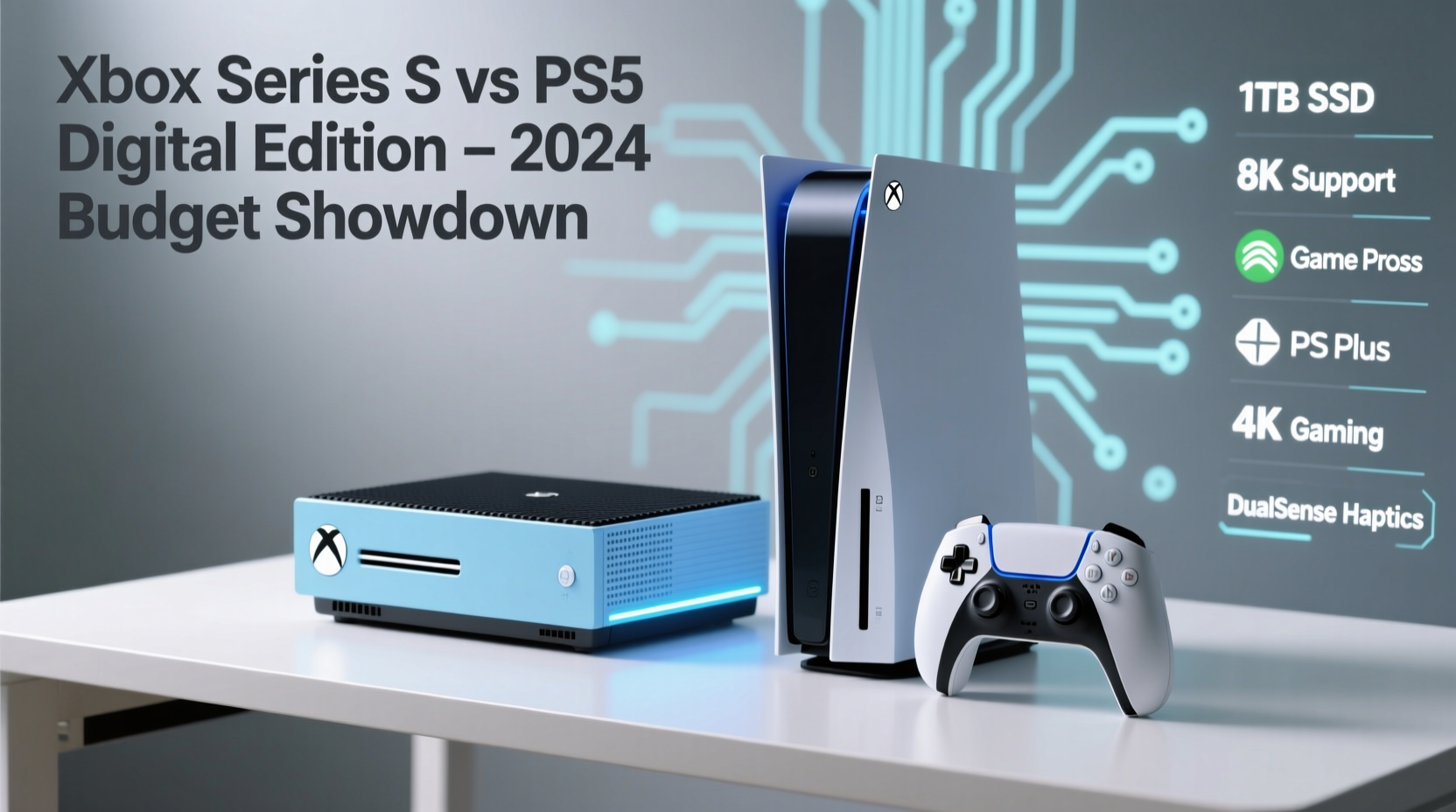
At the core of any console decision lies its technical foundation. While both consoles support 4K gaming, ray tracing, SSD loading, and 120Hz output, they achieve these features through vastly different hardware configurations.
| Feature | Xbox Series S | PS5 Digital Edition |
|---|---|---|
| Price | $299 | $449 |
| CPU | 8-core AMD Zen 2 @ 3.6GHz (3.4GHz w/ SMT) | 8-core AMD Zen 2 @ 3.5GHz (variable frequency) |
| GPU | 4 TFLOPS, RDNA 2, 20 CUs @ 1.565GHz | 10.28 TFLOPS, RDNA 2, 36 CUs @ 2.23GHz |
| Memory | 10GB GDDR6 (shared) | 16GB GDDR6 (shared) |
| Storage | 512GB custom NVMe SSD | 825GB custom NVMe SSD |
| Expandable Storage | Proprietary expansion card or USB external | M.2 NVMe slot + proprietary expansion |
| Target Resolution | 1440p (up to 4K upscaled) | 4K native (up to 8K upscaled) |
| Ray Tracing | Yes | Yes |
| SSD Speed | 2.4 GB/s (raw), 4.8 GB/s compressed | 5.5 GB/s (raw), 8–9 GB/s compressed |
The PS5 Digital Edition clearly outperforms the Series S in nearly every spec. Its GPU has over twice the compute power, enabling smoother frame rates and higher-resolution textures. It also benefits from faster internal bandwidth and greater memory headroom, allowing developers to push visual fidelity further. Meanwhile, the Series S targets 1440p output and relies heavily on upscaling to 4K, often using dynamic resolution scaling to maintain performance.
Game Library and Exclusive Titles
For many players, exclusives are the deciding factor. Sony has invested heavily in first-party studios, producing critically acclaimed titles like God of War Ragnarök, Spider-Man: Miles Morales, Horizon Forbidden West, and Ghost of Tsushima. These games are only playable on PlayStation, and they consistently rank among the best-reviewed titles of the generation.
Microsoft, on the other hand, emphasizes accessibility and cross-platform availability. Most Xbox Game Studios titles—including Halo Infinite, Forza Horizon 5, and Starfield—are available on PC and cloud via Xbox Cloud Gaming. While this expands reach, it means fewer true exclusives locked to the console itself.
“PlayStation’s investment in narrative-driven exclusives continues to set the benchmark for cinematic gaming.” — David Lefèvre, Senior Editor at IGN France
However, Microsoft counters with Xbox Game Pass—a subscription service offering over 100 high-quality games for $9.99/month. This includes day-one access to all first-party releases. For budget-conscious players, Game Pass dramatically lowers the effective cost per game, especially when paired with the cheaper Series S.
The PS5 lacks an equivalent all-inclusive catalog, though PlayStation Plus Premium offers a tiered library with classics, streaming, and select new releases. But even at $17.99/month, its value doesn’t match Game Pass Ultimate, which bundles cloud gaming, EA Play, and PC access.
Storage and Expandability
Both consoles come with limited usable storage after system files. The Series S offers around 364GB of free space; the PS5 Digital Edition provides roughly 667GB. Given that modern AAA titles regularly exceed 80–100GB, storage fills quickly.
Expanding storage differs significantly:
- Xbox Series S: Uses proprietary Seagate Expansion Cards ($220 for 1TB), which plug directly into the back panel and maintain full performance. Alternatively, slower USB external drives can store and play last-gen backward-compatible titles.
- PS5 Digital Edition: Supports user-upgradable M.2 NVMe SSDs (minimum 5,500 MB/s). A compatible 1TB drive costs around $70–$90, offering far better value. Like Xbox, USB drives work for PS4 games but not native PS5 titles.
This makes the PS5 notably more flexible and cost-effective for long-term storage upgrades. The Series S’s proprietary solution is convenient but expensive—doubling storage costs an additional 73% of the console’s original price.
Total Cost of Ownership Over Time
Choosing a console isn’t just about upfront cost—it’s about long-term spending. Here’s a realistic three-year projection for each platform:
- Initial Investment
- Xbox Series S: $299
- PS5 Digital Edition: $449
- Storage Upgrade (1TB)
- Xbox: $220 (Seagate card)
- PS5: $80 (M.2 SSD + heatsink)
- Subscription Services (3 years)
- Xbox Game Pass Ultimate: $120/year × 3 = $360
- PlayStation Plus Essential: $70/year × 3 = $210
- Purchase of Full-Price Games (3 titles at $70 each)
- Xbox: Potentially $0 if played via Game Pass
- PS5: $210 (assuming no sales or subscription coverage)
Total estimated cost over three years:
- Xbox Series S: $299 + $220 + $360 = $879
- PS5 Digital Edition: $449 + $80 + $210 + $210 = $949
While the PS5 starts $150 higher, the real gap widens due to storage and game acquisition. With Game Pass, the Series S can offer a richer, more diverse library at lower marginal cost. However, if you prefer owning games permanently and playing PlayStation exclusives, the PS5 remains the only option.
Mini Case Study: Alex’s Dilemma
Alex is a college student with a tight budget and a 1440p gaming monitor. He loves action-adventure games and plays about 15–20 hours per week. His options:
- Buy a PS5 Digital Edition and spend extra on games like Marvel’s Spider-Man 2 and Final Fantasy XVI.
- Get the Series S, subscribe to Game Pass, and access hundreds of titles including Bethesda RPGs and EA Sports FC 24.
After six months, Alex spent $299 on the Series S, $120 on Game Pass, and $0 on individual games. He played 12 major titles, used cloud gaming on his laptop during breaks, and expanded storage later with a USB drive. His total: $419.
If he’d chosen the PS5, he’d have spent $449 + $80 (storage) + $210 (three games) = $739—nearly double. For Alex, the Series S wasn’t just cheaper; it delivered more variety and flexibility within his constraints.
Future-Proofing and Longevity
How well will each console age over the next five years?
The PS5 Digital Edition’s superior specs position it better for demanding future titles. As game engines evolve and asset density increases, the 10.28 TFLOPS GPU and 16GB RAM will handle heavier loads more gracefully. Developers are already optimizing for higher-end hardware, meaning PS5 versions of multiplatform games often feature better textures, lighting, and draw distances.
The Series S, while capable today, may struggle with native 4K ambitions and complex open worlds in later-generation releases. Some upcoming titles, like Senua’s Saga: Hellblade II, do not support Series S at launch due to performance limitations. Others use dynamic resolution scaling as low as 1080p under load.
Yet Microsoft’s strategy mitigates this through cloud gaming. Even if a game runs poorly locally on Series S, it can be streamed from data centers running Series X hardware. This extends the console’s relevance beyond its local capabilities—a unique advantage in the current market.
Checklist: Choosing the Right Budget Console
Ask yourself the following before buying:
- ✅ Do I prioritize exclusive games like Uncharted or The Last of Us? → Lean toward PS5.
- ✅ Am I comfortable with upscaling and 1440p gaming? → Series S is viable.
- ✅ Do I want access to a vast game library without buying each title? → Game Pass favors Xbox.
- ✅ Will I upgrade storage soon? → PS5 offers cheaper, easier expansion.
- ✅ Do I value cloud gaming and cross-save features? → Xbox ecosystem wins.
- ✅ Is my TV or monitor 4K HDR with HDMI 2.1? → PS5 will utilize it better.
- ✅ Am I on a strict budget under $350? → Series S fits; PS5 requires compromise.
Frequently Asked Questions
Can the Xbox Series S really run next-gen games?
Yes, but with compromises. Most multiplatform games run at 1440p or dynamic 4K via upscaling, often with reduced texture quality or effects. Performance is generally stable at 30–60 FPS, but some titles omit features like ray tracing or variable refresh rate. It delivers a next-gen experience, just not at the highest fidelity.
Is the PS5 Digital Edition worth $150 more than the Series S?
It depends on your priorities. If you value native 4K, faster load times, stronger exclusives, and longer hardware relevance, yes. But if you’re budget-focused, play mostly online or indie titles, and embrace subscriptions, the Series S offers exceptional efficiency.
Can I add discs later to the PS5 Digital Edition?
No. Unlike previous generations, there is no official upgrade path. The disc drive is physically absent, and Sony does not sell a standalone unit. You would need to trade in the entire console for the standard PS5 model.
Conclusion: Which One Should You Buy?
The Xbox Series S and PS5 Digital Edition represent two philosophies of budget gaming. The Series S is a streamlined, subscription-first device built for affordability and ecosystem integration. It shines when paired with Game Pass, cloud gaming, and secondary screens. For students, casual players, or those upgrading from older Xbox hardware, it’s an unbeatable value.
The PS5 Digital Edition sacrifices portability and price to deliver near-flagship performance. It’s ideal for gamers who want the full breadth of next-gen visuals, own a 4K TV, and care deeply about Sony’s exclusive storytelling experiences. Despite lacking a disc drive, it remains a powerhouse with strong developer support and room to grow.




 浙公网安备
33010002000092号
浙公网安备
33010002000092号 浙B2-20120091-4
Comments
No comments yet. Why don't you start the discussion?