
Choosing between the Xbox Series S and the PS5 Digital Edition isn’t just about hardware—it’s a long-term investment in how you buy, play, and access games. While both consoles deliver next-gen performance without disc drives, their approaches to pricing, discounts, subscription services, and digital storefronts differ significantly. For budget-conscious gamers who plan to keep their console for years, understanding which platform delivers better ongoing value is essential.
The real question isn’t just which console has cheaper games today, but which one consistently offers smarter purchasing options, deeper discounts, and more flexible ownership models over time. This comparison dives into sales frequency, backward compatibility, subscription benefits, and marketplace trends to determine which system gives players more bang for their buck—year after year.
Pricing and Hardware Value at Launch and Beyond
The Xbox Series S launched at $299, while the PS5 Digital Edition came in at $399—a $100 difference that still influences long-term value perception. That initial savings on the Series S can be reinvested into games or accessories, giving it an early financial edge. But hardware price is only part of the equation. What matters more is how each ecosystem supports cost-effective gaming over multiple years.
Microsoft designed the Series S as a fully digital, entry-level alternative to the pricier Series X. It sacrifices 4K output and internal storage (only 512GB, with ~364GB usable) but retains full compatibility with the Xbox library, including thousands of optimized titles through Smart Delivery. Sony’s PS5 Digital Edition shares the same GPU and CPU as the standard PS5, offering identical performance—just no disc drive. Its larger 825GB SSD (about 667GB usable) allows slightly more room for large game installations.
Digital Storefronts and Sales Frequency
When evaluating long-term game deal quality, the frequency and depth of sales matter more than base prices. Both PlayStation Store and Microsoft Store run regular promotions, but their patterns and reach vary.
Sony’s PlayStation Store features weekly “Deals of the Week,” seasonal sales (like the Anniversary Sale or Holiday Sale), and publisher-specific events. Discounts on first-party titles are rare until months or even years after release. Third-party games often see 30–50% off during major events, but deep cuts (70%+) are less common unless tied to clearance events.
Microsoft’s store, accessible via console and PC, runs more frequent promotions. The “Spotlight Sale” occurs every few weeks, and there are overlapping deals from Xbox Live Gold, Microsoft Rewards, and regional partners. Crucially, many games go on sale across Xbox *and* PC simultaneously due to Microsoft’s unified storefront. This broader reach increases competition among retailers, sometimes leading to lower prices than PlayStation equivalents.
“Microsoft’s aggressive discounting strategy reflects its focus on ecosystem growth over short-term profit per sale.” — David Thornton, Industry Analyst at GameEconomy Insights
Xbox Game Pass vs. PlayStation Plus: Subscription Value Compared
No discussion of long-term game deals is complete without addressing subscriptions. Xbox Game Pass has redefined digital game access, offering hundreds of titles—including day-one first-party releases—for a flat monthly fee. The Core tier ($9.99) includes online multiplayer and a rotating library of 25+ games. The more popular Game Pass Ultimate ($16.99) bundles cloud gaming, EA Play, and two months of new Bethesda titles at no extra cost.
PlayStation Plus has evolved into a tiered model: Essential ($9.99) for online play and monthly games; Extra ($13.99) for a catalog of PS4/PS5 titles; Premium ($16.99) adds classics and cloud streaming. While Extra includes some third-party blockbusters, it lacks first-party exclusives on day one—a major disadvantage compared to Xbox.
For example, buying *Starfield* at full price ($70) would take over four months of PlayStation Plus Extra to break even, assuming it ever appears. On Xbox, it was available on Game Pass from launch. Over three years, a Game Pass subscriber could play dozens of $60–$70 titles without purchasing them individually—something PlayStation cannot match.
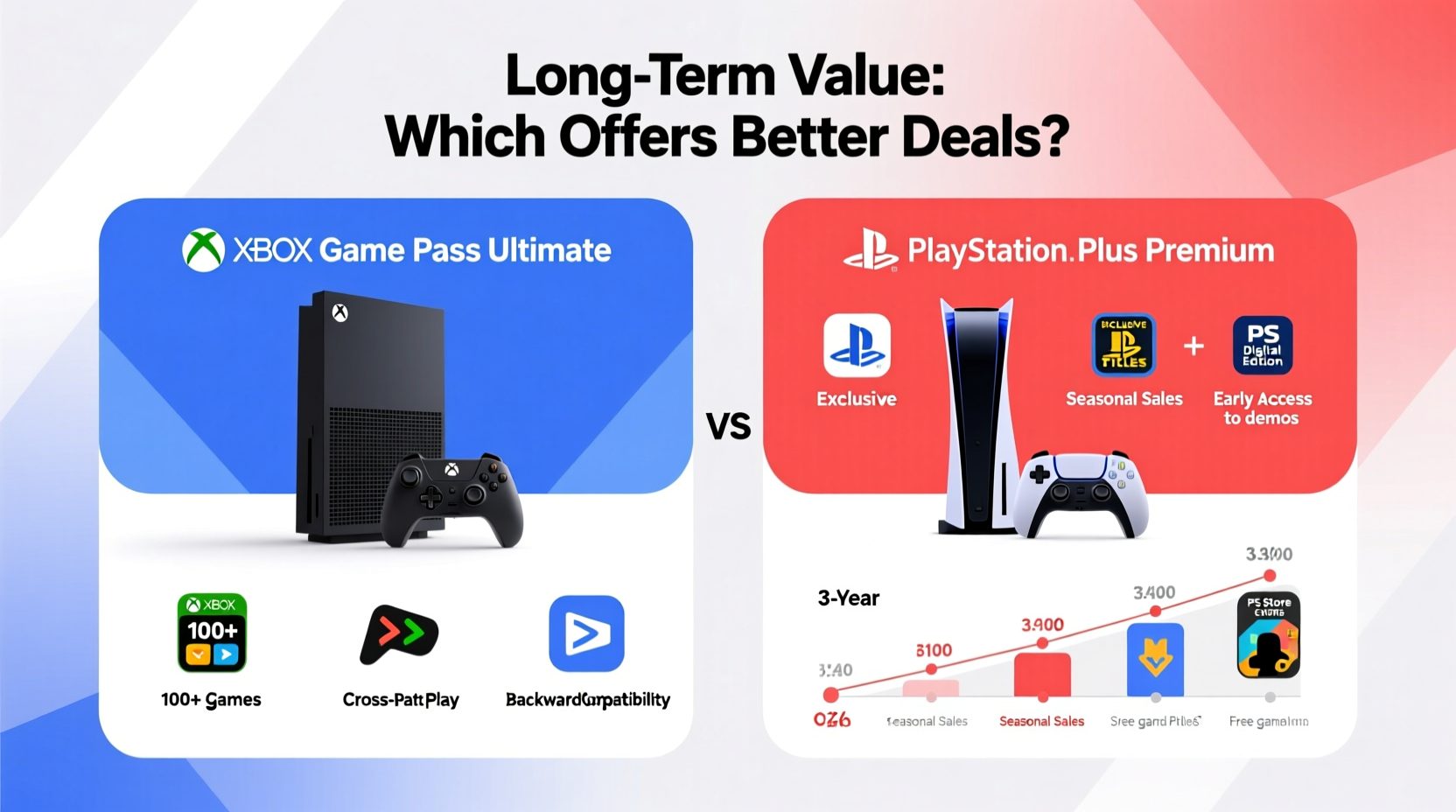
| Feature | Xbox Game Pass Ultimate | PlayStation Plus Premium |
|---|---|---|
| Price (Monthly) | $16.99 | $16.99 |
| Day-One First-Party Games | Yes | No |
| Backward Compatibility | Xbox One, 360, OG Xbox (with enhancements) | Limited PS1–PS4 remasters |
| Cloud Gaming | Yes, full console streaming | Yes, but limited regions and titles |
| Free Monthly Games | Not applicable (rotating catalog instead) | Yes (Essential tier) |
| EA Play Included | Yes | No |
The math favors Xbox for high-volume players. If you play five full-price games per year, Game Pass saves around $250 annually. Over five years, that’s $1,250 in potential savings—far exceeding the upfront hardware gap.
Backward Compatibility and Game Preservation
Long-term value also depends on how well your library holds up over time. Microsoft has invested heavily in backward compatibility, supporting thousands of Xbox One, Xbox 360, and original Xbox titles with FPS boosts, Auto HDR, and Quick Resume. Many older games are also included in Game Pass, effectively making past purchases relevant again.
Sony’s approach is more limited. PS5 plays nearly all PS4 titles, which is valuable given the strength of that generation’s library. However, PS3 and earlier games are only available through the PS Plus Premium streaming catalog—with spotty availability and no offline access. There’s no enhancement program for older titles beyond resolution patches on select remasters.
This affects resale and deal hunting. A used Xbox Series S owner might access hundreds of older titles through Game Pass or discounted backward-compatible sales. A PS5 Digital Edition user relies more on buying individual PS4 ports or waiting for sporadic PS Plus additions.
Real-World Example: Three Years of Gaming on Each Console
Consider Sarah, a gamer who bought a console in 2021 and plans to keep it until 2026. She plays 8–10 games per year, enjoys both exclusives and third-party hits, and prefers digital convenience.
She chose the Xbox Series S. Her $299 purchase was followed by a 2-year Game Pass Ultimate subscription ($407). During that time, she played *Halo Infinite*, *Forza Horizon 5*, *Starfield*, *Baldur’s Gate 3*, and 30+ other titles—all without additional purchase costs. She redeemed Microsoft Rewards for $20 in games and caught several 50–70% off sales on titles not in Game Pass.
Her total software spend: under $50 outside of subscription fees.
Compare this to Mark, who bought the PS5 Digital Edition. He paid $399 upfront and subscribed to PS Plus Extra for $335 over two years. He gained access to games like *Ghost of Tsushima* and *Spider-Man: Miles Morales* through the catalog, but had to buy *God of War Ragnarök* ($70), *Final Fantasy XVI* ($70), and *Marvel’s Spider-Man 2* ($70) at full price. No first-party titles appeared on PS Plus during his subscription.
His total software spend: $210 on top of the subscription.
Even accounting for the $100 hardware difference, Sarah saved over $250 in the same period—without sacrificing game variety or quality.
Smart Buying Strategies for Long-Term Savings
Maximizing value on either platform requires proactive habits. Here’s a checklist to ensure you’re getting the best long-term deals:
- Track price histories: Use sites like IsThereAnyDeal or GG.deals to monitor drops.
- Wait for seasonal sales: Black Friday, Summer Sale, and holiday events offer peak discounts.
- Use wishlists: Both stores notify users when wishlist items go on sale.
- Leverage loyalty programs: Microsoft Rewards gives points for searches and engagement redeemable for gift cards.
- Buy multi-platform games on the cheaper store: Titles like *Elden Ring* or *Cyberpunk 2077* often have price differences between platforms.
- Bundle subscriptions: Xbox Game Pass Ultimate includes PC and cloud access—use all tiers to maximize ROI.
- Avoid impulse buys: Wait 4–6 months post-launch for meaningful discounts on most third-party titles.
Step-by-Step: Building a Cost-Efficient Game Library
- Start with a subscription: Join Xbox Game Pass or PS Plus Extra to access a broad catalog risk-free.
- Identify must-keeps: After trying games via subscription, list those worth owning permanently.
- Monitor sales cycles: Set alerts for your chosen titles; most hit lowest prices within 12–18 months.
- Use rewards and cashback: Stack Microsoft Rewards or credit card points for additional savings.
- Re-evaluate annually: Cancel subscriptions if usage drops, or switch based on exclusive lineups.
Exclusive Lineups and Their Impact on Deal Value
While discounts matter, the appeal of exclusives influences purchasing behavior. Sony has a stronger lineup of critically acclaimed first-party studios: *The Last of Us*, *Horizon*, *God of War*, and *Demon’s Souls*. These rarely go on sale quickly and are never offered day-one via subscription.
Microsoft’s exclusives—while growing with *Starfield*, *Forza*, and *Halo*—have historically had shorter wait times before discounting. *Halo Infinite* went free-to-play within a year; *Psychonauts 2* dropped to $20 within six months. With Game Pass absorbing launch-day risk, Microsoft can afford to lower prices faster.
However, Sony’s exclusives tend to hold cultural weight longer, driving resale value and collector interest. If you prioritize narrative-driven single-player experiences, paying full price may feel justified—even if it reduces long-term deal efficiency.
Frequently Asked Questions
Can I get the same games cheaper on one platform?
Yes. Multi-platform titles like *Diablo IV*, *FIFA 24*, or *Assassin’s Creed Mirage* frequently have price discrepancies. Xbox often runs deeper percentage-based discounts, especially during combined Xbox & PC sales. Always compare prices before purchasing.
Do game prices drop faster on Xbox or PlayStation?
Xbox generally sees faster and deeper discounts, particularly for third-party titles. Microsoft’s reliance on Game Pass to drive engagement means they don’t need to protect full-price sales as aggressively. PlayStation maintains higher price integrity longer, especially for first-party games.
Is backward compatibility worth considering for long-term savings?
Absolutely. Xbox’s extensive backward compatibility lets you revisit or discover older titles through Game Pass or low-cost sales. PlayStation’s support ends at PS4, limiting long-term library growth. If you enjoy retro or classic games, Xbox offers more sustainable access.
Conclusion: Which Console Wins on Long-Term Game Deals?
The Xbox Series S emerges as the superior choice for gamers focused on long-term value. Its lower entry cost, combined with the unmatched flexibility of Xbox Game Pass, frequent sales, backward compatibility, and reward incentives, creates a more economical ecosystem over time. Even though the PS5 Digital Edition delivers excellent performance and a stellar exclusive lineup, its lack of day-one first-party inclusion in PlayStation Plus and slower discount cycles make it harder to justify purely on deal efficiency.
That said, personal preference still matters. If you deeply value playing *The Last of Us* or *Ghost of Tsushima* and are willing to pay full price, the PS5 may align better with your tastes. But if your goal is to play more games for less money—and maintain that advantage year after year—the Xbox Series S provides a demonstrably smarter financial path.




 浙公网安备
33010002000092号
浙公网安备
33010002000092号 浙B2-20120091-4
Comments
No comments yet. Why don't you start the discussion?