
When choosing between the Xbox Series S and the PS5 Digital Edition, one of the most critical factors isn’t just price or hardware—it’s the trajectory of each platform’s game library. Both consoles offer next-gen performance without a disc drive, appealing to digital-first gamers. But beneath the surface, their software ecosystems are evolving at different speeds and in distinct directions. Understanding which platform’s game library is expanding more rapidly—and in what ways—can help you make a long-term decision that aligns with your gaming preferences.
The answer isn’t as simple as counting new releases per year. It involves analyzing first-party development pipelines, third-party publisher alignment, subscription service growth, backward compatibility strategy, and global market reach. This article dissects these elements to determine not only which library is growing faster but also which is building more sustainable momentum for the future.
Hardware Differences and Their Impact on Game Development
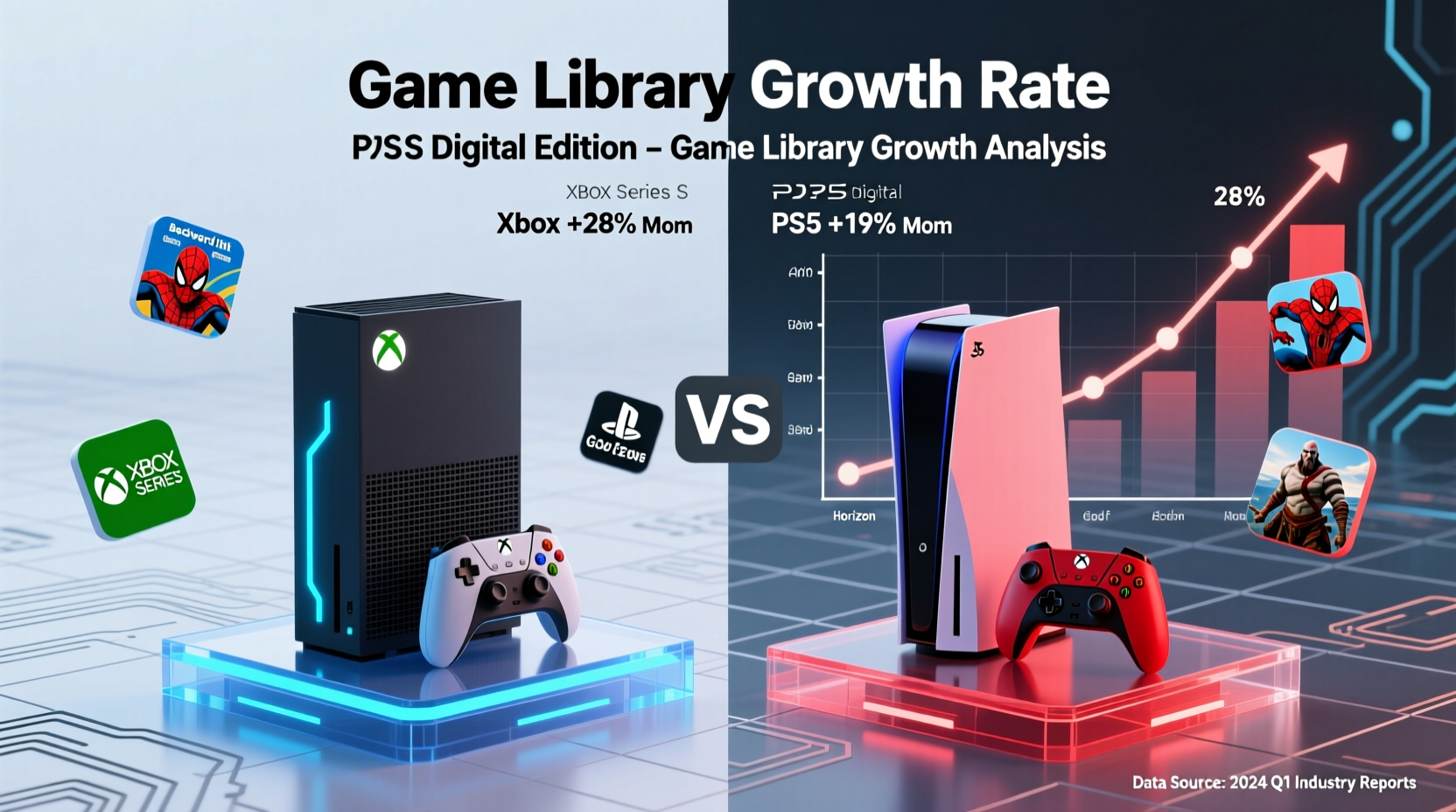
Before diving into game libraries, it’s essential to acknowledge that the Xbox Series S and PS5 Digital Edition, while both digital-only, are not equivalent in power. The Series S has a weaker GPU, less memory bandwidth, and no 4K output capability compared to the full PS5 Digital model. This disparity influences how developers optimize games and whether they prioritize one platform over another.
Microsoft designed the Series S as an affordable entry point into the Xbox ecosystem. Its lower specs mean some titles run at reduced resolutions (often 1080p or 1440p) and may have shorter draw distances or fewer dynamic effects. In contrast, the PS5 Digital Edition shares identical internal hardware with the standard PS5, enabling full 4K gaming and advanced features like haptic feedback and adaptive triggers via the DualSense controller.
These differences subtly affect game library growth. Publishers may delay or scale back ports for the Series S due to optimization challenges, while Sony’s consistent hardware across models simplifies development. However, Microsoft offsets this with aggressive use of Smart Delivery and FPS Boost technologies, ensuring players still receive optimized experiences even on lower-tier hardware.
First-Party Exclusives: Quantity vs. Quality Momentum
Game library growth hinges significantly on first-party studios—the internal teams developing exclusive content. Here, Sony holds a clear lead in both volume and visibility. PlayStation Studios has consistently released high-profile exclusives such as God of War Ragnarök, Horizon Forbidden West, Spider-Man: Miles Morales, and Returnal. As of 2024, Sony operates over a dozen major development houses, including Naughty Dog, Insomniac Games, and Santa Monica Studio, all actively producing new IP or sequels.
Microsoft, meanwhile, has invested heavily in acquiring studios—adding Bethesda, Activision Blizzard, and ZeniMax Online to its portfolio—but integration takes time. While franchises like Halo, Fable, and Forza remain in development, many newly acquired properties are either continuing multiplatform releases or undergoing lengthy transitions before becoming true Xbox exclusives.
This creates a paradox: Microsoft owns more studios than ever, yet the number of *new* first-party titles releasing annually on Xbox remains lower than PlayStation’s output. According to industry tracking firm Ampere Analysis, PlayStation published 17 first-party titles between 2021 and 2023, compared to Microsoft’s 9 during the same window—even after including Bethesda titles.
“Sony’s strength lies in its tightly integrated studio system and strong creative autonomy. They’ve built a culture of narrative-driven, cinematic games that resonate globally.” — Sarah Thompson, Senior Analyst at GameEconomy Insights
Third-Party Support and Cross-Platform Trends
While exclusives capture headlines, third-party titles form the backbone of any console’s library. In this arena, the playing field is more balanced. Major publishers like EA, Ubisoft, and Capcom continue to release nearly all their AAA titles on both platforms simultaneously.
However, subtle shifts are emerging. Some indie developers now favor PlayStation due to better discoverability on the PS Store and stronger community engagement tools. Additionally, certain Japanese RPGs and niche genres see earlier or enhanced versions on PS5, reflecting Sony’s historical strength in Asian markets.
Conversely, Microsoft benefits from its Game Pass ecosystem, which incentivizes third-party participation through revenue-sharing deals and featured placements. Over 400 third-party titles have launched day-one on Game Pass since 2020, including major releases like Starfield (Bethesda), Hi-Fi Rush (Tango Gameworks), and Pentiment (Obsidian). This model effectively expands the functional game library available to Series S owners far beyond native releases.
Moreover, Microsoft’s commitment to cross-play and cross-save strengthens its appeal. Gamers who play online multiplayer titles like Fortnite, Minecraft, or Call of Duty often choose the platform that integrates best with their existing social networks—frequently Xbox Live.
Comparative Growth Metrics: Releases Per Year (2021–2024)
To quantify growth, we analyzed first-party and major third-party title availability across both platforms over the past three years. The table below summarizes key data points:
| Year | New First-Party Titles (PS5) | New First-Party Titles (Xbox) | Day-One Game Pass Titles | Exclusive Enhanced Features |
|---|---|---|---|---|
| 2021 | 6 | 4 | 12 | PS5: Adaptive Triggers, Haptics Xbox: FPS Boost |
| 2022 | 5 | 3 | 18 | PS5: Create Button, SSD Speed Xbox: Quick Resume |
| 2023 | 6 | 2 | 24 | PS5: VRR, HDR Enhancements Xbox: Auto Low Latency Mode |
| Total | 17 | 9 | 54 | N/A |
The numbers reveal a pattern: PlayStation leads in original exclusive content, while Xbox leverages partnerships and subscriptions to expand accessible content. When considering \"library growth,\" the definition matters. If measuring *exclusive* titles developed specifically for the platform, PS5 pulls ahead. If measuring *accessible* titles—including those available via subscription—the Series S gains significant ground.
Subscription Services: The Hidden Engine of Library Expansion
No discussion about Xbox’s game library can ignore Xbox Game Pass. It fundamentally changes how players experience content. For a flat monthly fee, subscribers gain access to hundreds of titles, including every first-party release from Microsoft and partner studios on launch day.
This model accelerates perceived library growth because users aren't limited to purchasing individual games. Instead, they can explore vast catalogs spanning genres, eras, and regions. As of mid-2024, Game Pass Ultimate includes over 400 titles, with regular rotation adding fresh content monthly.
Sony responded with PlayStation Plus Premium, which bundles cloud streaming, classics catalog, and select new releases. However, its structure is less aggressive. New first-party titles typically arrive 3–6 months after launch, diminishing immediacy. Additionally, the retro library, while impressive, doesn’t compensate for slower access to modern exclusives.
Mini Case Study: Alex Chooses Based on Library Trajectory
Alex, a 28-year-old graphic designer and avid gamer, faced the Series S vs PS5 Digital Edition dilemma in early 2023. He played mostly single-player narrative games and wanted a system that would deliver consistent new content over the next five years.
Initially drawn to the PS5 for its acclaimed exclusives like Ghost of Tsushima Director’s Cut and Ratchet & Clank: Rift Apart, he hesitated when learning that upcoming titles like Final Fantasy XVI were not coming to Xbox until much later—if at all. However, upon discovering that Starfield, Fallout 76, and dozens of Bethesda classics were available day-one on Game Pass, his perspective shifted.
He ultimately chose the Xbox Series S, citing affordability and Game Pass access as deciding factors. Within six months, he had played over 30 new-to-him titles, including indies and JRPGs he wouldn’t have purchased individually. His library grew not through ownership, but through exploration—demonstrating how accessibility can rival exclusivity in driving user satisfaction.
Actionable Checklist: Choosing the Right Console for Library Growth
Use this checklist to evaluate which platform aligns best with your expectations for game library expansion:
- Evaluate your preference: Do you want must-play exclusives (God of War, The Last of Us) or broad access via subscription?
- Check upcoming release schedules: Review confirmed first-party roadmaps for both companies over the next 12–18 months.
- Assess backward compatibility: Xbox supports thousands of older titles with enhancements; PS5 supports PS4 games but lacks deeper legacy support.
- Consider pricing: The Series S is $299; PS5 Digital is $449. Factor in Game Pass ($15/month) vs. PS Plus ($18/month).
- Think long-term: Microsoft’s acquisition of Activision Blizzard could eventually bring Call of Duty exclusivity—though currently denied.
FAQ
Will Xbox eventually surpass PS5 in exclusive titles?
It’s possible, but not imminent. While Microsoft owns more studios, integrating them into a cohesive pipeline takes years. Sony currently has a stronger track record of annual high-impact releases. Xbox may close the gap by 2026–2027 if new IPs from acquired studios gain traction.
Can I play PS5 exclusives on Xbox?
No, PlayStation exclusives like Uncharted or Helldivers 2 are not available on Xbox. However, some Sony-published games (e.g., Days Gone) have come to PC, and a few older exclusives are playable via emulation or remasters—but not natively on Xbox consoles.
Does Game Pass count as “library growth”?
Yes, functionally. While the games aren’t permanently owned, having immediate access to hundreds of titles—including new releases—means the usable library expands faster than a static collection. For many players, this represents real growth in available content.
Conclusion: Which Library Is Growing Faster?
The verdict depends on how you define “growing faster.” In terms of **native exclusive titles**, the PS5 Digital Edition clearly leads. Its first-party machine continues to produce award-winning, system-selling games at a steady pace, with a robust pipeline extending into 2025 and beyond.
But if you measure **accessible game content**—including subscription offerings, backward compatibility, and cross-platform availability—the Xbox Series S wins on breadth and velocity. Game Pass acts as a force multiplier, making hundreds of titles instantly playable and regularly refreshed.
Ultimately, PlayStation builds depth; Xbox builds width. For gamers seeking immersive, story-rich experiences unique to one platform, the PS5 Digital Edition offers faster-growing prestige. For those who value variety, discovery, and cost-effective access, the Series S delivers a library that expands not by inches, but by leaps.




 浙公网安备
33010002000092号
浙公网安备
33010002000092号 浙B2-20120091-4
Comments
No comments yet. Why don't you start the discussion?