
Choosing between the Xbox Series S and the PS5 Digital Edition isn’t just about brand loyalty or exclusive games—it’s a financial decision. Both consoles eliminate the disc drive to offer lower entry prices, but their approaches differ significantly in hardware, ecosystem, and long-term value. For budget-conscious gamers who want the most bang for their buck, understanding where each dollar goes is essential. This analysis breaks down every factor that impacts value, from raw performance to subscription benefits and resale potential.
Price and Hardware: The Starting Line
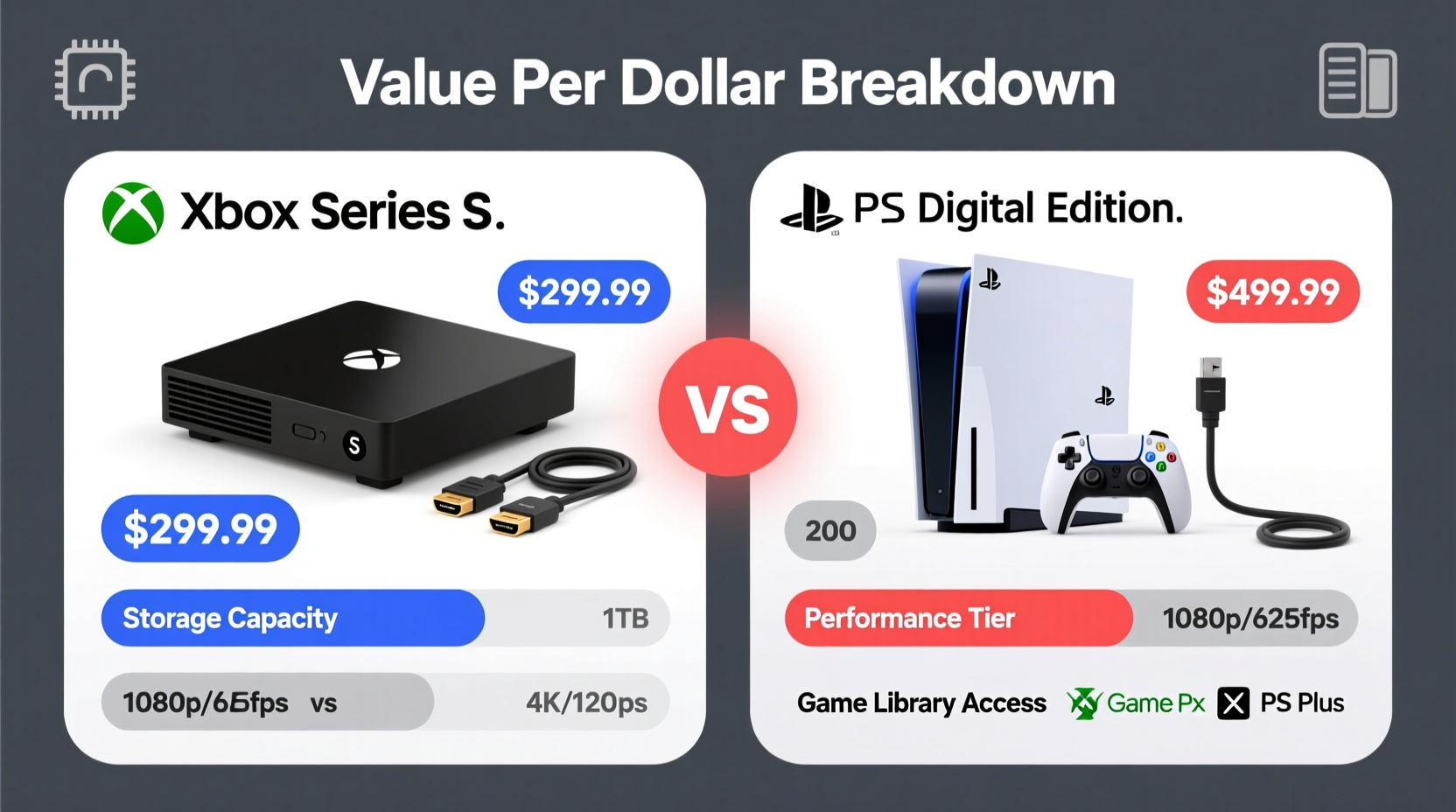
The sticker price is often the first consideration. At launch, the Xbox Series S retailed for $299, while the PS5 Digital Edition was priced at $399—a $100 difference that immediately sets the stage for a value debate. That gap hasn’t narrowed significantly, making the Series S the cheapest next-gen console on the market.
However, cost alone doesn’t determine value. You must consider what you’re getting for that money. The Series S uses a custom AMD GPU with 4 teraflops of power, targeting 1440p resolution at 60fps (with some games supporting up to 120fps). It has 10GB of shared GDDR6 memory and a 512GB SSD. In contrast, the PS5 Digital Edition shares the same internal specs as the disc version—10.3 teraflops of GPU power, 825GB of faster SSD storage, and support for native 4K gaming.
This performance gap means the PS5 can run games at higher resolutions, with better textures, ray tracing, and faster load times. But does that translate into double the value? Not necessarily—especially if you don’t own a 4K TV or prioritize frame rate over graphical fidelity.
Performance and Gaming Experience
The core of value lies in experience. A cheaper console that struggles with modern games offers poor ROI. The Series S compensates for its weaker hardware through smart upscaling, aggressive optimization, and strong SSD speeds. Many titles run smoothly at 60fps thanks to dynamic resolution scaling and reduced asset quality. Games like Forza Horizon 5, Halo Infinite, and Sea of Thieves perform admirably, especially when prioritizing gameplay fluidity over pixel density.
The PS5, meanwhile, consistently delivers near-4K or true 4K output in supported titles, with superior texture filtering, lighting effects, and audio processing via Tempest 3D AudioTech. Its larger, faster SSD reduces load times noticeably in open-world games like Spider-Man: Miles Morales or Horizon Forbidden West. The DualSense controller also enhances immersion with haptic feedback and adaptive triggers—features absent on the Xbox Wireless Controller.
Yet, for many players, these enhancements are luxuries rather than necessities. If your primary goal is playing multiplayer shooters or narrative-driven adventures without stuttering, the Series S holds up well. It’s not future-proof, but it’s competent for today’s gaming landscape.
“Value isn’t about max settings; it’s about consistent, enjoyable gameplay at a fair price. The Series S proves you don’t need 4K to have fun.” — Jordan Lee, Console Analyst at GameEconomy Insights
Game Library and Exclusives
One of the biggest arguments in favor of the PS5 is its lineup of timed and permanent exclusives. Titles like God of War: Ragnarök, The Last of Us Part I, Ghost of Tsushima Director’s Cut, and Marvel’s Spider-Man 2 are only available on PlayStation. These games often define a generation and influence purchasing decisions heavily.
Xbox, on the other hand, has shifted toward platform parity. Most first-party titles, such as Starfield, Forza Motorsport, and Fable, launch simultaneously on Xbox and PC. While this benefits Microsoft’s ecosystem, it weakens the exclusivity argument for buying an Xbox console.
However, Microsoft counters this with Game Pass—a subscription service that includes all first-party releases on day one. For $9.99/month, subscribers gain access to hundreds of games, including new launches. Sony has expanded its own PlayStation Plus tiers, but even the Premium tier ($17.99/month) lacks the same breadth and day-one exclusives.
If you plan to play a wide variety of games without buying each title individually, Game Pass dramatically increases the Series S’s value proposition. Over a year, spending $120 on Game Pass could give you access to over $1,000 worth of full-priced games.
Exclusive Game Comparison
| Platform | Key Exclusives | Day-One Game Pass? |
|---|---|---|
| Xbox Series S | Starfield, Forza Horizon 5, Halo Infinite, Fable (upcoming) | Yes |
| PS5 Digital Edition | God of War: Ragnarök, The Last of Us Part I, Spider-Man 2, Ghost of Tsushima | No |
Total Cost of Ownership Over Three Years
To assess real value, we must look beyond the initial purchase. Consider a three-year ownership scenario including accessories, games, subscriptions, and storage upgrades.
- Xbox Series S: Base cost $299. After three years, average user spends:
- $120/year on Game Pass Ultimate = $360
- $100 on additional games (mostly sales or included)
- $60 for 1TB expansion card
- Total: ~$819
- PS5 Digital Edition: Base cost $399. Average spend over same period:
- $180/year on PS Plus Extra/Premium = $540
- $300 on full-price exclusives (e.g., $70 each for 4 major titles)
- $110 for 1TB SSD upgrade
- Total: ~$1,149
In this model, the Series S saves users over $300 in three years—even after accounting for comparable gameplay time and enjoyment. This assumes moderate engagement with Game Pass and selective purchases on PlayStation.
Storage and Expandability
Both consoles come with limited internal storage, but managing space differs significantly. The Series S offers only 512GB, with roughly 364GB usable. Given that modern AAA games can exceed 100GB, users may fit only 3–4 large titles at once. Expanding requires a proprietary Seagate Storage Expansion Card, starting at $220 for 1TB—expensive per gigabyte.
The PS5 uses standard M.2 NVMe SSDs, allowing users to install third-party drives. A high-speed 1TB PCIe Gen4 SSD costs around $90, less than half the price per GB compared to Xbox’s solution. This makes long-term storage upgrades far more economical on PlayStation.
While the Series S wins on upfront cost, the PS5 wins on flexibility and scalability. Gamers planning to keep dozens of games installed will appreciate the PS5’s openness here.
Storage Comparison Summary
| Feature | Xbox Series S | PS5 Digital Edition |
|---|---|---|
| Internal Storage | 512GB (364GB usable) | 825GB (667GB usable) |
| Expansion Type | Proprietary Seagate Card | Standard M.2 NVMe SSD |
| Cost of 1TB Upgrade | $220 | $90 |
| Upgrade Ease | Plug-and-play, but costly | Requires setup, but affordable |
Real-World Example: Two Gamers, One Budget
Consider two friends, Alex and Jamie, both with a $500 total budget for a new console and gaming setup.
Alex chooses the Xbox Series S at $299. They spend $100 on a 3-month Game Pass Ultimate trial (often bundled free), then switch to individual purchases during sales. With $101 left, they buy select titles like Baldur’s Gate 3 and Hi-Fi Rush on sale. They play hundreds of hours across diverse genres without exceeding their budget.
Jamie opts for the PS5 Digital Edition at $399. Only $101 remains. They skip PS Plus initially and buy one full-priced exclusive: Marvel’s Spider-Man 2 at $70. They enjoy it deeply but have little room for additional games. To access more content, they’d need to either subscribe later or wait for deep discounts—slowing their overall game library growth.
Over six months, Alex explores 15+ games via Game Pass. Jamie finishes one major title and downloads a few smaller indies. While Jamie had a premium experience, Alex extracted far more variety and volume from the same budget. Value, in this case, leans toward versatility and access.
Resale Value and Longevity
After 2–3 years, many gamers trade in or sell their consoles. Resale value affects net cost. Historically, PlayStation consoles retain value better due to stronger demand and longer software support. A used PS5 Digital Edition typically sells for 60–70% of original price after two years, while the Series S fetches 45–55%.
However, longevity depends on developer support. As games grow more demanding, the Series S may struggle sooner to run new titles at acceptable settings. By 2027, it might be relegated to indie and backward-compatible games, whereas the PS5 should remain viable for AAA releases longer.
If you plan to upgrade every 3–4 years, the Series S’s lower depreciation risk balances its weaker future-proofing. But if you expect your console to last 5+ years, the PS5’s staying power adds value despite higher initial cost.
FAQ
Can the Xbox Series S run modern games well?
Yes, most modern games run at 1440p and 60fps through dynamic resolution scaling and optimized modes. Performance varies by title, but major first-party games are well-tuned. Avoid expecting native 4K or ultra-high textures.
Is Game Pass worth it compared to buying PS5 games outright?
For players who enjoy variety and don’t mind rotating libraries, Game Pass offers exceptional value. Spending $10/month gives access to new releases and classics. If you prefer owning and replaying a few premium exclusives, PS5’s model may suit you better.
Which console is better for families or casual gamers?
The Xbox Series S is ideal for casual or family use due to lower cost, ease of access via Game Pass, and strong backward compatibility. Families can explore different genres without financial pressure. The PS5 suits those committed to specific franchises or immersive single-player experiences.
Final Verdict: Where Your Dollar Goes Further
The Xbox Series S delivers more value per dollar for the average or budget-focused gamer. Its sub-$300 price, combined with Game Pass, creates an unmatched entry point into next-gen gaming. You sacrifice graphical power and storage flexibility, but gain affordability, instant access to a vast library, and lower long-term costs.
The PS5 Digital Edition offers a technically superior experience with exclusive blockbusters and better expandability. However, its higher price, lack of day-one exclusives on subscription, and steeper game costs reduce its efficiency per dollar spent.
If your priority is maximizing gameplay hours, variety, and cost efficiency, the Series S is the smarter investment. If you crave cinematic storytelling, cutting-edge visuals, and plan to keep the console for five years or more, the PS5 justifies its premium.




 浙公网安备
33010002000092号
浙公网安备
33010002000092号 浙B2-20120091-4
Comments
No comments yet. Why don't you start the discussion?