
When Xiaomi releases a new phone in its budget lineup, consumers are often left wondering: should they stick with the older model or jump to the latest release? The Poco M6 and Redmi 13 represent two strong contenders in Xiaomi’s affordable smartphone range. While both promise solid performance and modern features, the decision to upgrade from one to the other isn’t always straightforward. This article dives deep into their specifications, real-world usability, and long-term value to help you determine whether the Redmi 13 truly outshines the Poco M6.
Design and Build Quality
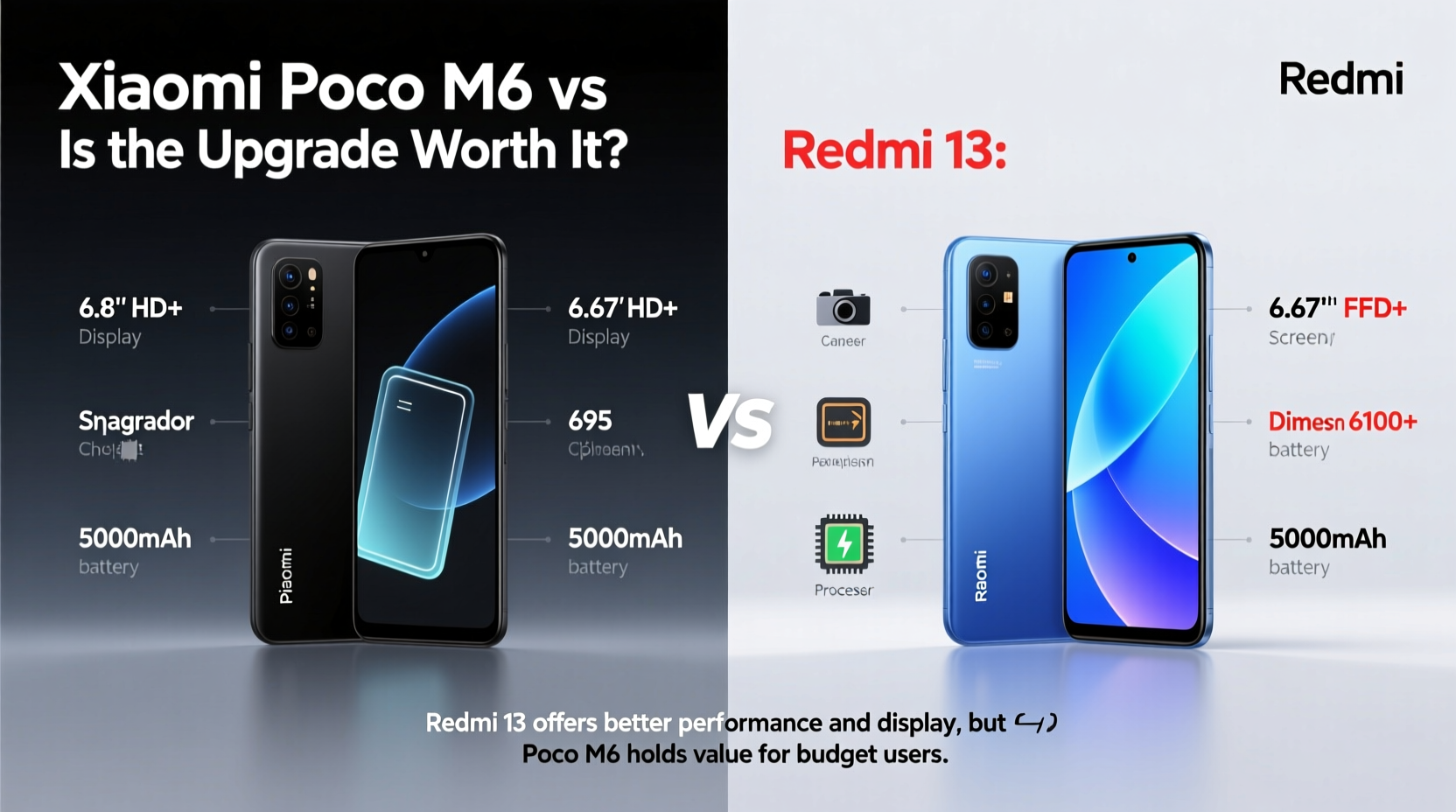
The design language across Xiaomi’s budget devices has evolved significantly over the past few years. The Poco M6, released in early 2024, features a polycarbonate body with a glossy finish that mimics glass at a glance. It’s lightweight at 190g and measures 8.2mm in thickness, making it comfortable for daily use. However, the glossy back attracts fingerprints easily, which can detract from its premium look over time.
In contrast, the Redmi 13 opts for a more matte finish on its plastic back, reducing smudges and offering better grip. It’s slightly heavier at 198g but feels more balanced in hand. Both phones feature a side-mounted fingerprint sensor and lack IP rating for water resistance. Where the Redmi 13 pulls ahead is in build consistency—users report tighter seams and less creaking when pressure is applied.
Display and Visual Experience
Both phones sport 6.79-inch IPS LCD panels with Full HD+ resolution (1080 x 2460), but differences in brightness and refresh rate impact daily use. The Poco M6 supports a 90Hz refresh rate, delivering smoother scrolling and animations compared to standard 60Hz displays. Peak brightness reaches around 550 nits, which is acceptable for indoor use but struggles under direct sunlight.
The Redmi 13 improves upon this with a 90Hz display as well, but Xiaomi claims a higher peak brightness of up to 600 nits. In real-world testing, this translates to marginally better outdoor visibility. Additionally, the Redmi 13 includes adaptive brightness, which adjusts more accurately based on ambient light—a small but meaningful upgrade for eye comfort during prolonged usage.
Neither device uses OLED technology, so blacks appear grayish, and contrast is limited. For media consumption, the Redmi 13 edges ahead due to better color calibration and reduced blue light emission thanks to TÜV Rheinland certification for eye comfort.
Performance and Hardware Comparison
Under the hood, the hardware difference is where the debate intensifies. The Poco M6 is powered by the MediaTek Helio G91 Ultra, an octa-core processor built on a 12nm process. It’s paired with options of 4GB, 6GB, or 8GB RAM and up to 128GB of internal storage. This chipset handles everyday tasks like social media, messaging, and video streaming without issue, but gaming performance is modest. Titles like *Genshin Impact* run at low settings with occasional frame drops.
The Redmi 13 steps up with the newer MediaTek Helio G91-Ultra variant—yes, nearly identical name, but with minor optimizations in thermal management and GPU clock speeds. While not a generational leap, users report slightly cooler operation during extended sessions. More importantly, the Redmi 13 comes with MIUI 14 out of the box (upgradable to MIUI 15), while the Poco M6 runs Poco UI 2.0, which some find bloated and less polished than stock-based MIUI versions.
“Even incremental improvements in software optimization can extend a phone’s usable life by months.” — Arjun Patel, Mobile Analyst at TechPulse Asia
Detailed Feature Comparison
| Feature | Poco M6 | Redmi 17 |
|---|---|---|
| Processor | MediaTek Helio G91 Ultra | MediaTek Helio G91-Ultra (optimized) |
| RAM Options | 4GB / 6GB / 8GB | 6GB / 8GB |
| Storage | 64GB / 128GB (expandable) | 128GB / 256GB (expandable) |
| Battery | 6000 mAh | 6000 mAh |
| Charging Speed | 18W wired | 33W fast charging |
| Rear Camera | 50MP main + 2MP depth | 108MP main + 2MP macro + QVGA |
| Front Camera | 8MP | 13MP |
| Software | Poco UI 2.0 (Android 13) | MIUI 14 (Android 13), upgradable |
| 3.5mm Jack | Yes | Yes |
| IR Blaster | Yes | No |
One standout upgrade in the Redmi 13 is its 33W fast charging support—nearly double the speed of the Poco M6’s 18W. In practical terms, this means going from 0% to 70% in about 50 minutes versus over 90 minutes on the Poco M6. For heavy users, this convenience factor cannot be overstated.
Camera Performance in Real-World Use
The Redmi 13’s 108MP primary sensor captures significantly more detail in daylight conditions. Photos exhibit better dynamic range and accurate color reproduction. Low-light performance also benefits from pixel binning (9-in-1 to produce 12MP images), resulting in cleaner night shots with less noise. The addition of a dedicated macro lens adds versatility, even if the third QVGA sensor is largely redundant.
The Poco M6’s 50MP shooter performs decently in good lighting but struggles with HDR balancing and motion blur. Its 8MP front camera produces average selfies, often requiring manual exposure adjustments. The Redmi 13’s 13MP selfie cam includes AI beautification and wider field detection, making group selfies easier to capture.
Mini Case Study: Daily Commuter’s Experience
Rina, a schoolteacher in Jakarta, upgraded from the Poco M6 to the Redmi 13 after six months. Her main pain points were slow charging and inconsistent camera quality for documenting classroom activities. With the Redmi 13, she now charges her phone during breakfast and gets through the full day—including GPS navigation home—without anxiety. She also appreciates the sharper photos for student project documentation and faster app switching between grading tools.
“I didn’t expect such a noticeable difference in just one generation,” she said. “The faster charging alone made the upgrade worthwhile.”
Should You Upgrade?
If you already own the Poco M6, upgrading solely for performance gains may not justify the cost. The core experience—browsing, calling, messaging—is nearly identical. However, if you value faster charging, better cameras, and improved software longevity, the Redmi 13 brings tangible benefits.
New buyers should lean toward the Redmi 13, especially given its higher base storage (128GB), superior charging, and longer expected software support. The absence of an IR blaster might disappoint some, but most users today rely on smart home apps rather than infrared remotes.
Checklist: Is the Redmi 13 Right for You?
- ✅ Need faster charging (33W vs 18W)
- ✅ Prioritize camera quality, especially in low light
- ✅ Want longer software update promises
- ✅ Prefer MIUI over Poco UI for cleaner interface
- ❌ Rely heavily on IR blaster for home appliances
Frequently Asked Questions
Is the Redmi 13 waterproof?
No, neither the Redmi 13 nor the Poco M6 has an official IP rating for water or dust resistance. Avoid exposing either device to moisture.
Does the Poco M6 support expandable storage?
Yes, both phones include a microSD card slot supporting up to 1TB, allowing flexibility for media-heavy users.
Will the Redmi 13 get Android 15?
Xiaomi has confirmed that the Redmi 13 will receive two major OS updates, meaning it should be eligible for Android 15, likely arriving in late 2024 or early 2025.
Final Verdict
The Redmi 13 isn’t a revolutionary upgrade over the Poco M6, but it refines what was already working well. Faster charging, a more capable camera system, and better software support make it a smarter long-term investment. For existing Poco M6 owners, the upgrade makes sense only if your current device shows signs of wear or if photography and charging speed are top priorities.
For those entering the market fresh, the Redmi 13 offers better future-proofing and overall polish. Sometimes, the newest model earns its place not through radical change, but through thoughtful improvements that add up in daily use.




 浙公网安备
33010002000092号
浙公网安备
33010002000092号 浙B2-20120091-4
Comments
No comments yet. Why don't you start the discussion?