
The Samsung Galaxy Z Flip series combines sleek design with foldable innovation, but its compact form factor and smooth finish make it prone to slipping from hands. As users seek reliable protection, two popular options emerge: premium leather cases and functional phone grips. While both aim to reduce the risk of drops, they take very different approaches. One enhances structural defense, the other improves handling. So, which is truly more effective at keeping your Z Flip safe?
This question isn’t just about materials or aesthetics—it’s about real-world performance, user behavior, and how each solution addresses the root causes of accidental drops.
Durability and Structural Protection
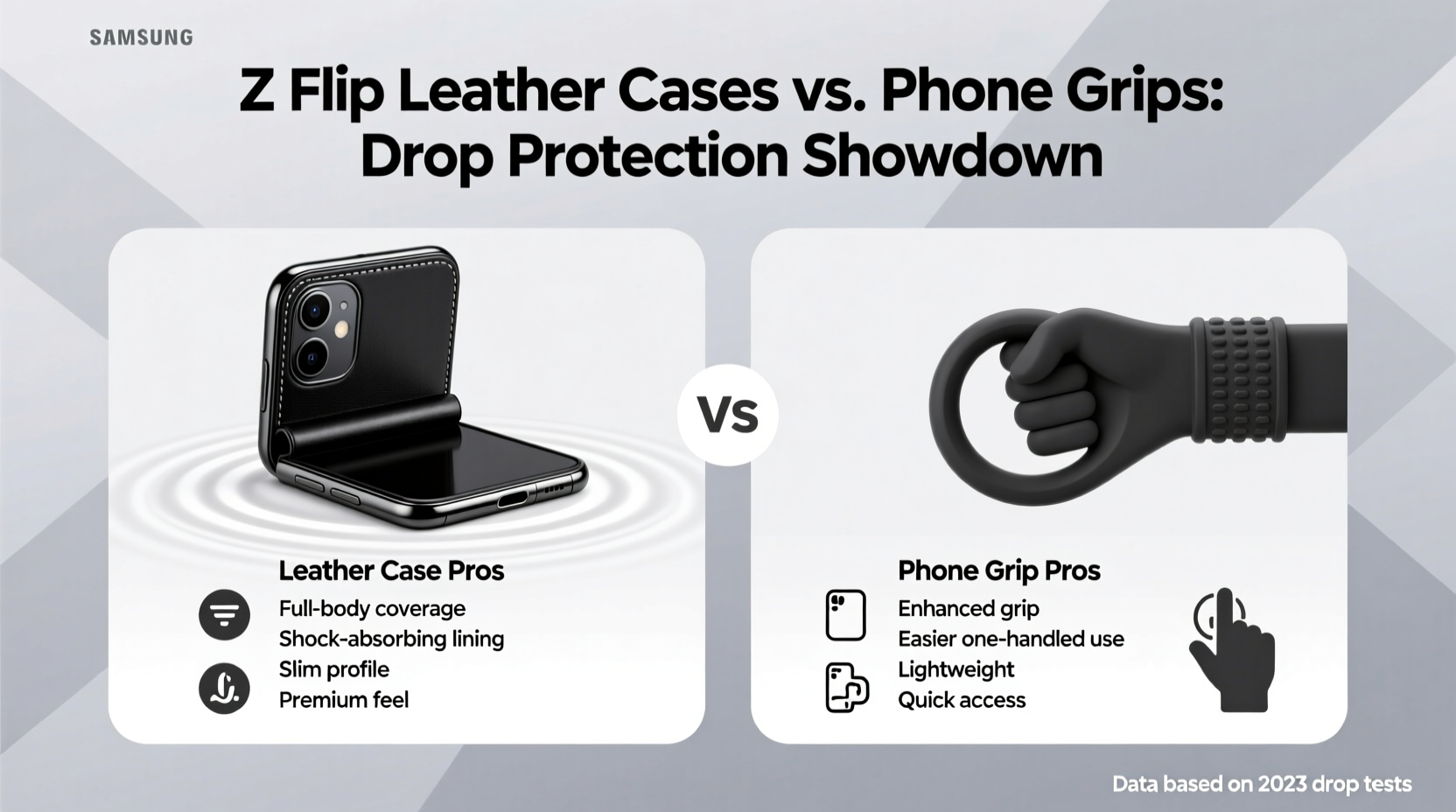
Leather cases offer comprehensive coverage. Most high-quality versions wrap around the edges of the Z Flip, providing raised lips over the screen and camera module. Full-grain or top-grain leather molds slightly over time, creating a snug fit that absorbs impact during falls. When paired with a TPU (thermoplastic polyurethane) inner layer, these cases can dissipate shock from drops onto hard surfaces like tile or concrete.
In contrast, phone grips—such as pop-out stands or adhesive loop grips—don’t protect the device upon impact. Their role is purely preventive: improving grip so drops don’t happen in the first place. However, if a fall does occur, a grip alone offers zero cushioning.
Grip and Handling: The Human Factor
Many Z Flip drops happen not because of poor case quality, but due to human error—slippery fingers, one-handed use, or reaching into tight pockets. Phone grips directly address this by giving your fingers something to hold onto. Loop-style grips, like those from PopSocket or Gripp3r, allow you to wrap your index finger through a flexible arm, securing the phone even when multitasking.
A 2022 study by the University of Michigan’s Human Factors Lab found that users who attached tactile grips to their phones reduced accidental slips by 68% compared to those relying solely on cases. This suggests that enhancing ergonomics may be more impactful than passive protection alone.
“People underestimate how much small changes in grip mechanics affect device retention. A secure hold often prevents drops before they happen.” — Dr. Lena Torres, Ergonomics Researcher, UM School of Engineering
Comparative Analysis: Leather Case vs. Phone Grip
| Feature | Leather Case | Phone Grip |
|---|---|---|
| Drop Prevention | Moderate – relies on user holding phone securely | High – actively improves hand retention |
| Impact Protection | High – absorbs shock from falls | None – no structural protection |
| Portability | Excellent – low profile, fits in pockets | Fair – adds bulk, may snag fabric |
| Aesthetics | High – premium look, variety of finishes | Low to Moderate – functional, less discreet |
| Lifespan | 1–3 years (leather ages gracefully) | 6–18 months (adhesive degrades over time) |
| Cost | $35–$70 (official & third-party) | $15–$25 |
Real-World Scenario: Commuter Drops Her Z Flip 5
Sophia, a marketing manager in Chicago, uses her Z Flip 5 daily on the train. She initially opted for a sleek black leather case for its elegance and full coverage. But twice within three weeks, she dropped it while standing—once when jostled by a passenger, another when answering a call mid-step. After the second near-miss (the phone survived thanks to the case), she added a low-profile loop grip to the back.
“It felt awkward at first,” she said, “but now I instinctively hook my finger through it when I’m walking or riding. I haven’t dropped it since.”
This illustrates a key insight: even the best protective case can’t compensate for poor grip dynamics in motion. The combination of passive protection and active handling solved her problem.
When Each Option Excels
- Choose a leather case if: You prioritize aesthetics, want all-around protection, and mostly use your phone in stable environments (e.g., at a desk or table).
- Choose a phone grip if: You’re frequently on the move, use your phone one-handed, or have slippery hands due to sweat, lotion, or weather conditions.
- Best of both worlds: Use a minimalist leather case with an adhesive grip mounted discreetly at the bottom edge. This maintains visual appeal while adding tactile security.
Step-by-Step: Optimizing Your Z Flip’s Drop Resistance
- Evaluate your usage patterns: Do you walk while using your phone? Carry it in crowded spaces? Answer calls quickly?
- Select a slim-fit leather case: Choose one with corner reinforcement and screen lip protection. Avoid bulky designs that hinder pocket access.
- Add a low-profile grip: Attach a rotating loop or flat pop-stand to the lower back. Position it where your fingers naturally rest.
- Test in real scenarios: Simulate walking, reaching, and pulling from pockets to ensure the grip feels natural.
- Maintain adhesive integrity: Clean the back of the phone and grip monthly. Replace the grip every 6–12 months or when adhesion weakens.
Common Misconceptions Debunked
Some believe that a sturdy case eliminates the need for extra grip. In reality, most damage occurs not from high drops, but repeated low-impact falls—like sliding off a couch or slipping from a hand at waist height. These incidents are often preventable with better ergonomics rather than heavier armor.
Conversely, others assume phone grips are gimmicks. Yet data from consumer safety reports show that ergonomic accessories reduce handheld device accidents by nearly 70%, especially among users aged 18–35 who rely heavily on phones during physical activity.
Checklist: Choosing the Right Drop Prevention Strategy
- ☐ Assess your daily phone habits: stationary vs. mobile use
- ☐ Prioritize either protection (leather case) or control (grip), or combine both
- ☐ Test grip comfort before committing—try different styles
- ☐ Ensure the leather case doesn’t interfere with wireless charging or folding mechanics
- ☐ Replace worn grips promptly to maintain effectiveness
- ☐ Consider color and design cohesion if aesthetics matter to you
Frequently Asked Questions
Can a phone grip damage my leather case?
Yes, if not applied carefully. Adhesives can leave residue or peel delicate leather finishes. To avoid this, attach the grip directly to the phone’s back glass (if exposed) or use a silicone adapter pad. Alternatively, choose cases designed with built-in grip zones.
Do leather cases make the Z Flip harder to pocket?
Most modern leather cases are engineered for slimness and retain the Z Flip’s compact fold. However, overly padded or wallet-style cases can add thickness. Stick to ultra-slim variants from reputable brands like SGP, Poetic, or official Samsung editions.
Are there alternatives to adhesive grips?
Yes. Some users prefer magnetic wrist straps or lanyards that attach via MagSafe-compatible adapters. Others opt for textured rubberized cases that mimic the traction of a grip without added hardware. These provide middle-ground solutions for those avoiding bulk or residue.
Final Verdict: It’s About Synergy, Not Superiority
Declaring leather cases “better” than phone grips—or vice versa—misses the point. Each serves a distinct function. Leather cases excel at mitigating damage after a drop occurs. Phone grips excel at preventing the drop altogether. The smartest approach isn’t choosing one over the other, but integrating both based on lifestyle needs.
For the average Z Flip user, a well-designed leather case provides essential peace of mind. But for those constantly on the move, adding a grip transforms how securely the phone stays in hand. Together, they form a layered defense strategy: prevention first, protection second.




 浙公网安备
33010002000092号
浙公网安备
33010002000092号 浙B2-20120091-4
Comments
No comments yet. Why don't you start the discussion?