
Coin purses may be small, but their design has a significant impact on daily usability, longevity, and storage capacity. Among the most common closures are zippers and clasps—two mechanisms that serve the same basic purpose but differ dramatically in performance. Whether you're choosing a new coin purse or evaluating one you already own, understanding how zipper and clasp designs compare in terms of capacity and durability is essential. This article breaks down both options with practical insights, real-world examples, and expert-backed advice to help you make an informed decision.
Capacity: How Much Can Each Type Hold?
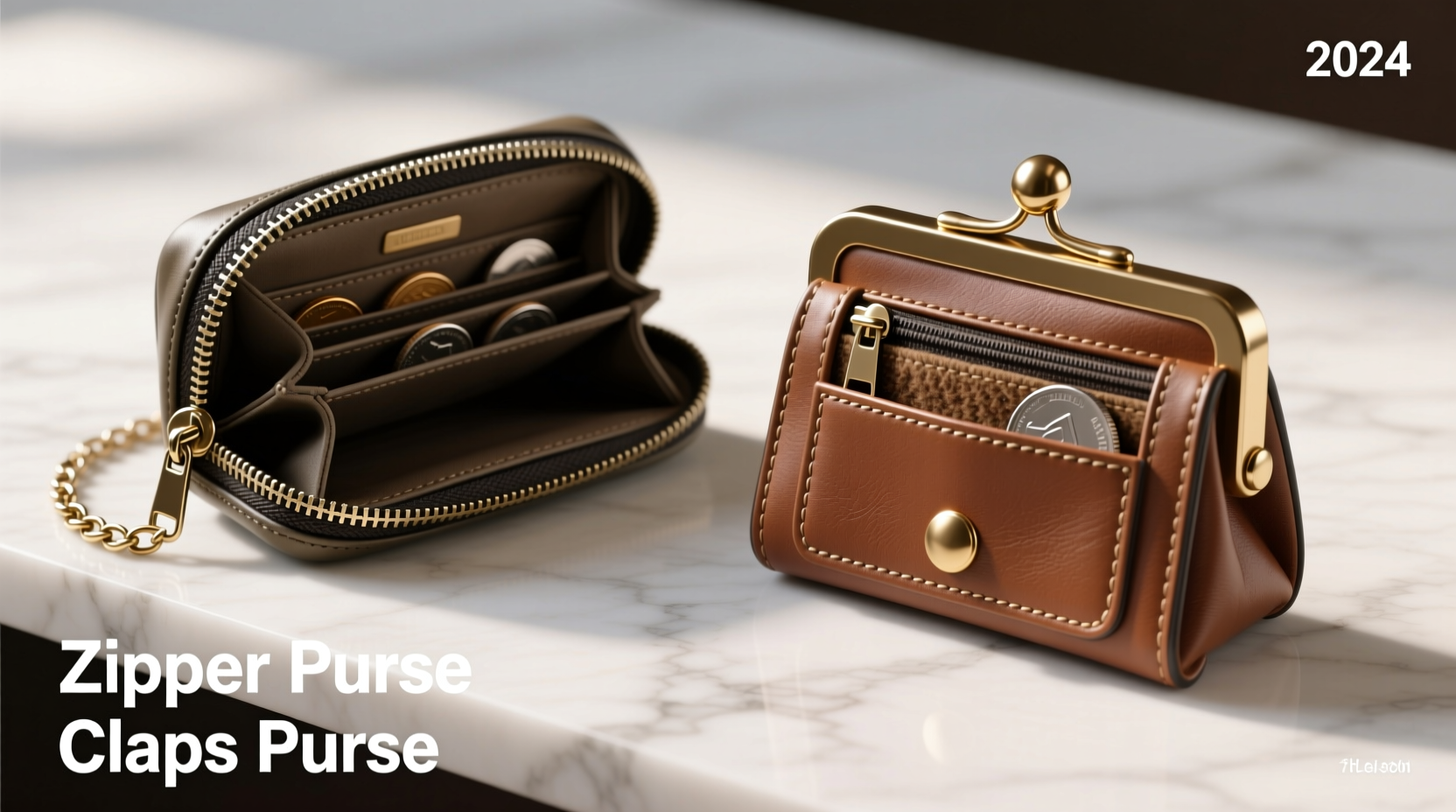
The internal volume of a coin purse depends not only on its size but also on its closure mechanism. Zippers and clasps affect usable space differently due to their structural design.
Zippers typically run along the top edge of the purse, creating a fully expandable opening. When unzipped, the entire top opens wide, allowing full access to the interior. This makes it easier to retrieve coins without digging and allows users to pack more efficiently. Because the fabric or material isn’t folded over or compressed by a mechanical clasp, the full depth of the purse remains accessible.
In contrast, clasp coin purses often feature overlapping flaps or folded edges secured by a snap, magnetic button, or turn-lock. These overlapping layers take up internal space and reduce effective depth. For example, a 3-inch-tall clasp purse might offer only 2.4 inches of usable height due to the folded lip. This loss of vertical space can limit how many coins fit before the purse becomes overstuffed and difficult to close.
Durability: Which Closure Lasts Longer?
Durability is where the differences between zippers and clasps become most apparent. Longevity depends on materials, frequency of use, and mechanical stress points.
Zippers are complex components with interlocking teeth (or coils) pulled together by a slider. While modern zippers are engineered for repeated use, they are vulnerable to snagging, misalignment, and slider failure—especially in smaller formats used in coin purses. A single pull at an angle or debris caught in the track can cause the zipper to jam or break. However, high-quality metal zippers, particularly those with double sliders or reinforced stops, can last for years with proper care.
Clasps, on the other hand, rely on simpler mechanics. Magnetic snaps, push-button closures, and turn-locks have fewer moving parts and are less prone to gradual wear from daily opening and closing. They don’t suffer from \"teeth stripping\" like zippers do. That said, weak springs or poorly aligned magnets can lead to accidental openings, especially if the purse is jostled in a bag. Over time, repeated pressure on the clasp mechanism can deform plastic housings or weaken tension.
“Zippers offer better security and full access, but their longevity hinges on quality. A well-made YKK zipper outlasts most budget clasps.” — Daniel Reed, Accessory Design Engineer
Comparison Table: Zipper vs Clasp Coin Purses
| Feature | Zipper Coin Purse | Clasp Coin Purse |
|---|---|---|
| Usable Capacity | Higher – full top opens, no overlap | Lower – flap reduces interior depth |
| Durability | Moderate to high (depends on zipper quality) | High for metal clasps; low for cheap plastic |
| Security | High – fully sealed, hard to open accidentally | Variable – magnets can fail under pressure |
| Ease of Use | Slightly slower – requires precise pulling | Fast – one-handed snap open/close |
| Repair Potential | Replaceable with skill or professional help | Often not repairable; replacement needed |
Real-World Example: Commuter’s Dilemma
Sarah, a city commuter, used a compact leather clasp coin purse for her daily metro fare and change. After six months, the magnetic closure weakened, and the purse opened twice inside her tote, spilling coins. She switched to a nylon zipper model with a wide mouth. Though slightly bulkier, it held nearly 50% more coins and never failed to stay closed—even when tossed into a crowded bag. After two years, the zipper still operated smoothly thanks to occasional cleaning with a dry toothbrush. The clasp purse lasted eight months; the zipper version is still going strong.
This scenario illustrates a common pattern: convenience-focused clasp designs may fail under frequent urban use, while sturdier zipper models excel in reliability despite a slight trade-off in speed.
How to Maximize Lifespan: Care Tips for Both Types
No matter which closure you prefer, maintenance plays a crucial role in extending the life of your coin purse.
- Avoid overfilling: Stuffed purses strain seams, distort shape, and increase stress on zippers and clasps.
- Clean regularly: Wipe down exteriors with a damp cloth; use a soft brush to remove lint from zipper tracks.
- Store properly: Keep in a dry place away from moisture and direct sunlight to prevent material degradation.
- Use gently: Don’t yank zippers or force clasps shut—align them carefully to avoid misalignment.
Step-by-Step Guide: Choosing the Right Coin Purse
- Assess your needs: Do you carry mostly coins, cards, or a mix? High-volume users benefit from zipper designs.
- Check materials: Look for reinforced stitching, metal zippers (e.g., YKK), or solid brass clasps.
- Test the closure: Open and close 5–10 times. Does it feel smooth? Is there resistance or looseness?
- Evaluate interior space: Measure depth with the closure closed—clasp types often lose 15–25% of height.
- Consider long-term use: Will this be in a heavy-use bag, or a backup accessory? Prioritize durability for daily carry.
Frequently Asked Questions
Can a broken zipper on a coin purse be fixed?
Yes, minor issues like misaligned sliders can sometimes be corrected by realigning the teeth. Full zipper replacements are possible but require sewing skills or a cobbler. Nylon coil zippers are easier to replace than molded plastic ones.
Are magnetic clasps secure enough for active use?
They’re convenient but not ideal for high-movement environments. If you frequently toss your bag around or carry it in crowded spaces, a zipper offers superior security against accidental openings.
Which material pairs best with each closure type?
Leather and canvas work well with both, but rigid leather flaps enhance clasp stability. Lightweight fabrics like nylon or polyester suit zippers better, as they allow full expansion without stiffness.
Final Recommendation
If maximizing capacity and ensuring long-term reliability are your top priorities, a well-constructed zipper coin purse is the superior choice. It provides greater usable space, consistent security, and better resistance to wear when made with quality components. Clasp purses win in speed and elegance but often fall short in durability and volume—especially under daily stress.
For optimal results, select a medium-sized zipper purse made from durable fabric or genuine leather, with a metal zipper and minimal lining bulk. Avoid ultra-compact clasp models if you regularly carry more than a handful of coins.




 浙公网安备
33010002000092号
浙公网安备
33010002000092号 浙B2-20120091-4
Comments
No comments yet. Why don't you start the discussion?