
When shopping for elegant, budget-friendly jewelry, many people find themselves comparing zircon and cubic zirconia. Both are known for their brilliance and affordability, especially in bracelet designs. But with similar names and sparkling appearances, confusion is common. Are they the same? Is the cheaper option obviously inferior? The answer isn’t as straightforward as it seems.
Understanding the differences between natural zircon and lab-created cubic zirconia goes beyond price tags. It involves geology, optical properties, durability, and long-term value. This guide cuts through the marketing noise to reveal what truly sets these materials apart—and whether the lower price point should raise red flags or signal smart shopping.
What Is Zircon?
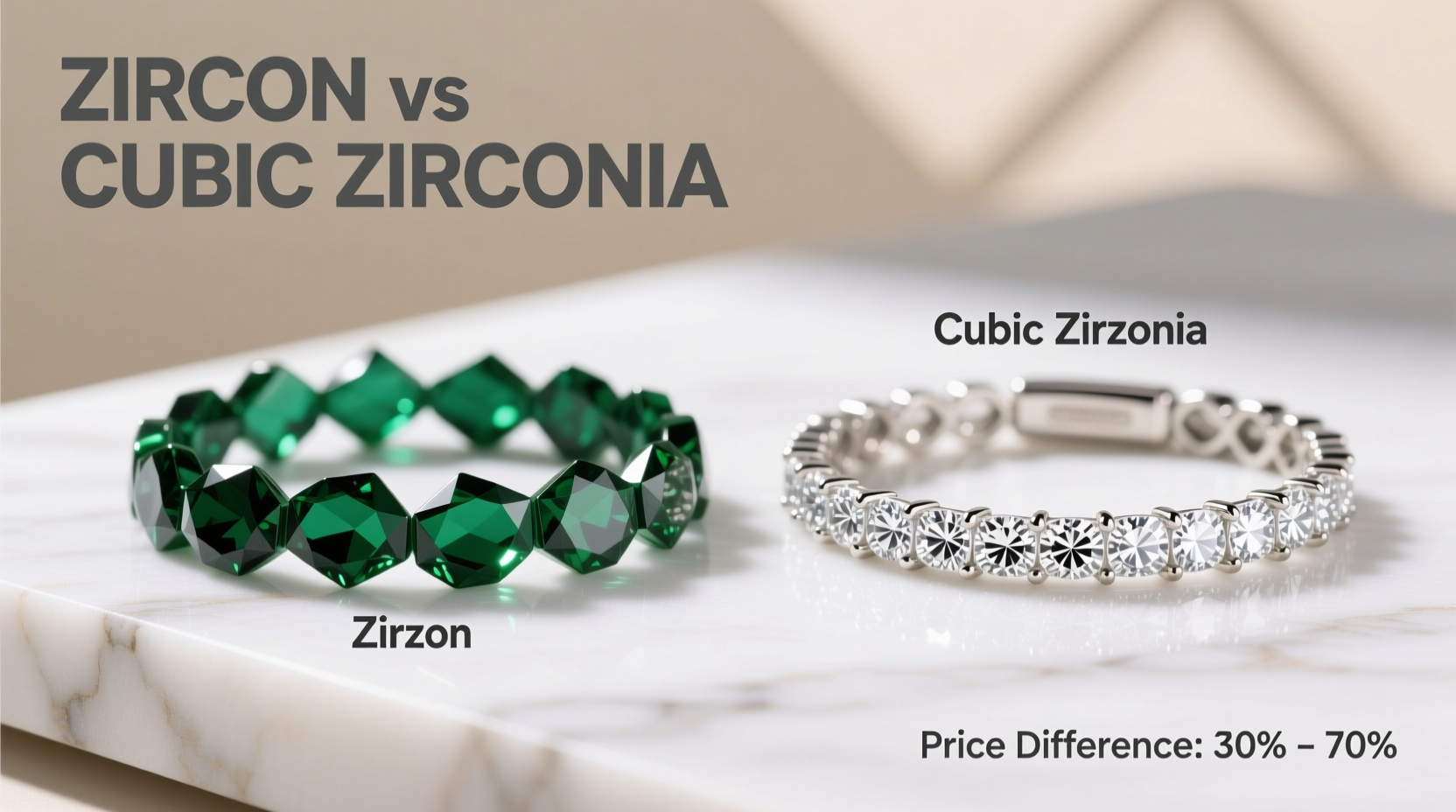
Zircon is a naturally occurring mineral composed of zirconium silicate (ZrSiO₄). Found in ancient rocks and beach sands across Australia, Cambodia, and Sri Lanka, it’s one of the oldest minerals on Earth—some specimens date back over 4 billion years. Natural zircon comes in a range of colors, including colorless, blue, yellow, and reddish-brown, depending on trace elements and radiation exposure.
In its colorless form, zircon has been used as a diamond simulant since the 19th century. It exhibits high refractive index and strong dispersion, giving it notable fire and sparkle. However, natural zircon is relatively soft compared to other gemstones, ranking around 6.5–7.5 on the Mohs hardness scale. This makes it more prone to scratches and chipping, especially in high-wear items like bracelets.
What Is Cubic Zirconia?
Cubic zirconia (CZ) is a synthetic material made in laboratories to mimic the look of diamonds. It's composed of zirconium dioxide (ZrO₂), stabilized with additives like yttrium or calcium to maintain its cubic crystalline structure. Unlike natural zircon, CZ does not occur in nature and is engineered for consistency, clarity, and brilliance.
First developed in the Soviet Union in the 1970s, cubic zirconia quickly became the most popular diamond alternative due to its low cost and dazzling appearance. It ranks 8–8.5 on the Mohs scale, making it significantly harder and more scratch-resistant than natural zircon. Its flawless internal structure allows for excellent light performance, often surpassing zircon in brilliance under store lighting.
Because it’s lab-made, cubic zirconia can be produced in large quantities with uniform quality, which keeps prices low. A well-cut CZ bracelet typically costs less than half of a comparable natural zircon piece.
Comparing Key Characteristics
| Feature | Natural Zircon | Cubic Zirconia (CZ) |
|---|---|---|
| Origin | Natural mineral | Synthetic (lab-grown) |
| Composition | Zirconium silicate (ZrSiO₄) | Zirconium dioxide (ZrO₂) |
| Hardness (Mohs) | 6.5–7.5 | 8–8.5 |
| Brightness/Fire | High dispersion, noticeable fire | Higher brilliance, consistent sparkle |
| Durability | Prone to scratching and cleavage | Resistant to wear; better for daily use |
| Price Range (Bracelet) | $50–$200+ | $20–$80 |
| Rarity | Relatively rare in gem-quality form | Made on demand; widely available |
“While cubic zirconia wins in durability and consistency, natural zircon carries geological history and unique optical charm that collectors appreciate.” — Dr. Lena Torres, Gemologist at the American Gem Society
Is the Cheaper Option Obvious—and Inferior?
The immediate assumption might be that a $30 cubic zirconia bracelet is clearly “worse” than a $150 zircon one. But this overlooks context. In terms of everyday wear, CZ often performs better. Its higher hardness means it resists clouding from micro-scratches, a common issue with softer stones. Over time, a zircon bracelet may lose its luster if not carefully maintained, while a CZ piece can retain its shine for years with basic cleaning.
However, value isn’t only about durability. Natural zircon appeals to those who prioritize authenticity, rarity, and connection to Earth’s history. For some buyers, owning a mineral older than continents holds intrinsic worth that no lab-grown stone can replicate. Additionally, fine blue zircons—especially those heat-treated to enhance color—are prized in niche markets and can appreciate slightly in value.
The key is matching the stone to your lifestyle. If you want a flashy, durable bracelet for regular wear, cubic zirconia is likely the smarter investment. If you’re drawn to natural gemstones with character and story, zircon offers something CZ cannot replicate—authenticity.
Real-Life Example: Two Buyers, Two Choices
Consider Sarah and Mia, both shopping for an anniversary gift. Sarah opts for a delicate gold-plated bracelet set with natural blue zircon. She values the uniqueness of natural stones and plans to wear it only on special occasions. She stores it separately in a soft pouch and avoids water exposure.
Mia chooses a bolder, rhodium-plated tennis bracelet with colorless cubic zirconia. She wears it daily, even while washing dishes or commuting. After six months, her bracelet still sparkles, while Sarah notices slight surface haze on her zircon links after accidental contact with lotion and keys.
Neither choice was wrong—each aligned with their habits. Mia prioritized practicality; Sarah valued sentiment and natural origin. The “better” option depends on how and when you plan to wear the piece.
How to Make the Right Choice: A Buyer’s Checklist
- ✅ Determine your primary use: occasional elegance or daily wear?
- ✅ Check the metal setting—sterling silver or gold vermeil adds longevity.
- ✅ Inspect for visible flaws: natural zircon may have inclusions; CZ should be internally flawless.
- ✅ Consider maintenance: are you willing to clean and store it carefully?
- ✅ Set a realistic budget without assuming higher price = better quality.
- ✅ Buy from reputable sellers who disclose material origins.
Caring for Your Bracelet: A Step-by-Step Guide
- Remove before activity: Take off your bracelet before swimming, exercising, or applying cosmetics.
- Clean weekly: Soak in warm water with mild dish soap for 10 minutes. Use a soft toothbrush to gently scrub settings.
- Rinse and dry: Rinse under lukewarm water and pat dry with a lint-free cloth.
- Inspect regularly: Check prongs and links for looseness every few months.
- Store properly: Keep in a fabric-lined jewelry box, separate from other pieces to prevent scratches.
Frequently Asked Questions
Can you tell zircon and cubic zirconia apart just by looking?
Not easily. Under bright light, zircon tends to show more colored fire (spectral flashes), while CZ has higher overall brilliance. A trained eye might notice slight doubling of facet lines in zircon due to birefringence—a property absent in CZ. But for most consumers, they appear nearly identical in jewelry settings.
Does cubic zirconia get cloudy over time?
Yes, but slowly. Cloudiness usually results from buildup of oils, lotions, or micro-scratches. Regular cleaning restores shine in most cases. High-quality CZ with protective coatings lasts longer without dulling.
Is natural zircon ethical to buy?
Generally yes. Unlike conflict diamonds, zircon mining is not linked to major human rights issues. Most gem-quality zircon comes from stable regions with regulated mining practices. Still, ask for sourcing details if ethical sourcing is important to you.
Final Thoughts: Price Isn’t the Only Measure of Worth
The cheaper bracelet isn’t automatically “obvious” in its inferiority. Cubic zirconia offers remarkable value for its price, combining durability, beauty, and consistency. Natural zircon, while more expensive, brings geological significance and organic variation that resonate with collectors and nature enthusiasts.
Instead of focusing solely on cost, consider your priorities: Do you want a resilient accessory for everyday glamour? Choose cubic zirconia. Are you seeking a meaningful, conversation-starting piece with natural heritage? Then zircon may be worth the extra investment.




 浙公网安备
33010002000092号
浙公网安备
33010002000092号 浙B2-20120091-4
Comments
No comments yet. Why don't you start the discussion?