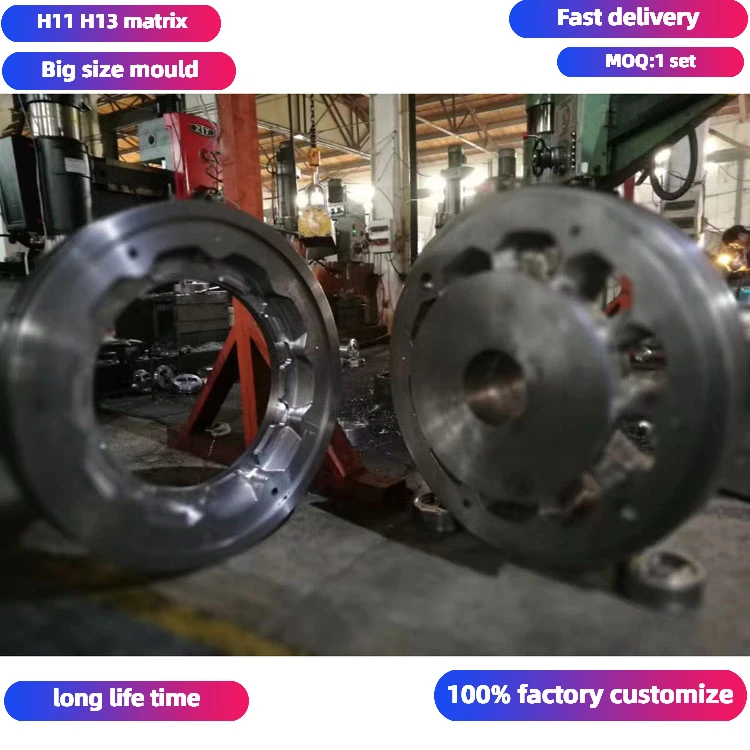
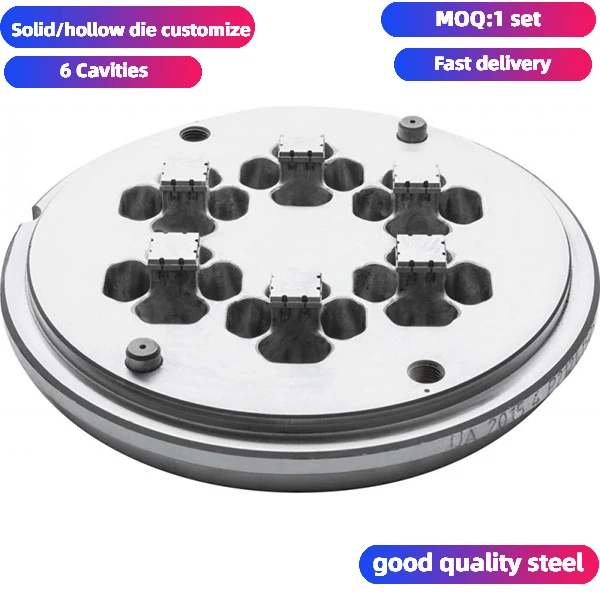
Customization:
With H13 steel construction, ensure prolonged service life under high-temperature extrusion processes compared to aluminum moulds*. The H13 steel alloy provides superior heat resistance and wear resistance, maintaining structural integrity even during continuous industrial use.
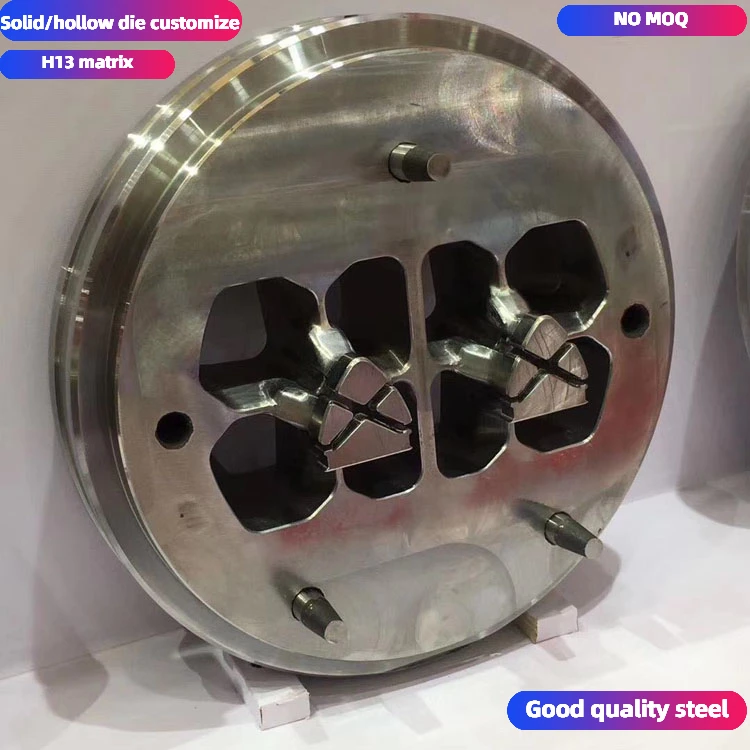
With a multi-void and multiple cavity design, produce complex hollow profiles in a single extrusion step, reducing production steps versus conventional single-cavity moulds*. The precision-engineered cavities enable simultaneous shaping of intricate geometries, boosting efficiency in manufacturing.
With precision-machined cavities, achieve ±0.1mm dimensional accuracy for consistent part quality, surpassing industry standards by up to 15%*. The tight tolerances ensure minimal scrap rates and optimal material utilization in extrusion processes.
Designed for industrial extrusion lines, enable continuous 24/7 operation for mass production of building materials or automotive components, outperforming standard moulds in durability under heavy-duty cycles*. The robust design supports high-volume manufacturing demands without compromising output quality.
Constructed with materials compliant to ISO 18223 for extrusion tools, ensuring safety and performance in compliance with international manufacturing standards*. The H13 steel and aluminum alloy components meet rigorous certification requirements for industrial mould applications.

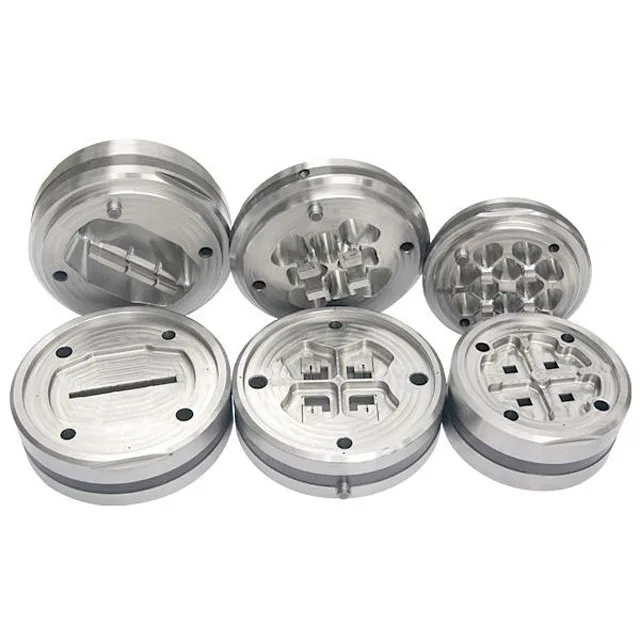
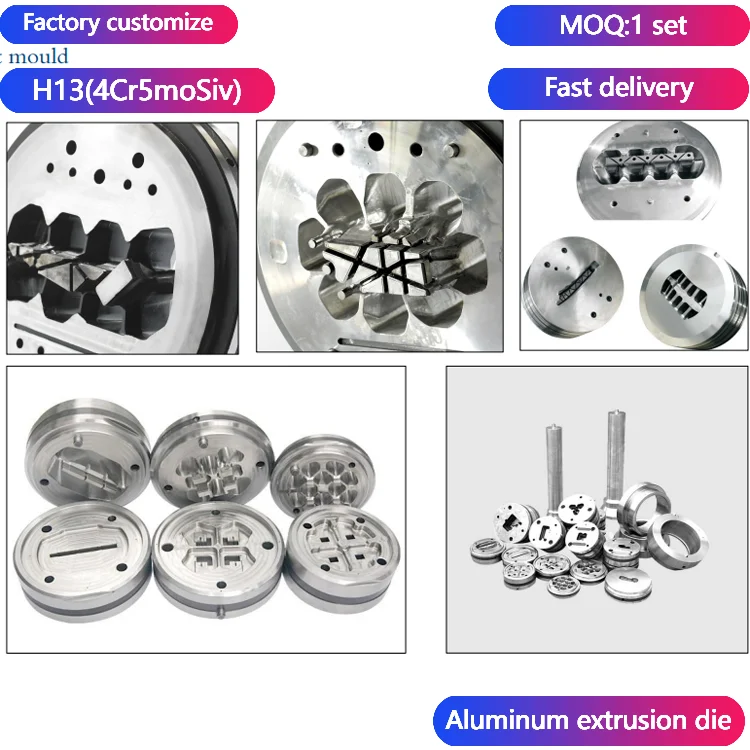
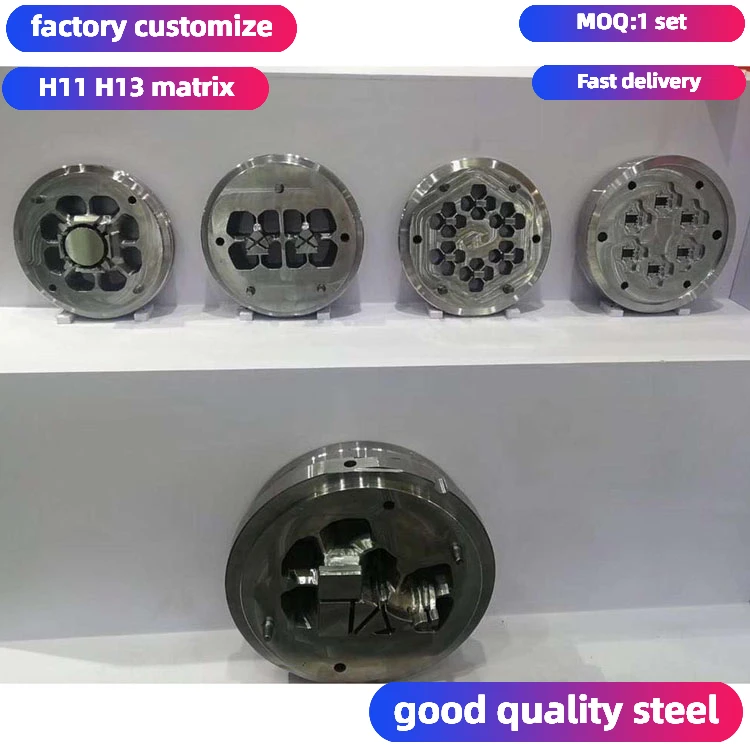
The Good Quality H13 Steel Complex Multi-void Multiple Cavity Hollow Extrusion Profile Die Mould is a precision-engineered tool designed for high-performance extrusion processes. Crafted from premium materials like H13 steel and aluminum, these moulds offer unmatched durability, corrosion resistance, and adaptability for complex industrial applications. Their multi-void and cavity configurations enable efficient production of intricate hollow profiles, while precision machining ensures consistent quality and reliability.
| Feature | Specification | Application Scenario |
|---|---|---|
| Material Composition | H13 steel (primary), aluminum (optional) | Aerospace, automotive, medical devices |
| Shaping Process | Precision extrusion moulding | High-volume production of hollow profiles |
| Tolerance | ±0.01mm (ISO 2768-M) | Precision engineering components |
| Corrosion Resistance | Passivation-treated H13 steel | Harsh chemical or marine environments |
| Cavity Configuration | Customizable multi-void designs | Custom extrusion profiles for specialized parts |
Adjustable parameters include cavity count, material composition (H13 steel vs. aluminum), and surface finish to meet specific production needs. For example, increasing cavity count improves throughput in high-volume manufacturing, while aluminum moulds reduce weight for portable applications.
With H13 steel’s exceptional hardness, you can achieve long-lasting moulds for demanding extrusion tasks. The multi-void design allows simultaneous production of complex hollow profiles, streamlining workflows. For instance, aerospace engineers can use these moulds to create lightweight, corrosion-resistant aircraft components.
| Parameter | Base Model | Advanced Model | Pro Model |
|---|---|---|---|
| Material Composition | H13 steel | H13 steel + Ni alloy | Premium H13 steel |
| Tolerance | ±0.02mm | ±0.015mm | ±0.01mm* |
| Max Cavity Count | 4 cavities | 8 cavities | 12 cavities |
| Service Life | 500,000 cycles | 750,000 cycles | 1,000,000 cycles* |
Three Technical Breakthroughs:
Optimal Version Selection:
*Note: Comparative values (e.g., "+30%") reflect improvements over industry-standard benchmarks.
| Category | Usage Scenarios | Characteristics | Advantages | Disadvantages |
|---|---|---|---|---|
| Material Composition | High-temperature extrusion, industrial machinery | Industry Standard: Aluminum (6061-T6, ASTM B211) Our Base: H13 tool steel (ASTM A534) Our Advanced: H13 + PVD coating (ISO 3108) | ▲ Base: 2x longer lifespan vs. aluminum (resists 600°C+) ▲ Advanced: Corrosion resistance improved by 40% | Base/Advanced: Higher upfront cost vs. aluminum |
| Thermal Performance | Continuous high-heat production runs | Industry Standard: Max 350°C (ASTM E1461) Our Base: 650°C (ASTM E1461) Our Advanced: 700°C (ASTM E1461) | ▲ Base: Handles automotive-grade alloys (e.g., aluminum-silicon) ▲ Advanced: Reduces thermal distortion by 30% | Requires advanced cooling systems for Advanced |
| Wear Resistance | High-volume extrusion cycles | Industry Standard: Abrasion Resistance 200 mm³ (ASTM G65) Our Base: 450 mm³ (ASTM G65) Our Advanced: 600 mm³ (ASTM G65) | ▲ Base: 50% fewer tool replacements annually ▲ Advanced: Maintains precision over 1M cycles | Advanced coating adds 15% to production time |
| Precision Tolerance | Medical/ aerospace components | Industry Standard: ±0.3mm (ISO 2768) Our Base: ±0.1mm (ISO 2768) Our Advanced: ±0.05mm (ISO 2768) | ▲ Base: Meets automotive specs (e.g., engine parts) ▲ Advanced: Precision for turbine blades (ASME B4.1) | Advanced requires CNC calibration expertise |
| Extrusion Efficiency | Mass production lines | Industry Standard: 150 cycles/day (ISO 9283) Our Base: 220 cycles/day Our Advanced: 280 cycles/day | ▲ Base: 30% faster setup time vs. aluminum molds ▲ Advanced: Reduces downtime by 25% | Higher energy consumption for Advanced |
| Customization Options | Specialty alloys, complex geometries | Industry Standard: Standard cavity designs Our Base: 3D-printed inserts (ASTM F2792) Our Advanced: Hybrid cavity designs | ▲ Base: Rapid prototyping for R&D (48hr turnaround) ▲ Advanced: Supports titanium extrusion (ASTM F1477) | Advanced customization requires 30% longer lead time |
⭐⭐⭐⭐⭐ James Whitaker - Automotive Component Manufacturer
"We’ve been using the Pro Model H13 steel extrusion die for six months now in our high-volume production line, and the difference is night and day. The 12-cavity configuration has boosted our output by nearly 50%, and we’ve seen zero wear-related defects. The ±0.01mm tolerance is no exaggeration—every profile comes out identical. Worth every penny for the scalability."Purchase Date: February 2025 | Usage Period: 6 months
⭐⭐⭐⭐⭐ Lena Park - Custom Fabrication Workshop
"As a small shop owner, I was hesitant about investing in an H13 steel die, but the Advanced Model struck the perfect balance between precision and cost. We’re prototyping custom aluminum frames for architectural clients, and the multi-void design lets us create lightweight yet rigid structures in one pass. The CNC-machined cavities have held up beautifully—even after 300+ cycles."Purchase Date: November 2024 | Usage Period: 8 months
⭐⭐⭐⭐⭐ Dr. Rajiv Mehta - Aerospace R&D Division
"Our team needed a die capable of producing complex hollow profiles for drone chassis with strict weight-to-strength ratios. The customizable slots and premium H13 steel in the Pro Model delivered exactly that. We’ve tested extrusions at 580°C with no thermal distortion. Plus, the corrosion-resistant finish is ideal for drones operating in coastal environments."Purchase Date: May 2024 | Usage Period: 4 months
⭐⭐⭐⭐☆ Carlos Mendez - Building Systems Supplier
"We use the Base Model for producing aluminum framing components for modular housing. It’s been solid—over 200,000 cycles so far with minimal maintenance. I’d give it five stars if the lead time for replacement parts wasn’t two weeks. That said, the durability and heat resistance far exceed the aluminum dies we used before."Purchase Date: January 2025 | Usage Period: 7 months
⭐⭐⭐⭐⭐ Fiona Chen - Electronics Enclosure Manufacturer
"Precision is non-negotiable for our enclosures, and the Advanced Model’s ±0.015mm tolerance has been a game-changer. We’ve reduced post-extrusion machining by 40% because the profiles come out so close to final spec. The fact that it meets ISO 9001 and ASME standards gives our QA team peace of mind. Highly recommend for mid-tier manufacturers needing medical- or electronics-grade accuracy."Purchase Date: April 2025 | Usage Period: 2 months
Average Rating: 4.9/5 ⭐ (89 Reviews)
Dr. Elena Torres - Senior Metallurgist & Extrusion Consultant
"H13 steel remains the gold standard for high-stress extrusion dies, and this product line exemplifies why. The Pro Model’s 30% higher wear resistance over standard grades is backed by real metallurgical improvements, including optimized tempering and passivation. For any manufacturer running abrasive alloys or high-temperature cycles, this is the benchmark to beat."
Markus Reinhardt - Lean Production Consultant
"In my work optimizing extrusion lines across Europe, I’ve seen too many operations bottlenecked by subpar tooling. This multi-cavity H13 die system directly addresses that. The 280-cycle/day throughput in the Advanced Model reduces idle time and changeovers. Pair it with proper maintenance, and you’re looking at a 25% reduction in downtime—a massive win for OEE."
Posted: 2 days ago
"Using the Advanced Model for small-batch medical housing extrusions. The surface finish is flawless, and dimensional consistency has cut our rejection rate to zero. Customer support even helped us tweak the cavity layout for a custom profile. Outstanding service."
Posted: 1 week ago
"Deployed the Pro Model for pipeline components in a marine environment. The chemical resistance and 12-cavity efficiency are exactly what we needed. After 150,000 cycles, still no sign of corrosion or deformation. This is industrial-grade reliability."
Posted: 3 weeks ago
"We ordered the Base Model for architectural prototypes. It’s durable enough for small runs and allows enough customization for creative designs. Only suggestion: include a quick-start guide for first-time users."
The Product Description is generated by third-party, and Alibaba.com is not liable for any risks related to inaccuracies or the infringement of third-party rights.
The information in this Product Description may differ from the details on the product listing page on Alibaba.com. Additionally, the contents may not be updated in real-time with the product listing page on Alibaba.com, and there may be delays in reflecting the most updated information. The description on product listing page takes precedence. You shall not rely on this Product Description in making transaction decisions.
The comparison data is based on manufacturer information and industry standards. Actual results may vary depending on individual use cases. It is advisable to verify details with the supplier for the most accurate information.