
The foundation of clear thinking, effective communication, and thorough investigation lies in a simple yet powerful framework: the 5 Ws and H. Who, What, When, Where, Why, and How form the backbone of inquiry across journalism, business, education, law enforcement, and everyday decision-making. By systematically addressing each element, individuals and organizations gain clarity, uncover root causes, and communicate with precision.
This method isn’t just for reporters writing news stories—it’s a universal tool for anyone seeking to understand situations deeply, solve problems efficiently, or convey information accurately. Whether you're analyzing a project failure, planning an event, or responding to a customer complaint, applying the 6 questions ensures nothing critical is overlooked.
What Are the 5 Ws and H?
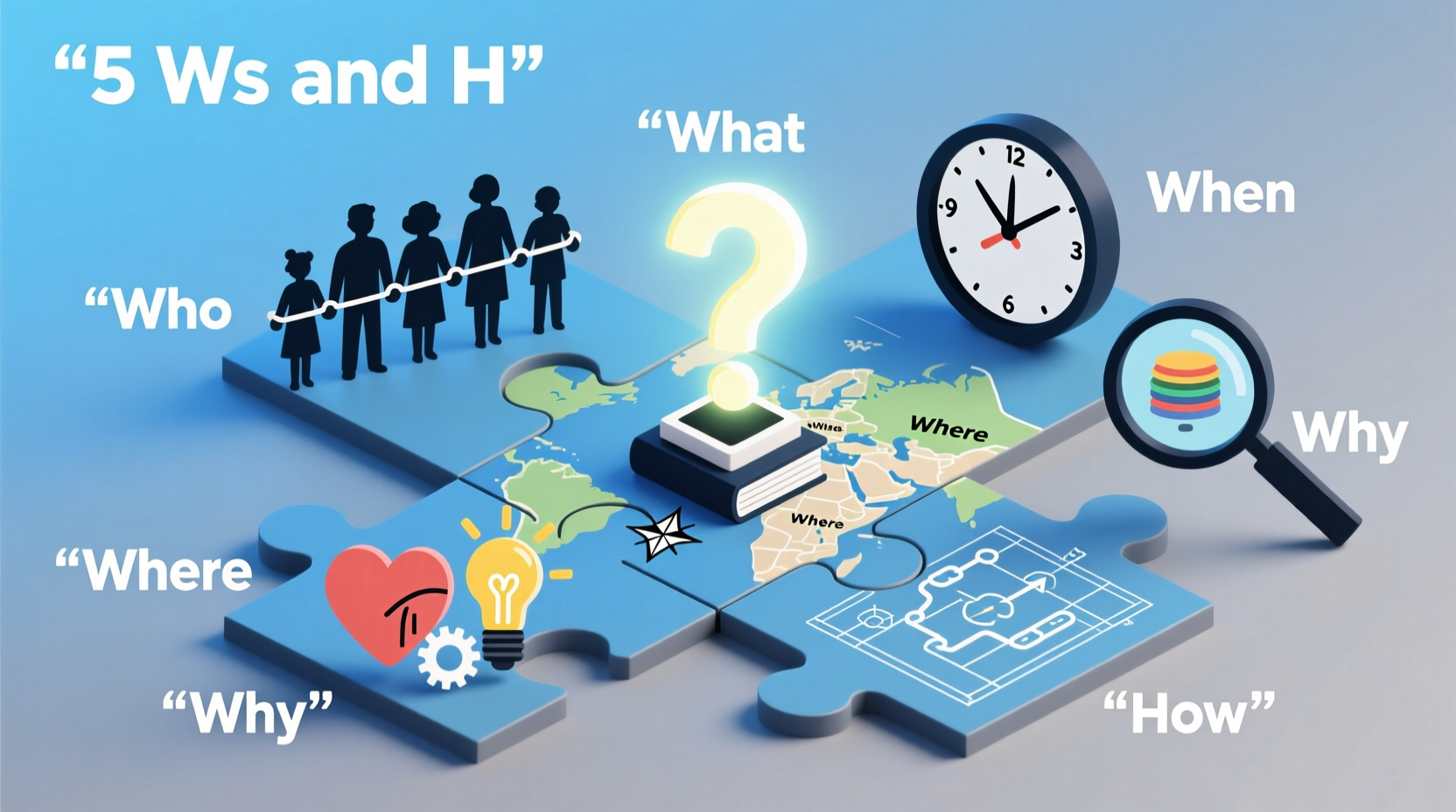
The 5 Ws and H are interrogative prompts used to extract comprehensive information about any subject:
- Who? – Identifies the people involved.
- What? – Describes the event, action, or issue.
- When? – Specifies the time or timeline.
- Where? – Locates the place or environment.
- Why? – Explores the reasons or motivations.
- How? – Explains the method, process, or manner.
Together, these six questions create a complete narrative arc. Omitting even one can leave gaps that lead to confusion, misinterpretation, or incomplete solutions.
Applications Across Industries
The versatility of the 5 Ws and H makes it indispensable in diverse fields. Here's how different sectors apply this framework:
| Industry | Application | Example |
|---|---|---|
| Journalism | Structuring news articles | A reporter uses the 5 Ws to answer who was involved in a protest, what happened, when and where it occurred, why participants gathered, and how events unfolded. |
| Business Management | Root cause analysis | A team investigates a missed deadline: who was responsible, what task failed, when the delay started, where communication broke down, why resources were insufficient, and how processes can be improved. |
| Education | Critical thinking development | Students analyze historical events by identifying who led the movement, what actions were taken, when and where they happened, why change was sought, and how outcomes were achieved. |
| Healthcare | Patient intake and diagnosis | Clinicians ask: who is the patient, what symptoms are present, when did they start, where is the pain located, why might it be occurring, and how has it progressed? |
| Customer Service | Issue resolution | An agent determines who reported the problem, what went wrong with the product, when it occurred, where the order was shipped, why the error happened, and how to fix it. |
Step-by-Step Guide to Applying the 5 Ws and H
To harness the full power of this framework, follow this structured approach:
- Define the subject or event. Start with a clear idea of what you’re investigating—be it an incident, decision, project, or story.
- Ask “What?” first. Clarify the core action or outcome. Example: “What was delivered late?”
- Determine “Who?” is involved. Identify stakeholders, actors, or affected parties. Example: “Who placed the order? Who processed it?”
- Pinpoint “When?” it occurred. Establish timing, frequency, and duration. Example: “When was the expected delivery date?”
- Locate “Where?” the event took place. This could be physical, digital, or organizational. Example: “Where was the item shipped from?”
- Investigate “Why?” it happened. Dig into motivations, causes, or objectives. Example: “Why was there a delay at the warehouse?”
- Explain “How?” it was done or occurred. Describe mechanisms, procedures, or sequences. Example: “How did the tracking system fail to update?”
- Review and validate answers. Ensure consistency and completeness. Fill any gaps with further research.
“Clarity begins with questions. The 5 Ws and H force us to move beyond assumptions and build understanding on evidence.” — Dr. Linda Torres, Cognitive Scientist
Real-World Example: Investigating a Product Recall
Consider a consumer electronics company facing a sudden spike in complaints about overheating devices. Using the 5 Ws and H, the quality assurance team conducts a rapid assessment:
- Who? Affected customers, manufacturing plant workers, distribution staff.
- What? Devices are overheating during normal use.
- When? Reports began three weeks after the latest batch shipped.
- Where? Issues reported globally, but concentrated in units from Factory B in Malaysia.
- Why? Investigation reveals a supplier substituted a cheaper thermal resistor not rated for high loads.
- How? The component passed initial inspection but degraded under sustained use, leading to heat buildup.
By answering each question, the team traces the problem to a procurement decision, initiates a targeted recall, and revises supplier vetting protocols—preventing future incidents.
Common Pitfalls and How to Avoid Them
Despite its simplicity, misapplying the 5 Ws and H can undermine its effectiveness. Watch out for these mistakes:
- Answering superficially. Saying “The system crashed” without exploring why or how limits learning.
- Skipping “Why?” This is often the most revealing question but also the easiest to avoid due to discomfort or time pressure.
- Assuming intent without evidence. Jumping to conclusions about motivation without data leads to blame rather than insight.
- Neglecting “How?” Without understanding process, replication or prevention becomes guesswork.
Checklist: Mastering the 5 Ws and H
Use this checklist to ensure thorough application:
- ✅ Have I clearly identified all key individuals or groups (Who)?
- ✅ Is the event or action fully described (What)?
- ✅ Is the timing precise and relevant (When)?
- ✅ Is the location specified, including digital or organizational context (Where)?
- ✅ Have I explored underlying reasons, not just surface causes (Why)?
- ✅ Is the process or mechanism explained step by step (How)?
- ✅ Are all answers supported by facts or verifiable sources?
- ✅ Can someone unfamiliar with the topic understand the full picture?
Frequently Asked Questions
Why are the 5 Ws and H important in communication?
They ensure messages are complete and reduce ambiguity. Whether writing an email, presenting findings, or briefing a team, covering all six elements prevents misunderstandings and follow-up questions.
Can the 5 Ws and H be used for personal decision-making?
Absolutely. When deciding on a career move, for example: Who will be affected? What am I changing? When will the transition happen? Where will I be working? Why am I making this shift? How will I manage the change? This brings structure to emotional or complex choices.
Is there a correct order to ask the questions?
While “What?” often works best as a starting point, the sequence can vary based on context. In crisis response, “When?” and “Where?” may come first. For strategic planning, “Why?” should lead. Adapt the flow to your needs.
Conclusion: Turn Inquiry Into Insight
The 5 Ws and H are more than a journalistic relic—they are a timeless tool for disciplined thinking. In an age of information overload, the ability to extract meaning, identify root causes, and communicate clearly is invaluable. By making these six questions a habit, you enhance your analytical skills, improve collaboration, and make decisions grounded in understanding rather than assumption.




 浙公网安备
33010002000092号
浙公网安备
33010002000092号 浙B2-20120091-4
Comments
No comments yet. Why don't you start the discussion?