
Understanding how to calculate the surface area of a box is a fundamental skill in geometry, with applications ranging from packaging design and construction to everyday tasks like wrapping gifts or painting a storage container. While the concept may seem abstract at first, breaking it down into manageable steps makes it accessible—even if you haven’t touched math in years. This guide walks you through each stage clearly, using real-world context and practical advice to ensure you not only learn the formula but also understand why it works.
What Is Surface Area?
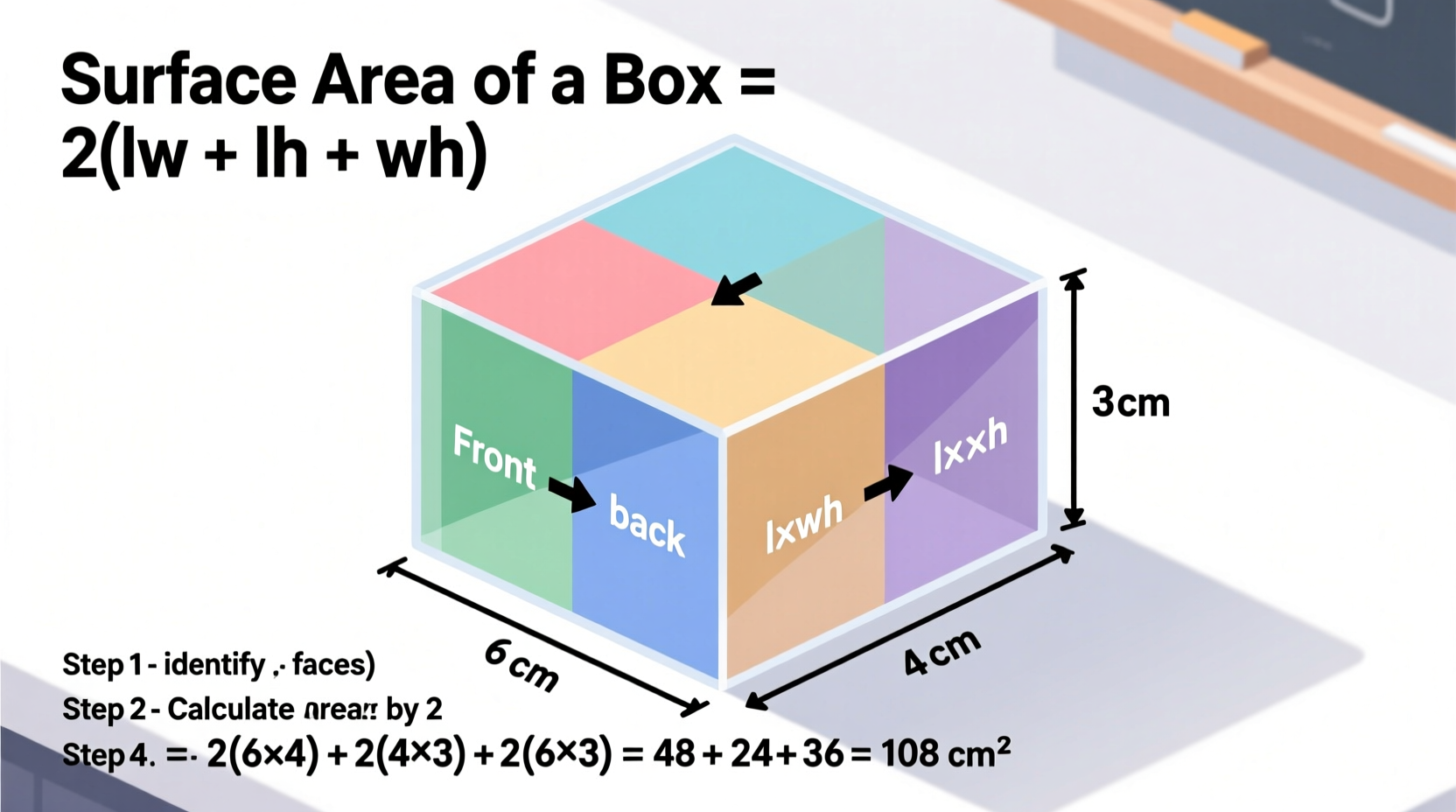
Surface area refers to the total area covered by the outer surfaces of a three-dimensional object. For a box—also known as a rectangular prism—this means adding up the areas of all six faces. Unlike volume, which measures the space inside, surface area focuses solely on the exterior.
A standard box has three pairs of identical opposite faces: top and bottom, front and back, left and right. Each pair contributes equally to the total surface area. By calculating the area of one face from each pair and multiplying accordingly, we arrive at the full measurement.
The Formula Explained
The surface area \\( A \\) of a rectangular box can be calculated using the formula:
\\( A = 2lw + 2lh + 2wh \\)
Where:
- l = length
- w = width
- h = height
This formula accounts for each pair of faces:
- Top and bottom: Each has an area of \\( l \\times w \\), so together they contribute \\( 2lw \\).
- Front and back: Each has an area of \\( l \\times h \\), totaling \\( 2lh \\).
- Sides (left and right): Each has an area of \\( w \\times h \\), summing to \\( 2wh \\).
Adding these components gives the complete surface area.
Why Multiply by Two?
Because every face on a box has a matching counterpart directly opposite it, we multiply each individual face area by two. This eliminates the need to measure each of the six sides separately, streamlining the process significantly.
“Surface area isn't just a classroom exercise—it’s used daily in industries like shipping, manufacturing, and interior design.” — Dr. Alan Reyes, Mathematics Educator and STEM Curriculum Developer
Step-by-Step Calculation Process
Follow this clear sequence to compute the surface area accurately:
- Measure the dimensions: Use a ruler or tape measure to find the length, width, and height of the box. Record them in consistent units.
- Calculate the area of each unique face:
- Multiply length × width (top/bottom)
- Multiply length × height (front/back)
- Multiply width × height (sides)
- Multiply each result by 2: Account for both sides of each face pair.
- Add the three doubled values: The sum is the total surface area.
- Label your answer: Include the correct square units (e.g., cm², in²).
Example Walkthrough
Suppose you have a shipping box measuring 10 inches long, 6 inches wide, and 4 inches high.
- Length (l) = 10 in, Width (w) = 6 in, Height (h) = 4 in
- Compute:
- \\( 2lw = 2 \\times 10 \\times 6 = 120 \\)
- \\( 2lh = 2 \\times 10 \\times 4 = 80 \\)
- \\( 2wh = 2 \\times 6 \\times 4 = 48 \\)
- Add: \\( 120 + 80 + 48 = 248 \\)
- Final Answer: The surface area is 248 square inches.
Practical Applications and Real-World Example
Knowing how to calculate surface area isn’t limited to academic exercises. It plays a role in many real-life decisions.
Mini Case Study: Wrapping a Gift Box
Sarah wanted to wrap a gift she was sending to her sister. The box measured 8 inches long, 5 inches wide, and 3 inches tall. She needed to know how much wrapping paper to cut without wasting excess.
Using the surface area formula:
- \\( 2lw = 2 \\times 8 \\times 5 = 80 \\)
- \\( 2lh = 2 \\times 8 \\times 3 = 48 \\)
- \\( 2wh = 2 \\times 5 \\times 3 = 30 \\)
- Total: \\( 80 + 48 + 30 = 158 \\) in²
Sarah now knew she needed at least 158 square inches of paper. Factoring in overlap and folding, she added about 30 extra square inches, cutting a sheet roughly 14 x 14 inches—efficient and waste-free.
Common Mistakes and How to Avoid Them
Even simple calculations can go wrong if basic errors aren’t caught early. Below is a summary of frequent pitfalls and how to prevent them.
| Mistake | Why It’s Wrong | How to Fix It |
|---|---|---|
| Forgetting to multiply by 2 | Only one face per pair is counted, halving the true area | Double-check that each face pair is accounted for |
| Mixing measurement units | Using inches and feet together skews results | Convert all values to the same unit before calculating |
| Confusing surface area with volume | Using \\( l \\times w \\times h \\) instead of the area formula | Remember: volume is space inside; surface area is outside coverage |
| Skipping labeling | Answers lack context (e.g., “248” vs. “248 in²”) | Always include squared units in your final answer |
Frequently Asked Questions
Can the same method be used for cubes?
Yes. A cube is a special type of box where length, width, and height are equal. If each side is \\( s \\), the surface area becomes \\( 6s^2 \\). This is simply a simplified version of the rectangular prism formula.
Do I need to measure all six sides?
No. Because opposite faces are identical, measuring just three dimensions—length, width, and height—is sufficient. The formula automatically accounts for symmetry.
What if the box has flaps or irregular edges?
If you're calculating for practical purposes like painting or covering, include the flaps as additional rectangles. Measure their dimensions separately and add their areas to the total. For precise engineering work, treat each surface individually.
Checklist: Calculating Surface Area Correctly
Use this checklist whenever you need to determine the surface area of a box:
- ☐ Measure length, width, and height in the same unit
- ☐ Verify that the shape is a rectangular prism (all angles 90°, flat faces)
- ☐ Apply the formula: \\( 2lw + 2lh + 2wh \\)
- ☐ Double-check arithmetic, especially multiplication
- ☐ Add all components carefully
- ☐ Label the final answer with appropriate square units
- ☐ Consider real-world adjustments (e.g., extra material for overlap)
Conclusion: Put Knowledge Into Action
Calculating the surface area of a box is more than a math problem—it's a practical tool for smarter decision-making in crafting, logistics, home improvement, and beyond. Whether you’re determining how much paint to buy, optimizing packaging materials, or helping a child with homework, understanding this straightforward method empowers you with accuracy and confidence.




 浙公网安备
33010002000092号
浙公网安备
33010002000092号 浙B2-20120091-4
Comments
No comments yet. Why don't you start the discussion?