
Composite functions are a cornerstone of algebra and precalculus, yet many students struggle when they encounter expressions like \"g of f\" or (g ∘ f)(x). The notation can be confusing, and the process may seem abstract without proper context. But once you break it down into manageable steps, composing functions becomes not only understandable but intuitive. This guide walks through exactly how to evaluate g(f(x)), explains why order matters, and provides practical strategies for mastering composite functions.
What Are Composite Functions?
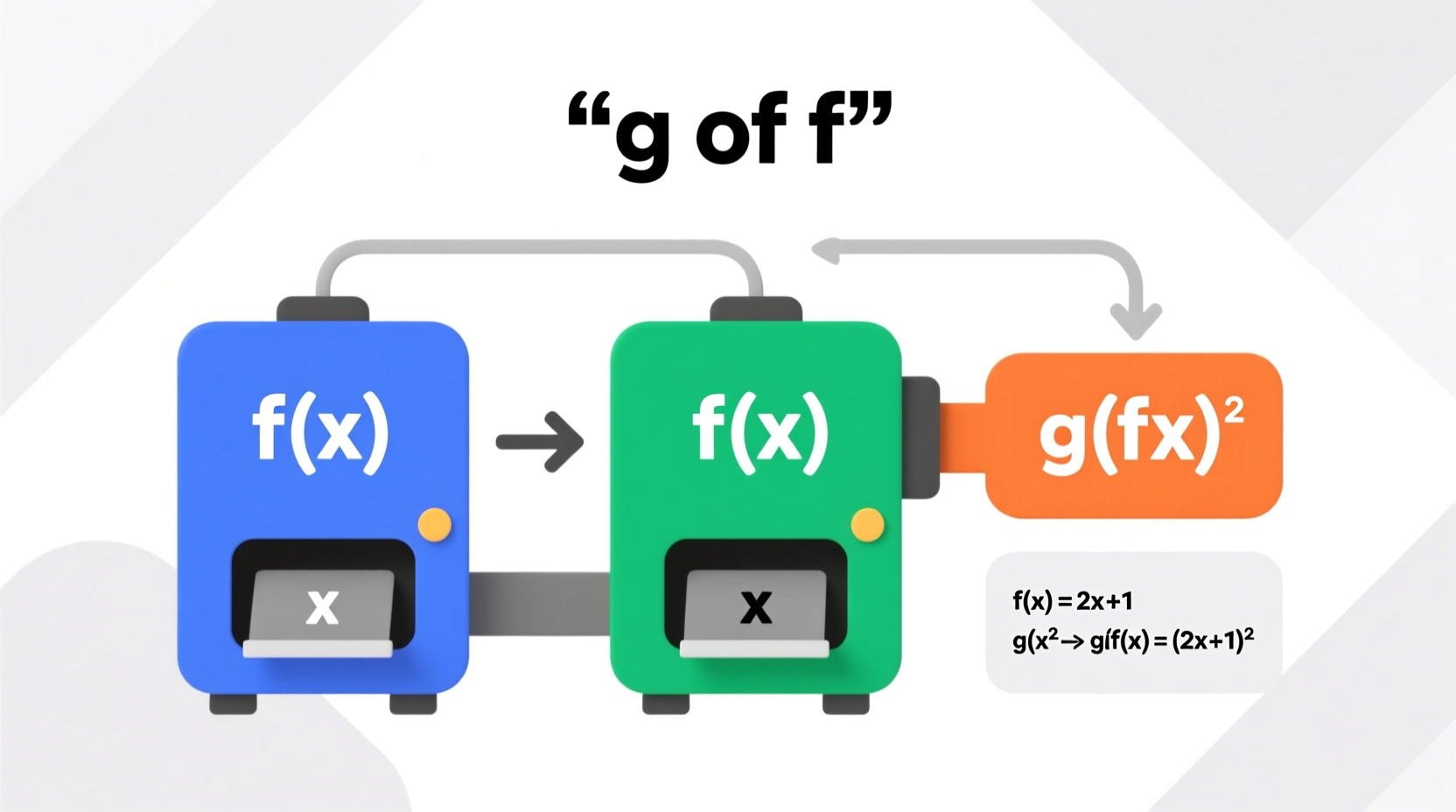
A composite function combines two or more functions so that the output of one becomes the input of another. When we write (g ∘ f)(x), read as \"g composed with f of x,\" it means we apply function f first, then use its result as the input for function g. Mathematically:
(g ∘ f)(x) = g(f(x))
This is not the same as multiplying the functions or applying them simultaneously. The sequence is critical—f acts first, then g. Reversing the order often leads to a completely different result.
“Function composition mirrors real-world processes: you must bake the cake before frosting it. Order defines outcome.” — Dr. Alan Reyes, Mathematics Educator
Step-by-Step Guide to Finding g of f
Evaluating g(f(x)) involves a clear sequence of logical steps. Follow this structured approach to avoid common mistakes.
- Identify both functions: Clearly determine what f(x) and g(x) are from the problem statement.
- Determine the inner function: In g(f(x)), f(x) is inside—it must be evaluated first.
- Substitute f(x) into g(x): Replace every instance of 'x' in g(x) with the entire expression for f(x).
- Simplify the resulting expression: Use algebraic rules to expand, combine like terms, and reduce if possible.
- Check domain restrictions: Ensure that the output of f(x) lies within the domain of g(x).
Example Walkthrough: Finding g(f(x))
Let’s say:
- f(x) = 2x + 3
- g(x) = x² – 1
We want to find (g ∘ f)(x) = g(f(x)).
Step 1: Identify f(x) = 2x + 3 and g(x) = x² – 1.
Step 2: Since f(x) is the inner function, plug it into g wherever there's an 'x':
g(f(x)) = (2x + 3)² – 1
Step 3: Expand and simplify:
= (4x² + 12x + 9) – 1
= 4x² + 12x + 8
So, (g ∘ f)(x) = 4x² + 12x + 8.
Note: If we reversed the order—f(g(x))—we’d get a different result:
- f(g(x)) = f(x² – 1) = 2(x² – 1) + 3 = 2x² + 1
Clearly, g(f(x)) ≠ f(g(x)). Function composition is not commutative.
Common Pitfalls and How to Avoid Them
Many learners make predictable errors when working with composite functions. Recognizing these early helps build confidence and accuracy.
| Pitfall | Description | How to Prevent |
|---|---|---|
| Ignoring order | Treating g(f(x)) the same as f(g(x)) | Always identify which function is inner and outer |
| Misplaced substitution | Plugging f(x) into only part of g(x), e.g., squaring just x instead of the full expression | Use parentheses rigorously during substitution |
| Domain neglect | Not checking whether f(x) produces values acceptable to g | Analyze domains: e.g., if g(x) = √x, f(x) must produce non-negative outputs |
| Overcomplicating simplification | Failing to expand or combine terms correctly | Apply standard algebraic identities methodically |
Real-World Application: A Mini Case Study
Consider a small business owner calculating final product pricing. They first apply a cost markup using function f(x) = 1.5x (where x is base cost), then add shipping via g(x) = x + 10.
To automate total price calculation, they define the composite function g(f(x)):
- f(x) = 1.5x → increases item cost by 50%
- g(x) = x + 10 → adds $10 shipping
Then:
g(f(x)) = g(1.5x) = 1.5x + 10
For an item costing $20:
- Marked-up cost: 1.5 × 20 = $30
- Total with shipping: 30 + 10 = $40
The composite function streamlines pricing: input any base cost, and get the final customer price instantly. This demonstrates how function composition models sequential transformations in real systems.
Essential Tips for Mastering Composite Functions
- Practice with diverse function types: linear, quadratic, rational, absolute value, and radical.
- When evaluating numerically (e.g., g(f(2))), compute f(2) first, then plug into g.
- If given graphs instead of equations, trace the output of f at x, then use that value as input on the graph of g.
- Use color-coding or brackets to distinguish layers during substitution.
Checklist: Evaluating g(f(x)) Successfully
- ☑ Write down both f(x) and g(x) clearly.
- ☑ Confirm that f is the inner function in g(f(x)).
- ☑ Substitute the entire expression of f(x) into every 'x' in g(x).
- ☑ Simplify using algebra carefully—watch signs and exponents.
- ☑ Verify that the domain of f does not produce invalid inputs for g (e.g., negative under square root).
- ☑ Test your result with a numerical value to check correctness.
Frequently Asked Questions
Can g(f(x)) ever equal f(g(x))?
Yes, but only in special cases. For example, if f(x) = x + 5 and g(x) = x – 5, then both compositions yield x. However, this symmetry is rare. Most functions do not commute under composition.
What happens if f(x) outputs a value outside g’s domain?
The composition is undefined for that input. For instance, if f(x) = -x² – 1 (always negative) and g(x) = √x, then g(f(x)) has no real value because you can’t take the square root of a negative number in the real system.
Do I always need to simplify g(f(x))?
It depends on context. In homework or exams, simplification is usually required unless instructed otherwise. In applied settings, a simplified form makes computation faster and interpretation clearer.
Final Thoughts and Next Steps
Understanding how to find g of f opens doors to advanced topics in mathematics, including calculus, transformations, and modeling complex systems. It teaches precision in logic and attention to detail—skills valuable far beyond math class.
You now have a reliable framework: identify, substitute, simplify, verify. With consistent practice across various function types, composition will shift from daunting to second nature.




 浙公网安备
33010002000092号
浙公网安备
33010002000092号 浙B2-20120091-4
Comments
No comments yet. Why don't you start the discussion?