
In an age where every meeting, lecture, and brainstorming session seems to unfold on a tablet or laptop, the humble A5 notebook persists. Its quiet presence in backpacks, coat pockets, and bedside tables defies the assumption that digital tools have rendered paper obsolete. But with apps like Notion, Evernote, and Apple Notes offering seamless syncing, searchability, and multimedia integration, one question lingers: are tablets truly killing paper, or is the resurgence of analog note-taking just a nostalgic fad?
The answer isn’t binary. For some, digital is indispensable—efficient, scalable, and collaborative. For others, the tactile rhythm of pen on paper fosters clarity, retention, and creativity. The real debate isn't about superiority but alignment: what works best for your mind, your workflow, and your goals.
The Cognitive Edge of Paper: Why Analog Still Matters
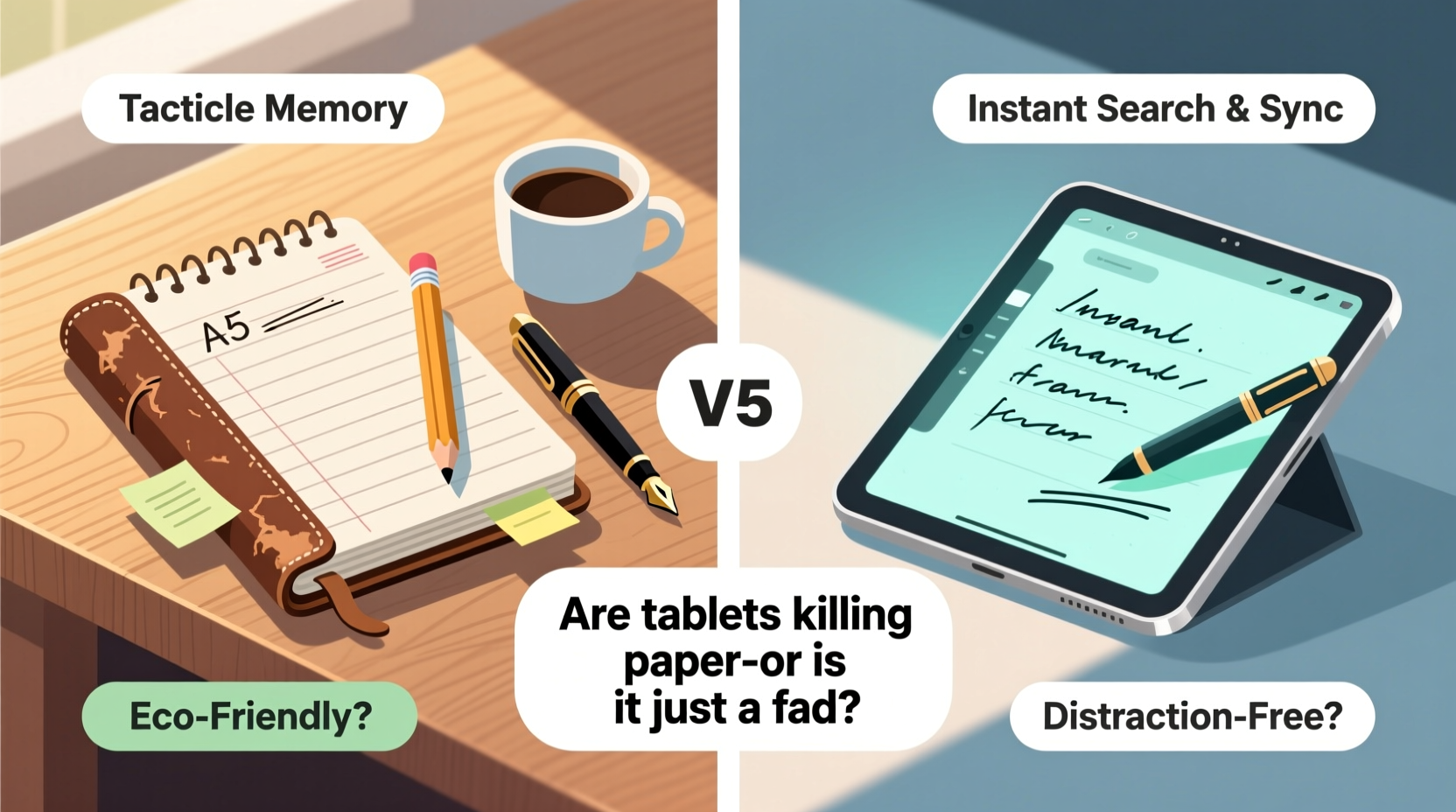
Decades of cognitive science suggest that writing by hand engages the brain differently than typing. In a 2014 study published in Psychological Science, researchers found that students who took notes longhand performed better on conceptual questions than those who typed their notes verbatim on laptops. The act of handwriting forces summarization and processing, not just transcription.
“Writing by hand slows us down in a way that benefits learning. It creates a deeper cognitive trace.” — Dr. Pam Mueller, Princeton University Cognitive Psychologist
This “slowness” is not a flaw—it’s a feature. An A5 notebook doesn’t allow copy-paste, Ctrl+Z, or infinite scrolling. It demands intention. Each page is finite; each word carries weight. That constraint fosters focus, especially in environments rife with digital distractions.
Digital Dominance: Speed, Search, and Scalability
Tablets and digital note apps excel where paper cannot: organization at scale, instant retrieval, and multimodal input. Imagine searching for a specific quote from a two-hour meeting across 30 notebooks versus typing a keyword into an app and finding it in seconds. Digital platforms integrate voice memos, sketches, web clippings, and even AI-powered summaries—all within a single document.
For professionals managing complex projects, frequent collaboration, or vast information archives, digital tools offer unmatched efficiency. Cloud sync ensures you never lose your work. Version history tracks changes. Sharing is one tap away.
Yet, this convenience comes with trade-offs. Notifications, app switching, and the temptation to multitask erode deep work. A tablet can become a portal to distraction, not just a tool for creation.
A5 Notebook vs Digital: A Practical Comparison
| Feature | A5 Notebook | Digital Tablet |
|---|---|---|
| Portability | Lightweight, no charging needed | Bulky with accessories, requires charging |
| Note-Taking Speed | Slower, promotes processing | Faster, risks verbatim transcription |
| Searchability | None (unless indexed manually) | Instant keyword search |
| Durability | Paper tears, ink bleeds | Screen cracks, software fails |
| Distraction Level | Near zero | High (notifications, apps) |
| Cost Over Time | Low (refills cost pennies) | High (device + apps + accessories) |
| Eco Impact | Biodegradable but resource-intensive | High e-waste, energy use |
Hybrid Workflows: The Best of Both Worlds
Increasingly, the most effective systems aren’t either/or—they’re both. Many knowledge workers now adopt a hybrid model: using an A5 notebook for initial thinking, journaling, or meeting notes, then digitizing key pages via scanning apps like Adobe Scan or Microsoft Lens. This preserves the cognitive benefits of handwriting while gaining digital advantages in archiving and retrieval.
Some even use smart pens like the Livescribe or Moleskine Pen+ that record handwritten notes digitally in real time, syncing them to cloud services. While these tools bridge the gap, they often come with complexity and cost that may outweigh their benefits for casual users.
Mini Case Study: Sarah, the Strategy Consultant
Sarah leads client workshops across Europe. She used to take notes on her iPad, but noticed she was less present—tapping, swiping, and occasionally checking emails mid-conversation. After switching to an A5 dotted notebook, she found her listening improved dramatically. Post-meeting, she spends 10 minutes transferring key insights to Notion, tagging clients and action items. The dual process reinforces memory and ensures nothing slips through the cracks. “I’m more engaged in the room,” she says, “and my digital records are cleaner because I’ve already filtered the noise.”
When Paper Wins—and When It Doesn’t
Paper shines in contexts requiring focus, creativity, and emotional expression. Journaling, sketching, planning, and learning benefit from the sensory feedback of handwriting. The absence of a delete button encourages authenticity—what you write stays, flaws and all.
Digital dominates when collaboration, revision, or data-heavy tasks are involved. Writing a report with team feedback, managing a product backlog, or tracking expenses across months is impractical on paper alone.
- Choose paper if: You value mindfulness, need to minimize distractions, or are capturing ideas in early stages.
- Choose digital if: You require fast editing, frequent sharing, or integration with other tools (calendars, task managers, etc).
Actionable Checklist: Building Your Ideal Note-Taking System
- Assess your primary use cases (e.g., meetings, journaling, project planning).
- Identify pain points in your current method (e.g., lost notes, poor search, distractions).
- Test one analog tool (like an A5 notebook) for a week in low-stakes settings.
- Test one digital tool (like Apple Notes or OneNote) for a high-collaboration task.
- Compare retention, ease of access, and mental fatigue after each.
- Combine both: use paper for capture, digital for storage and sharing.
- Review monthly—adjust based on what’s actually working.
FAQ: Common Questions About Analog vs Digital Notes
Can digital notes ever replicate the brain benefits of handwriting?
Not fully. While stylus input on tablets mimics pen-on-paper motion, studies show that the physical resistance and slower pace of real paper enhance memory encoding. Digital handwriting also lacks the permanence and spatial context of a physical page.
Are A5 notebooks outdated for professionals?
No. Many executives, designers, and academics still rely on them for strategic thinking. The size is portable yet spacious enough for diagrams and lists. Their “outdated” status is more myth than reality—especially as mindfulness and attention become professional assets.
Is going fully digital more sustainable?
Not necessarily. Tablets require rare earth minerals, significant energy to produce, and contribute to e-waste. Paper, when sourced responsibly, is biodegradable and recyclable. Sustainability depends on usage patterns: a single notebook used for years has far less impact than a tablet replaced every three.
Conclusion: Tools Don’t Think—You Do
The narrative that tablets are “killing” paper oversimplifies a nuanced reality. Technology evolves, but human cognition does not. We still learn best by engaging deeply, remembering through effort, and creating in focused bursts. Paper supports that. So can digital—if used deliberately.
The A5 notebook isn’t a relic. It’s a tool of intentionality. And tablets aren’t inevitable replacements—they’re accelerants, best used when direction is already clear. The future of note-taking isn’t analog or digital. It’s mindful. It’s choosing the right medium for the moment, the task, and the mind behind the pen—or the stylus.




 浙公网安备
33010002000092号
浙公网安备
33010002000092号 浙B2-20120091-4
Comments
No comments yet. Why don't you start the discussion?