
In an increasingly noisy world—whether from city traffic, office chatter, or airplane engines—people are turning to headphones for relief. But not all sound-blocking methods are created equal. Two dominant technologies exist: active noise cancelling (ANC) and passive sound isolation. While both aim to reduce unwanted noise, they operate on fundamentally different principles. One relies on advanced electronics and microphones; the other depends purely on physical design. So, do you actually need electronics to block sound effectively? The answer isn’t as straightforward as it seems.
Understanding the strengths and limitations of each approach can help you make smarter choices when purchasing headphones, earbuds, or even designing quiet spaces. Whether you're a frequent traveler, a remote worker, or someone who simply values peace, knowing the difference between ANC and passive isolation is essential.
How Passive Sound Isolation Works
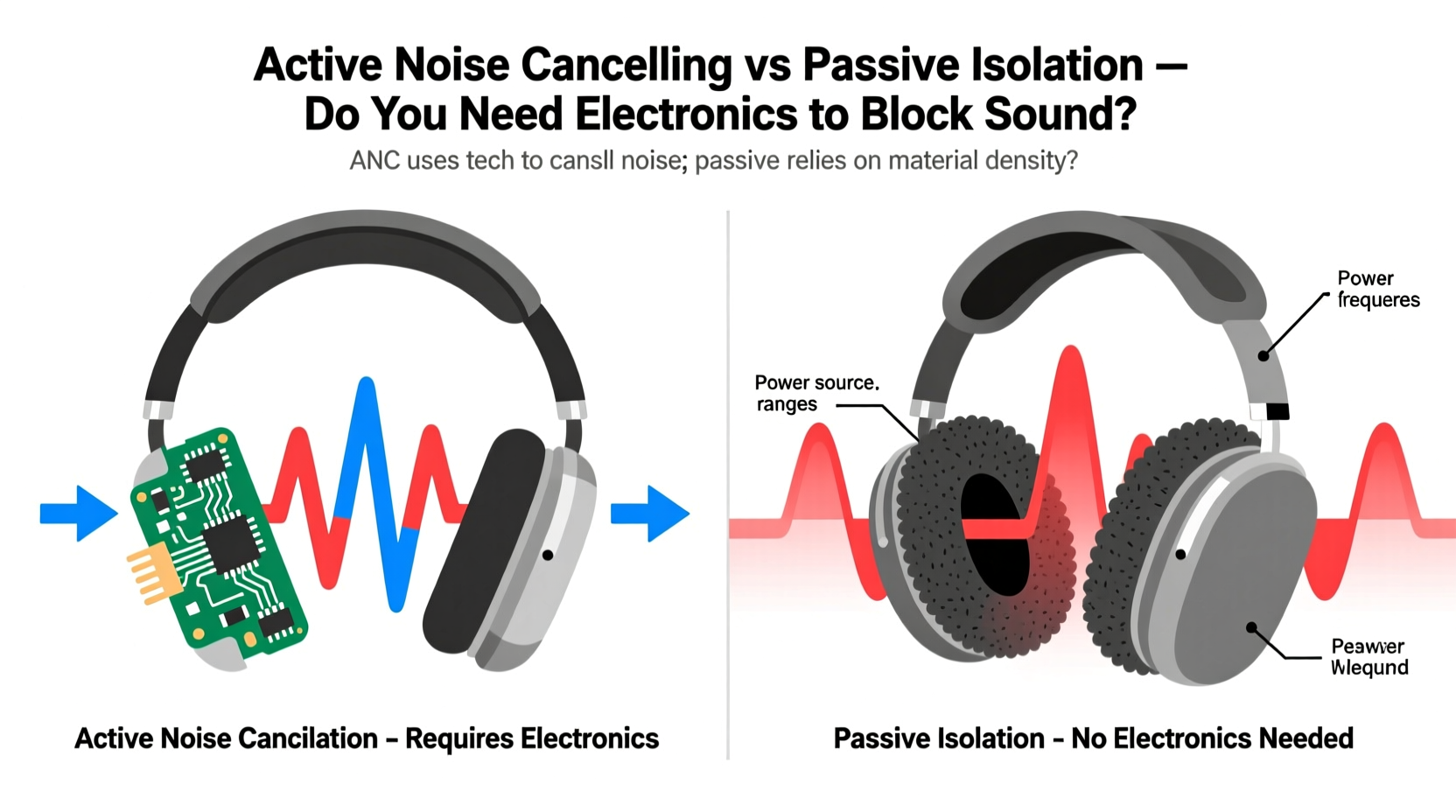
Passive sound isolation, sometimes called passive noise reduction, relies entirely on physical barriers to block external sound. This method doesn’t use any electronic components. Instead, it depends on materials, fit, and design to create a seal between your ears and the outside environment.
Think of it like closing a window to keep out street noise. In-ear monitors (IEMs), over-ear headphones with thick padding, and well-fitted earbuds all use this principle. The denser the material and the tighter the seal, the more sound energy is reflected or absorbed before reaching your eardrums.
This type of noise reduction is especially effective against high-frequency sounds—like voices, keyboard clicks, or birds chirping—because these waves have shorter wavelengths that are easier to block physically. However, low-frequency rumbles such as engine hums or HVAC systems are harder to stop passively because they vibrate through materials more easily.
The Science Behind Active Noise Cancelling
Active noise cancelling takes a more sophisticated approach. It uses built-in microphones to detect ambient sounds, then generates “anti-noise” signals—sound waves that are the exact inverse of incoming noise. When these opposing waves meet, they cancel each other out through a phenomenon known as destructive interference.
This process happens in real time and requires power, digital signal processing (DSP) chips, and battery-operated circuitry. Because ANC actively responds to environmental noise, it excels at reducing consistent, low-frequency sounds like airplane engines, train rumble, or air conditioning units.
However, ANC struggles with sudden or irregular noises—such as a door slamming or someone calling your name—because there’s a slight delay in processing. Additionally, the quality of ANC varies widely between devices. Premium models use multiple microphones and adaptive algorithms to adjust to changing environments, while budget options may offer only basic cancellation with noticeable hiss or pressure-like sensations in the ears.
“Active noise cancelling isn’t magic—it’s physics combined with precision engineering. The best systems adapt dynamically, but they still depend heavily on a good passive seal.” — Dr. Lena Patel, Acoustic Engineer at AudioSonic Labs
Comparing Effectiveness: ANC vs Passive Isolation
To understand which method performs better under different conditions, consider the following comparison:
| Feature | Active Noise Cancelling (ANC) | Passive Isolation |
|---|---|---|
| Mechanism | Electronics generate anti-noise via microphones and DSP | Physical barrier blocks sound (foam, seals, fit) |
| Best Against | Low-frequency, continuous noise (e.g., engines, fans) | High-frequency, intermittent noise (e.g., voices, typing) |
| Power Required? | Yes – needs battery and electronics | No – works without power |
| Affected by Fit? | Yes – poor seal reduces effectiveness | Critical – performance hinges on fit |
| Cost | Higher due to tech complexity | Generally lower |
| Sounds Natural? | Can create “pressure” feeling; some audio coloration | More natural listening experience |
The table shows that neither method is universally superior. Instead, they complement each other. High-end noise-cancelling headphones often combine both: excellent passive sealing as a foundation, enhanced by active cancellation for deeper noise suppression.
Real-World Example: The Airplane Traveler’s Dilemma
Consider Sarah, a business consultant who flies weekly between New York and London. On her last flight, she used two different pairs of headphones: one with top-tier ANC and another with high-quality passive isolation but no electronics.
With the ANC headphones, the constant drone of the jet engines faded into near silence. She could listen to her podcast at 40% volume without straining. However, when a baby cried three rows back, she still heard it clearly—sudden mid-to-high frequency sounds weren’t fully canceled.
Switching to her passive-only in-ears, she noticed the cabin noise was louder overall, especially the engine hum. But once she found the right ear tip size and achieved a secure fit, speech and nearby conversations were significantly muffled. The lack of electronic processing also meant the music sounded more balanced and natural.
Sarah concluded that for long-haul flights, ANC provided unmatched comfort by eliminating fatigue from constant low-end noise. But for short commutes or gym sessions, her passive isolating earbuds were lighter, more reliable, and didn’t require charging.
Do You Need Electronics to Block Sound?
The short answer: not always. If your primary concern is blocking voices, typing, or urban chatter, a well-designed pair of passive isolating earphones might be all you need. Many audiophiles and musicians actually prefer passive isolation for its fidelity and zero latency.
However, if you frequently encounter steady low-frequency noise—like commuting on subways, working near machinery, or flying—then active noise cancelling provides tangible benefits that passive methods alone can't match. The electronics aren’t just a gimmick; they address a specific acoustic challenge that physical barriers struggle with.
That said, relying solely on ANC without good passive sealing severely limits performance. Even the most advanced algorithm can’t compensate for a loose fit. Think of passive isolation as the foundation and ANC as the enhancement layer. Together, they deliver the quietest possible experience.
Step-by-Step Guide to Choosing the Right Solution
Follow this practical sequence to determine whether you need ANC, passive isolation, or both:
- Identify your main noise sources: Are they constant (e.g., engines) or intermittent (e.g., conversations)? Use a notebook or voice memo app to log common distractions over a week.
- Assess your usage environment: Frequent travel favors ANC. Office or home use may benefit more from passive options.
- Determine your budget: ANC adds cost and complexity. If you’re price-sensitive, prioritize passive models with proven isolation ratings.
- Try before you buy: Visit a store to test fit and comfort. Pay attention to how much outside sound disappears when music is off.
- Check battery and maintenance needs: ANC requires regular charging. If you dislike managing batteries, passive options are simpler and more durable.
- Read expert reviews: Look for measurements of attenuation across frequencies, not just marketing claims.
Checklist: What to Look for in Noise-Blocking Headphones
- ✅ Secure, comfortable fit for extended wear
- ✅ Replaceable or multiple sizes of ear tips (for in-ears)
- ✅ Measured noise attenuation data (especially in 100–1000 Hz range)
- ✅ Transparent sound profile—no excessive bass boost masking poor cancellation
- ✅ Long battery life if using ANC (ideally 20+ hours)
- ✅ Option to use in passive mode when battery dies
- ✅ Lightweight design for daily carry
Frequently Asked Questions
Can passive isolation block airplane noise effectively?
Partially. Passive isolation can reduce higher-pitched cabin sounds like announcements or crying babies, but it struggles with the deep 80–200 Hz engine rumble typical of flights. For full relief, ANC is far more effective against this frequency range.
Does active noise cancelling affect audio quality?
Sometimes. Lower-tier ANC systems can introduce a faint hiss or alter the sound signature, particularly in the midrange. Higher-end models minimize this with better calibration. Some allow you to toggle ANC on/off to compare clarity directly.
Are there health risks associated with ANC?
No direct evidence suggests ANC harms hearing. However, some users report a sensation of “ear pressure,” similar to ascending in an elevator. This usually subsides with use. If discomfort persists, switching to passive isolation or taking breaks is advisable.
Final Thoughts: Balancing Technology and Simplicity
The debate between active noise cancelling and passive isolation ultimately comes down to personal needs and context. Electronics aren’t strictly necessary to block sound—but they expand your capabilities in environments dominated by low-frequency noise. Passive isolation remains a powerful, reliable, and often underrated solution that works without batteries, updates, or malfunctions.
The smartest choice isn’t picking one over the other, but understanding how they work together. Many leading headphones now blend both approaches seamlessly, offering layered protection against a wide spectrum of noise. By prioritizing fit, material quality, and real-world performance over specs alone, you can find a solution that delivers peace—whether powered or not.




 浙公网安备
33010002000092号
浙公网安备
33010002000092号 浙B2-20120091-4
Comments
No comments yet. Why don't you start the discussion?