
Fairy lights possess an undeniable magic: soft glow, gentle warmth, subtle shimmer. But too often, that magic curdles into visual chaos—a tangle of wires, uneven spacing, harsh brightness, or over-the-top festivity that undermines the bedroom’s essential purpose: rest, retreat, and quiet intention. The “party tent” effect isn’t born from bad taste—it’s usually the result of good intentions applied without spatial awareness, lighting hierarchy, or material sensitivity. This isn’t about banning fairy lights. It’s about treating them as intentional design elements—not decorative afterthoughts.
Interior designers don’t avoid fairy lights in serene bedrooms; they deploy them with surgical precision. They understand that light is architecture’s most malleable material—and that ambient layering, not saturation, creates atmosphere. What follows is a field-tested methodology grounded in residential lighting principles, real-room constraints, and aesthetic discipline. No glitter bombs. No ceiling-draped constellations. Just calm, considered, deeply livable illumination.
1. Start with Intent, Not Inventory
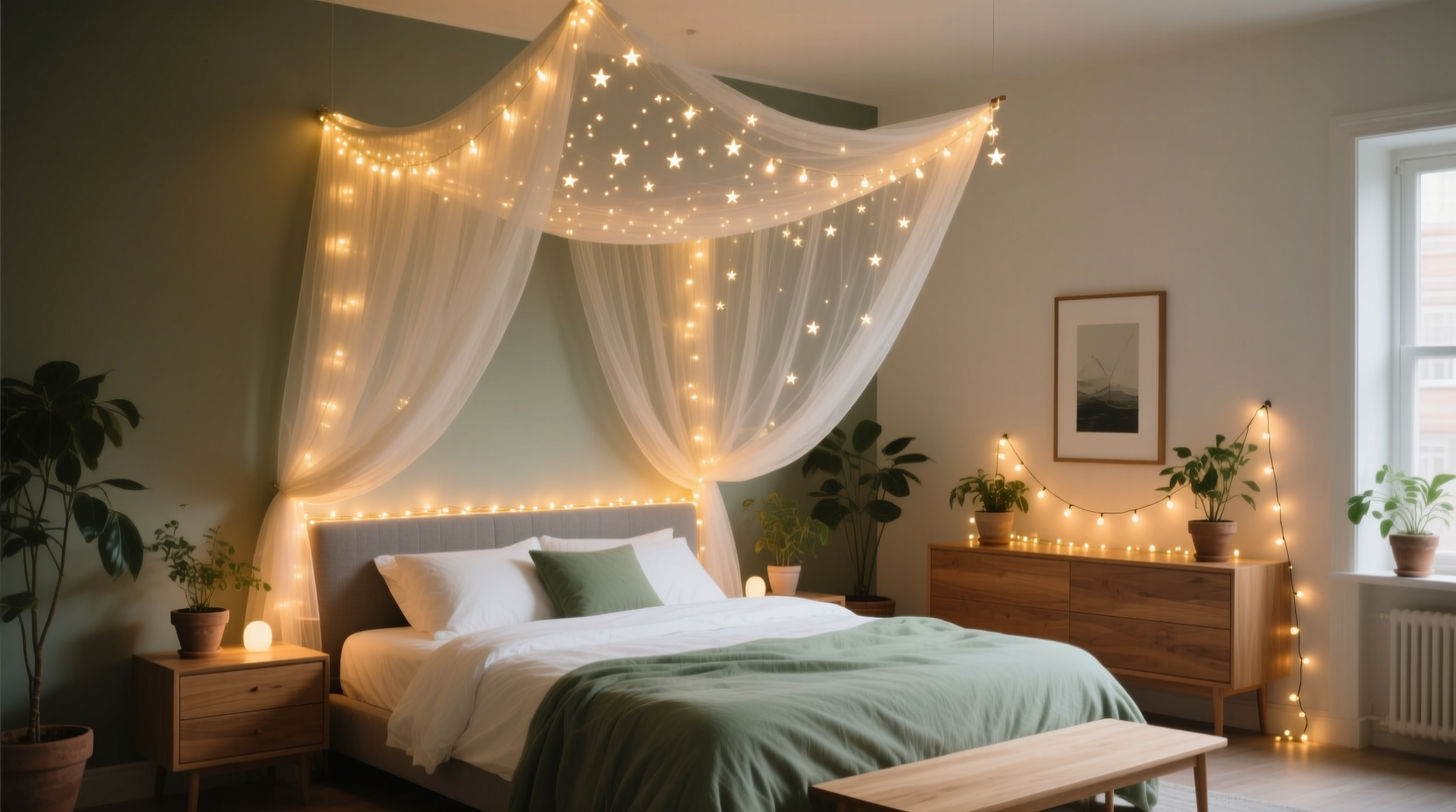
Before you unbox a single string, ask: *What role should light play here?* A bedroom needs three functional layers: task (reading), ambient (general orientation), and accent (mood or feature emphasis). Fairy lights almost never serve as task lighting—and rarely as primary ambient. Their strength lies in accent and secondary ambient roles: softening edges, highlighting texture, or creating a gentle transition between wakefulness and sleep.
That means rejecting the “more is more” instinct. One thoughtfully placed string does more than five haphazard ones. If your goal is relaxation, skip warm-white strings brighter than 2700K or with a CRI below 90—they’ll feel clinical or washed-out. If you seek intimacy, avoid blinking modes, chasing effects, or RGB colors that shift unpredictably. Consistency in tone, tempo, and temperature is non-negotiable.
2. Master the Art of Strategic Placement
Placement determines whether fairy lights feel integrated or imposed. Avoid these common missteps: wrapping bed frames (creates visual noise at eye level), draping across ceilings (triggers “tent” reflex), or clustering around mirrors (intensifies glare and fragmentation). Instead, anchor lights to architectural or furnishing features that already define the room’s rhythm.
Here’s where they earn their keep:
- Behind headboards: Tuck battery-operated micro-LED strips or fine-gauge warm-white fairy lights behind a fabric-upholstered or wooden headboard. The light diffuses softly upward, casting a halo on the wall without exposing bulbs. Works best with 2–3 inches of clearance and matte wall finishes.
- Along baseboards or skirting: Run low-profile string lights just above floor level, tucked beneath furniture legs or behind a low-profile bench. Creates a grounding, horizon-line glow—especially effective in rooms with dark floors or deep rugs.
- In floating shelves: Mount small LED pucks or flexible strip lights *under* the front lip of open shelving. Illuminates objects gently while keeping the light source invisible. Ideal for displaying ceramics, books with textured spines, or dried botanicals.
- Inside glass cloches or apothecary jars: Coil a short string (1–2 meters) inside a large glass dome or vintage-style jar. Place on a nightstand or dresser. The glass diffuses and contains the light, transforming it into a sculptural, self-contained object—not a scattered installation.
Crucially: every placement must pass the “unplugged test.” If you remove the lights, does the space still function and feel coherent? If yes, you’ve succeeded. If the area feels hollow or visually abandoned, the lights were compensating—not enhancing.
3. Wiring, Power, and the Invisible Infrastructure
The “party tent” look often stems less from bulb choice and more from visible infrastructure: dangling cords, exposed batteries, mismatched plugs, or tangled adapters. In a bedroom, infrastructure must recede. Period.
Choose power sources deliberately:
| Type | Best For | Key Consideration |
|---|---|---|
| Battery-operated (with timer) | Headboard backing, shelf undersides, cloche displays | Batteries last 100+ hours on timer mode; replace annually—even if unused—to prevent leakage.|
| USB-powered (with wall adapter) | Desk-side accents, built-in shelf lighting, bedside tables | Use flat, braided USB cables in charcoal or black; route along furniture backs and under drawers using adhesive cable clips.|
| Hardwired (via licensed electrician) | Permanent shelf lighting, recessed canopy accents, custom headboard integration | Only pursue if rewiring aligns with renovation plans; never DIY mains voltage.
Never run cords across walkways, drape them over lampshades, or tape them to painted walls. Instead, use cord covers that match your baseboard color, or route cables through existing furniture grommets. If your nightstand has a rear access hole, feed the cord through it and secure it with a small Velcro strap inside the drawer.
4. Color, Temperature, and Dimming: The Quiet Triad
Color isn’t just hue—it’s psychological weight. Cool white (5000K+) reads as alert, sterile, or institutional. Pure yellow (2200K) can feel dated or sickly. The sweet spot for bedrooms is 2700K–3000K: warm enough to signal safety and rest, but clean enough to avoid murkiness. Look for bulbs labeled “warm white” or “soft white”—and verify the Kelvin rating on packaging, not marketing copy.
Dimming isn’t optional—it’s foundational. Non-dimmable fairy lights force binary choices: on (too bright) or off (no ambiance). Opt for models with built-in dimmers (rotary dials or touch-sensitive pads) or pair them with external smart dimmers compatible with your home system. Set default brightness to 30–40%—bright enough to register as presence, too soft to disrupt melatonin production.
As for color variety: monochrome reigns. White-only strings (warm or neutral) integrate seamlessly with all palettes. If using colored lights, restrict yourself to one tone—e.g., amber for earthy schemes, muted sage for organic modern, or soft blush for muted feminine spaces—and ensure bulbs are frosted, not clear. Clear bulbs expose filaments and create distracting hotspots.
“Lighting should whisper, not announce. In bedrooms, the most successful fairy light installations are the ones guests notice only when they’re *not* there—because the absence feels like a loss of warmth.” — Lena Torres, Lighting Designer & Author of *Ambient Intelligence in Residential Spaces*
5. Real-World Integration: A Case Study
Consider Maya, a graphic designer living in a 320-square-foot downtown studio with 8-foot ceilings, white shiplap walls, and a platform bed with a low-profile walnut headboard. Her initial attempt involved draping 3-meter copper-wire fairy lights across her ceiling beams—resulting in a jarring, carnival-like grid that competed with her carefully curated artwork and made the space feel smaller and louder.
She revised her approach in phases:
- Week 1: Removed all ceiling lights. Installed a 2.5-meter warm-white micro-LED strip (2700K, dimmable) behind the headboard, secured with double-sided tape and hidden by the upholstered panel’s slight overhang.
- Week 2: Added two 1-meter battery-operated strings with frosted bulbs inside matching glass apothecary jars on her oak nightstands—positioned so light spilled softly onto the rug, not the bed.
- Week 3: Replaced a harsh LED reading lamp with a swing-arm fixture and added a 0.8-meter USB-powered strip under her floating oak shelf, illuminating a row of ceramic vases.
Result? No visible wires. No blinking. No glare. The room retained its minimalist clarity—but gained perceptible depth, warmth, and a tactile sense of invitation. Guests consistently remarked on how “calm” the space felt—not how many lights were present.
6. The Essential Bedroom Fairy Light Checklist
Before installing, verify each item:
- ☑️ Bulbs are warm-white (2700K–3000K) and frosted—not clear or cool-white.
- ☑️ String length matches the intended zone (e.g., 1.5m for a nightstand jar; 2.5m for a standard headboard).
- ☑️ Power source is concealed: batteries stashed in drawer compartments, USB cords routed behind furniture, no dangling adapters.
- ☑️ Lights are mounted *behind*, *under*, or *within* existing elements—not draped *across* or *around* them.
- ☑️ Dimmer is functional and set to ≤40% brightness at default activation.
- ☑️ No bulbs are visible from primary sightlines (e.g., lying in bed, standing at door).
- ☑️ Installation survives the “unplugged test”: removing lights doesn’t leave a visual void or functional gap.
7. FAQ
Can I use fairy lights safely near bedding or curtains?
Yes—if using LED-only strings rated for indoor use and certified by UL or ETL. LEDs emit negligible heat, eliminating fire risk from proximity. Never use incandescent fairy lights near fabric—they reach unsafe temperatures quickly. Always check manufacturer specs for “low-heat” or “LED-only” labeling.
How do I hide the battery pack for cordless lights?
Slide it into a fabric-covered box tucked inside a nightstand drawer, nestle it behind a folded throw blanket on a bench, or secure it inside a hollowed-out hardcover book on a shelf. Avoid stuffing it under pillows or mattresses—restricted airflow can cause battery swelling. Use battery packs with built-in auto-shutoff timers (e.g., 6/12-hour cycles) to prevent overnight drain.
Will fairy lights interfere with my sleep quality?
Not if used intentionally. Blue-rich light suppresses melatonin—but warm-white LEDs at 2700K contain virtually no blue spike. The bigger risk is brightness and timing. Keep lights dim (≤40%), place them away from direct line-of-sight while lying down, and turn them off 60–90 minutes before bedtime. For true circadian support, use them only during evening wind-down—not all night.
Conclusion
Fairy lights belong in bedrooms—not as festive intrusions, but as quiet collaborators in crafting sanctuary. Their power lies not in spectacle, but in subtlety: the way a soft glow behind a headboard makes a wall feel deeper, how light pooling under a shelf turns ordinary objects into quiet treasures, or how a single jar’s gentle radiance transforms a nightstand from functional surface to intentional pause point. This isn’t decoration. It’s atmospheric choreography.
You don’t need permission to install lights. You need permission to edit—to remove what doesn’t serve rest, to conceal what distracts, and to amplify only what soothes. Start small. Choose one zone. Prioritize invisibility over visibility. Let the light do the work—so you don’t have to.




 浙公网安备
33010002000092号
浙公网安备
33010002000092号 浙B2-20120091-4
Comments
No comments yet. Why don't you start the discussion?