
Bass isn’t just a component of sound—it’s an experience. Whether you're watching action films, hosting weekend movie nights, or listening to deep electronic beats, a quality subwoofer transforms audio from flat to immersive. Yet many assume high-performance bass requires high-end prices. That’s no longer true. Today’s market offers several affordable subwoofers that rival premium models in output, clarity, and room-filling power. The key lies in understanding what drives performance and knowing where to invest wisely.
Understanding What Makes a Subwoofer Powerful
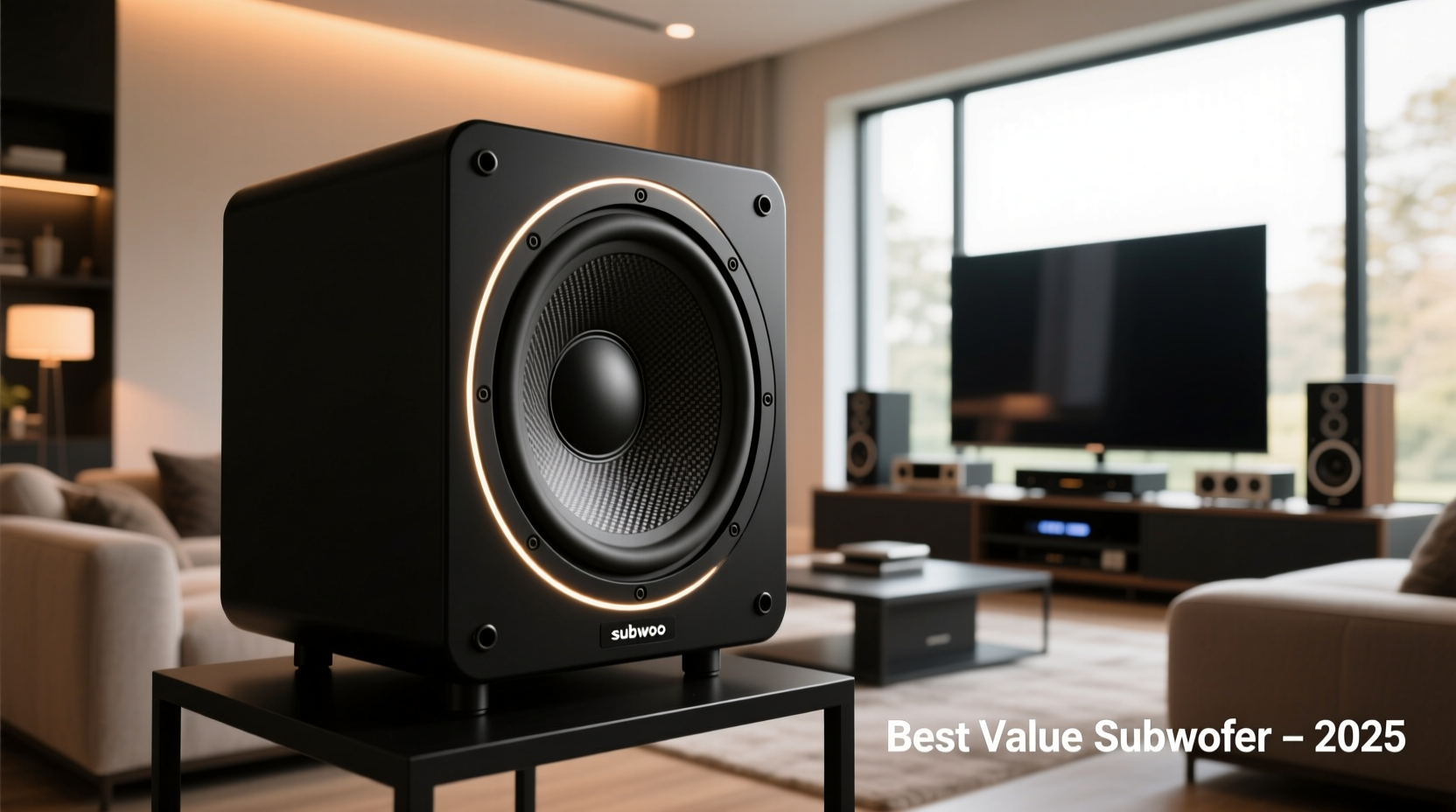
Power in a subwoofer doesn’t come solely from wattage. While amplifier strength matters, it’s only one piece of a larger puzzle. True performance stems from the synergy between driver size, cabinet design, porting, frequency response, and room integration.
- Driver Size: Common sizes are 8\", 10\", 12\", and 15\". Larger drivers move more air, producing deeper bass—though smaller drivers can outperform if well-engineered.
- Amplifier Power (RMS): Look for continuous RMS ratings, not peak wattage. A 300W RMS subwoofer is often more reliable than a 600W \"peak\" model.
- Cabinet Design: Sealed enclosures offer tighter, more accurate bass; ported (bass reflex) designs enhance volume and depth at lower frequencies.
- Frequency Response: Aim for a range below 40Hz for cinematic rumble. Some budget models now dip into the 20Hz range—ideal for feeling thunder or explosions.
Top Affordable Subwoofers Delivering Premium Performance
You don’t need to spend $1,000+ to get impactful bass. Several brands have cracked the code on balancing cost, materials, and engineering. Below are five standout models under $500 that consistently earn praise for both value and sonic impact.
| Model | Price Range | Driver Size | RMS Power | Low-Frequency Output |
|---|---|---|---|---|
| Klipsch R-120SW | $350–$400 | 12\" | 400W | 28 Hz |
| Skytec SW-12P | $250–$300 | 12\" | 300W | 30 Hz |
| Pioneer TS-W304R | $280–$330 | 12\" | 350W | 27 Hz |
| Monoprice 12” Powered Subwoofer | $200–$250 | 12\" | 300W | 32 Hz |
| Jamo Sub 210 Air | $450–$500 | 10\" | 200W | 26 Hz |
The Klipsch R-120SW stands out with its all-copper voice coil and front-firing port, allowing flexible placement. Meanwhile, Monoprice delivers surprising depth for under $250, making it a favorite among home theater DIYers. Jamo’s Sub 210 Air includes wireless connectivity—a rare feature at this price—and tight Danish engineering.
“Affordable doesn’t mean compromised. With modern amplification and better cone materials, even budget subs can produce reference-grade bass.” — David Lin, Audio Engineer & Home Theater Consultant
Optimizing Placement for Maximum Impact
No subwoofer performs at its peak straight out of the box. Room layout, furniture, and wall reflections dramatically influence how bass travels. Poor placement can cause boomy peaks or dead zones, even with a powerful unit.
Follow this step-by-step guide to find your room’s sweet spot:
- Start in the primary seating position. Place the subwoofer where you normally sit.
- Play bass-heavy content (like a movie soundtrack or test tone around 40Hz).
- Walk around the room and listen for where the bass sounds fullest and most even.
- Move the sub to that location, facing outward or toward the nearest wall.
- Experiment with orientation: Try corner placement for maximum output, mid-wall for balance, or near the front speakers for tighter integration.
Smaller rooms benefit from corner placement, which uses boundary gain to amplify low frequencies. Larger spaces may require mid-wall positioning to avoid overwhelming one area.
Real-World Example: Turning a Tight Budget Into Deep Bass
Mark, a film enthusiast in Austin, wanted theater-quality bass but had only $400 to spend. After researching, he chose the Pioneer TS-W304R—not the flashiest option, but one with strong reviews for handling dynamic movie scenes. He placed it in the front left corner of his living room, angled slightly toward the center couch. Using the built-in phase and crossover controls, he matched it to his existing bookshelf speakers.
The result? Explosions in *Dune* rattled the floorboards without distortion. Dialogue remained clear, and ambient scores carried emotional weight. “I didn’t think I’d feel bass this deep under $400,” Mark said. “Now my friends won’t stop asking how I did it.”
Checklist: Getting the Most From Your Budget Subwoofer
Maximize your investment with these essential steps:
- ✅ Match the sub’s crossover setting to your main speakers (usually 80Hz unless specified otherwise)
- ✅ Use phase control to align timing with your front speakers (start at 0°, adjust if bass feels thin)
- ✅ Calibrate volume with a sound meter app or AVR auto-setup (Audyssey, YPAO, etc.)
- ✅ Avoid overdriving the sub—distortion damages drivers and ruins immersion
- ✅ Update firmware if the sub has digital connectivity (e.g., Jamo Air series)
- ✅ Re-evaluate placement when rearranging furniture
Frequently Asked Questions
Can a small subwoofer outperform a larger, cheaper one?
Yes. A well-designed 10\" sub with a high-excursion driver and efficient amplifier can deliver tighter, deeper bass than a poorly made 12\" model. Engineering quality often trumps raw size.
Do I need two subwoofers for good bass?
Not necessarily—but dual subs reduce room-induced peaks and nulls, creating smoother bass across multiple seats. For under $500, start with one powerful model and upgrade later if needed.
Are wireless subwoofers less powerful?
Wireless refers only to the signal connection, not power delivery. Many wireless-ready subs (like the Jamo Sub 210 Air) perform identically to wired versions once connected. The convenience often outweighs minor latency concerns.
Conclusion: Power Doesn’t Have to Be Pricey
Exceptional subwoofer performance is no longer reserved for audiophiles with six-figure systems. Advances in amplifier efficiency, lightweight composite cones, and intelligent cabinet design have democratized deep bass. By choosing thoughtfully from today’s affordable lineup and optimizing placement and settings, you can achieve chest-thumping, theater-grade sound on a realistic budget.
The right subwoofer doesn’t just add volume—it adds emotion, tension, and realism to every scene and song. You don’t need to compromise. Start with one of the proven models listed, follow the tuning tips, and experience how much impact a smart investment in bass can deliver.




 浙公网安备
33010002000092号
浙公网安备
33010002000092号 浙B2-20120091-4
Comments
No comments yet. Why don't you start the discussion?