
In compact kitchens where every inch counts, choosing between an air fryer and a convection oven isn’t just about cooking performance—it’s a battle for real estate. Toast might seem like a minor use case, but for many households, perfectly crisp, golden-brown slices are a daily ritual. So when you’re deciding whether to dedicate valuable counter space to an air fryer solely for toasting, the question becomes: does the result justify the footprint?
The answer depends on more than speed or browning. It hinges on lifestyle, kitchen layout, frequency of use, and how much you value consistency and convenience. Let’s break down both appliances not just as toasters, but as tools in a modern kitchen ecosystem.
How Each Appliance Works: The Science Behind the Crust
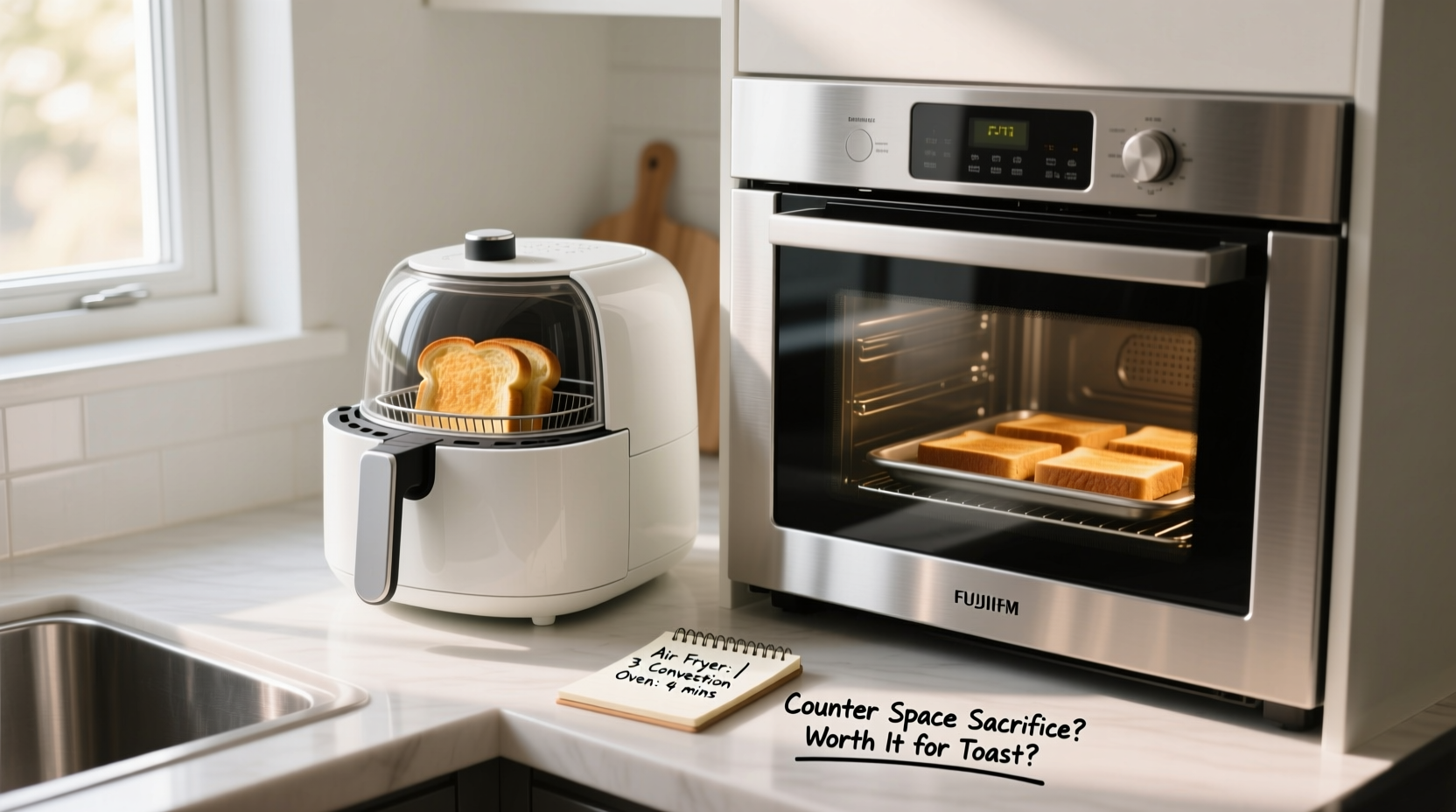
To understand why one might outperform the other for toast, it helps to know how they generate heat and circulate air.
A convection oven uses a heating element (either electric or gas) combined with a rear-mounted fan that circulates hot air evenly around the food. This circulation reduces hot spots and speeds up cooking compared to a conventional oven. Most full-size ovens now come with a convection setting, and countertop models replicate this function at a smaller scale.
An air fryer, by contrast, is essentially a highly concentrated convection oven. It uses a powerful fan and a top-mounted heating coil to blast food with superheated air from above. The compact chamber forces rapid airflow, creating a Maillard reaction—responsible for browning—faster than most traditional ovens can achieve.
When it comes to toast, this forced convection matters. The air fryer’s intense, direct airflow crisps bread quickly and evenly, often without the need to flip. A convection oven, while capable, typically requires more time and may demand mid-cycle flipping for uniform results—especially if the model has uneven airflow.
Speed Comparison: From Bread to Breakfast
Time is a critical factor in morning routines. Here's how the two stack up when toasting two slices of sourdough:
| Appliance | Preheat Time | Toast Time | Total Time |
|---|---|---|---|
| Air Fryer (3.5–5 qt) | 1–2 minutes | 3–4 minutes | 4–6 minutes |
| Countertop Convection Oven | 3–5 minutes | 5–7 minutes | 8–12 minutes |
| Full-Size Convection Oven | 8–10 minutes | 6–8 minutes | 14–18 minutes |
The air fryer wins decisively on speed. Its small cavity heats rapidly, and because the fan is closer to the food, airflow is more aggressive. For someone making toast daily, saving 8–10 minutes each morning adds up to over 40 hours a year—a compelling argument for efficiency.
Bread Performance: Texture, Browning, and Consistency
Great toast isn’t just browned—it’s crisp on the outside, tender within, and evenly cooked edge to edge. How do these appliances deliver?
Air fryers excel at surface crisping. The high-velocity air creates a shatteringly crisp exterior, ideal for avocado toast or open-faced sandwiches. However, some models tend to brown the top more than the bottom unless the basket is shaken or flipped midway. Newer models with dual-directional fans mitigate this issue.
Convection ovens, especially those with multiple rack positions and larger footprints, offer more flexibility. You can toast on a wire rack for even exposure or directly on a baking sheet. Because the heat source is distributed across the back or sides, browning tends to be more balanced—but only if the oven is properly calibrated. Inconsistent airflow in cheaper models can lead to patchy results.
“Air fryers deliver restaurant-style toast in under five minutes. Their thermal efficiency makes them unmatched for small-batch browning.” — Dr. Lena Torres, Appliance Engineer & Food Tech Consultant
Bread Type Matters
Not all breads respond the same way:
- Sourdough: Thick-cut sourdough benefits from the air fryer’s intense heat, which crisps the crust without drying the center.
- Brioche: High-fat brioche can burn easily in an air fryer. A convection oven’s gentler, more diffuse heat preserves its richness.
- Gluten-free: Often dries out quickly. Both appliances work, but convection ovens allow better moisture retention when used at slightly lower temps.
- Frozen waffles or English muffins: Air fryers shine here—no thawing required, and results are consistently crisp.
Counter Space and Kitchen Workflow
This is where the real trade-off lies. An average air fryer occupies 1.5–2 square feet of counter space. A countertop convection oven takes 2.5–3.5 square feet. Full-size convection ovens don’t count toward counter clutter, but they’re not practical for quick tasks like toasting.
If your kitchen is under 150 square feet—or if your counters are already crowded with a coffee maker, blender, and toaster—adding another appliance demands justification. But consider usage frequency. If you toast daily, an air fryer may replace not just a toaster, but also eliminate trips to the full oven, preserving energy and reducing heat buildup in summer.
Many users report that their air fryer becomes a “default” appliance—not just for fries or chicken wings, but for reheating pizza, roasting vegetables, and yes, daily toast. That versatility increases its value per square inch.
Real-Life Scenario: The Brooklyn Apartment Test
Maria, a graphic designer living in a 600-square-foot Brooklyn studio, faced a dilemma. Her kitchen counter was 48 inches long—already hosting a kettle, toaster, and cutting board. She bought a 5.8-quart air fryer after her convection oven failed, expecting to use it mostly for frozen meals.
Within weeks, she stopped using her standalone toaster. “The air fryer gives me crisper toast, and I can cook eggs in a silicone mold right after,” she said. “I reheat leftovers and toast bread in the same cycle. My tiny kitchen feels more efficient.”
She eventually moved her convection oven to a storage closet, pulling it out only for holiday turkeys. For daily needs—including toast—the air fryer proved more practical despite its footprint.
This isn’t universal. In larger kitchens, keeping both makes sense. But in constrained spaces, consolidation around a multi-functional device often wins.
Energy Efficiency and Long-Term Costs
Running a full-size oven to make toast is energy-intensive. According to the U.S. Department of Energy, a standard electric oven uses 2.0–2.5 kWh per hour. An air fryer uses 1.2–1.5 kWh, but runs for far less time.
For a 5-minute toast cycle:
- Air fryer: ~0.12 kWh
- Countertop convection oven: ~0.15 kWh
- Full-size convection oven: ~0.40 kWh (including preheat)
Over a year, that’s a savings of roughly 100 kWh if you switch from a full oven to an air fryer for daily toasting—about $15 in electricity, depending on local rates. Not a fortune, but part of a broader efficiency trend.
Additionally, air fryers generate less ambient heat, reducing strain on air conditioning in warm climates. This indirect benefit is often overlooked but meaningful in small, poorly ventilated kitchens.
Checklist: Is an Air Fryer Worth It for Your Toast Routine?
Answer these before committing counter space:
- Do you toast bread more than 3 times a week?
- Do you value speed and consistency over slight variations in browning?
- Is your current toaster outdated or inconsistent?
- Do you already own or plan to use an air fryer for other foods?
- Can you store the unit conveniently when not in frequent use?
- Are you willing to clean a basket instead of a crumb tray?
If you answered “yes” to four or more, the air fryer is likely a worthwhile investment—even primarily for toast.
FAQ: Common Questions About Toasting Performance
Can I toast bread in an air fryer without drying it out?
Yes, but timing is key. Set the temperature to 350°F (175°C) and toast for 3–4 minutes. Thicker breads may need a light spray of water or a dab of butter to retain moisture. Avoid exceeding 4 minutes for standard slices.
Why does my convection oven toast unevenly?
Uneven browning often stems from poor airflow or incorrect rack placement. Always use the middle rack, and place bread on a wire cooling rack inside the oven to expose both sides to air. Rotate the pan halfway through for best results.
Is an air fryer safer than a toaster for homes with kids?
In some ways, yes. Most air fryers have cool-touch exteriors and automatic shutoffs. The basket pulls out from the side or front, reducing risk of burns compared to a toaster’s upward-facing slots. However, the interior and basket remain very hot after use, so supervision is still necessary.
Final Verdict: The Counter Space Trade-Off
For the sole purpose of toasting, a $30 toaster is still the most space-efficient option. But if you're considering an air fryer anyway—or already own one—the incremental cost of using it for toast is zero. And the benefits—speed, crispness, versatility—add up in real-world use.
The sacrifice of counter space is only worth it if the appliance earns its keep. An air fryer used only once a month for toast doesn’t justify its footprint. But one that handles breakfast, snacks, and dinner components—including perfect toast—transforms from a gadget into a kitchen anchor.
In modern, fast-paced households, efficiency often trumps minimalism. The air fryer delivers consistent, high-quality toast faster than almost any alternative, integrates seamlessly into multi-step morning routines, and replaces several single-use devices. When viewed as part of a broader cooking ecosystem, its presence on the counter isn’t a compromise—it’s a strategic upgrade.




 浙公网安备
33010002000092号
浙公网安备
33010002000092号 浙B2-20120091-4
Comments
No comments yet. Why don't you start the discussion?