
In an age of constant digital interruptions, staying punctual often means more than just knowing the time—it’s about maintaining focus. While both analog watches and smartwatches display hours and minutes, their impact on attention, productivity, and time awareness differs significantly. For professionals, students, or anyone striving for disciplined routines, choosing the right timepiece can influence not just punctuality, but mental clarity. This article examines how each device supports—or undermines—your ability to stay on schedule without distraction.
The Psychology of Time Perception and Focus
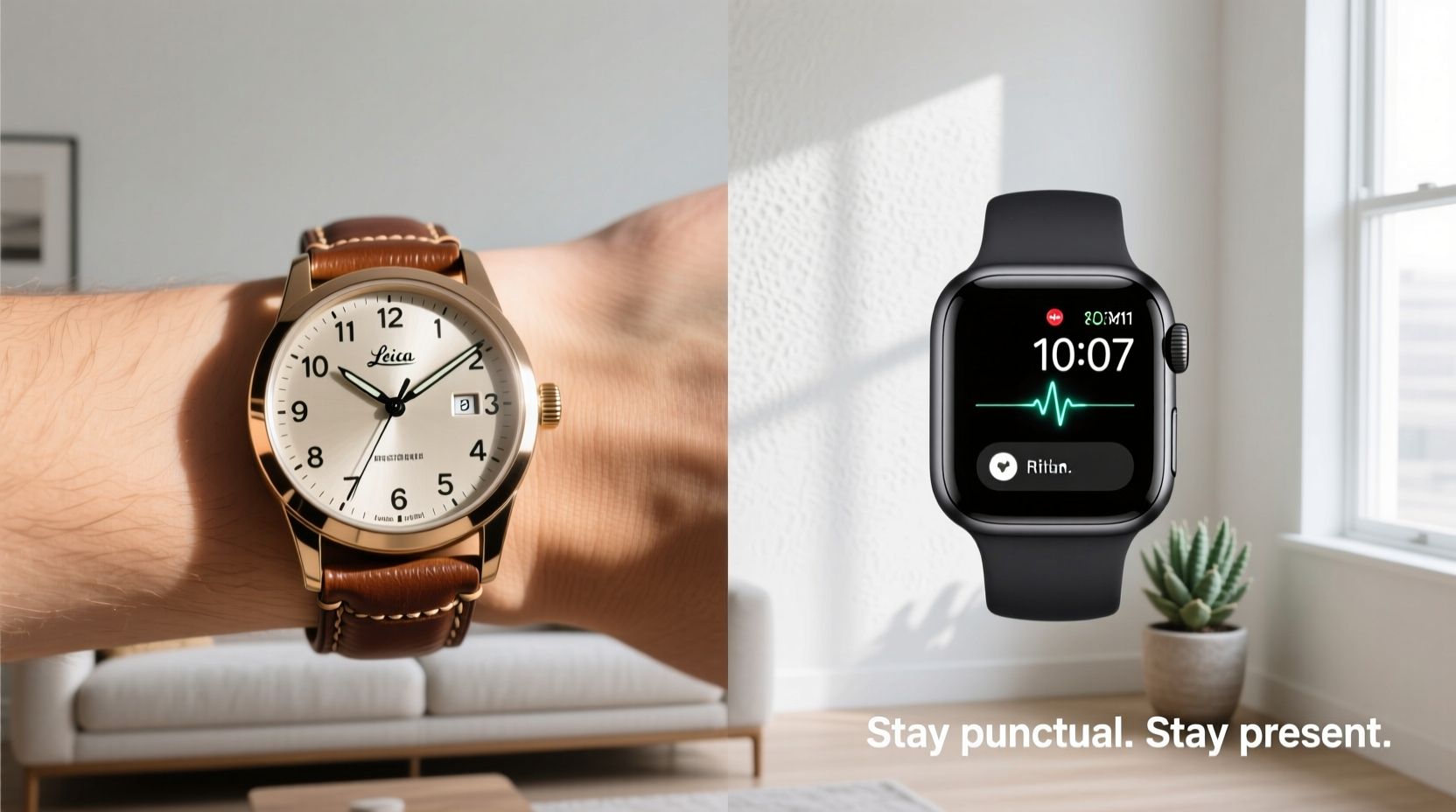
How we perceive time is deeply influenced by the tools we use to measure it. A 2021 study from the University of California found that individuals who relied on physical clocks or analog watches were more likely to develop a “time horizon” awareness—meaning they mentally segmented their day into meaningful blocks. In contrast, those using smart devices frequently reported time distortion, often losing track of minutes due to notifications and app-switching.
Analog watches reinforce a continuous, flowing sense of time through the movement of hands. This visual progression encourages users to internalize duration rather than react to alerts. Smartwatches, while precise, condition us to respond to pings—transforming time into a series of interruptions.
“Time awareness isn’t about checking the clock constantly; it’s about cultivating a rhythm. Analog timepieces support that rhythm.” — Dr. Lena Torres, Cognitive Psychologist, Stanford Behavioral Lab
Functional Comparison: What Each Watch Offers
To understand which device better supports punctuality without distraction, it's essential to compare core functionalities. The table below outlines key differences:
| Feature | Analog Watch | Smartwatch |
|---|---|---|
| Time Display | Continuous analog dial; no backlight needed in daylight | Digital or customizable face; requires screen activation |
| Battery Life | 2–5 years (mechanical/quartz), no daily charging | 1–3 days, requires nightly charging |
| Distraction Level | Negligible; no notifications or apps | High; messages, calls, social media alerts |
| Punctuality Support | Passive time awareness through visual cues | Active reminders and calendar alerts |
| Reliability | Consistent; unaffected by software bugs | Dependent on OS updates and connectivity |
| Maintenance | Occasional battery replacement or servicing | Frequent charging, software troubleshooting |
While smartwatches offer advanced features like GPS, heart rate tracking, and call integration, these same capabilities contribute to cognitive load. For the sole purpose of staying punctual, simplicity often wins.
A Day in the Life: Real-World Scenarios
Consider two professionals with identical schedules—meetings at 9:00 AM, 11:00 AM, 1:30 PM, and 4:00 PM.
Case Study: Sarah, the Designer (Wears an Analog Watch)
Sarah glances at her minimalist analog watch throughout the morning. She notices the minute hand approaching the 11 as she wraps up a design draft. Without needing an alert, she senses it’s time to transition. Her workflow remains uninterrupted because her time awareness is ambient, not intrusive. She arrives at each meeting composed and on time.
Case Study: James, the Sales Manager (Uses a Smartwatch)
James relies on his smartwatch’s calendar alerts. At 10:58 AM, he receives a vibration: “Meeting in 2 minutes.” He pauses mid-email, checks the reminder, then rushes to join. Later, during a client call, a text notification pops up—a family member sent a meme. Though he doesn’t open it, the flicker distracts him for a split second, breaking his concentration. By afternoon, he feels mentally fatigued from micro-interruptions.
Sarah maintains control over her time. James reacts to it. Both are punctual, but Sarah experiences less stress and greater presence.
When Simplicity Enhances Punctuality
Analog watches promote what behavioral scientists call “prospective memory”—the ability to remember to perform a planned action at the right time. Instead of relying on external alerts, users develop internal time estimation skills. Over time, this leads to better self-regulation.
Smartwatches, despite their accuracy, foster dependency. Users begin to wait for alarms rather than anticipate transitions. This reactive mindset weakens time intuition. A 2020 study published in *Applied Cognitive Psychology* showed that participants who used silent analog watches estimated task durations 27% more accurately than those using smartwatch timers.
Moreover, the ritual of winding or simply observing an analog watch creates a mindful pause. That brief moment of attention reinforces intentionality—a subtle but powerful tool for staying punctual without urgency.
Step-by-Step Guide: Transitioning to a Distraction-Free Timekeeping Habit
If you're considering reducing digital clutter and improving punctuality through intentional timekeeping, follow this five-step process:
- Assess Your Current Relationship with Time
Track how often you check your phone or smartwatch for the time over two days. Note whether each check was necessary or habitual. - Select a Reliable Analog Watch
Choose one with clear numerals, good legibility, and a comfortable strap. Mechanical or quartz models both work—prioritize readability over luxury. - Sync It Daily
Set your analog watch to atomic time via a trusted source (like time.gov) each morning. Accuracy matters, even without digital connectivity. - Practice Time Estimation
Before looking at your watch, guess the current time. This builds internal time calibration and reduces dependency on external checks. - Limit Smartwatch Use to Specific Contexts
Reserve smartwatches for workouts, travel, or situations requiring navigation—not daily office or personal routines.
This gradual shift trains your brain to stay time-aware without being interrupted. After three weeks, most users report improved focus and fewer instances of “time blindness.”
The Role of Design in Minimizing Distractions
Watch design plays a crucial role in usability and attention management. Analog watches typically follow minimalist principles: clean dials, limited complications (sub-dials), and absence of interactive elements. This design language supports single-tasking.
In contrast, smartwatches are designed for engagement. Touchscreens invite swiping, tapping, and scrolling. Even glanceable widgets encourage interaction. Apple Watch’s “Digital Crown,” for example, is engineered to make navigation intuitive—but also habit-forming.
Some hybrid models attempt to bridge the gap. The Withings ScanWatch, for instance, uses an analog face with subtle LED indicators for notifications. However, any form of alert reintroduces the risk of distraction, especially if users feel compelled to acknowledge every signal.
- Analog watches eliminate choice fatigue around notifications.
- They require no user interface learning curve.
- Their aesthetic consistency avoids the obsolescence cycle of tech gadgets.
FAQ: Common Questions About Timekeeping and Focus
Can a smartwatch be used without distractions?
Yes, but it requires strict configuration. Turn off all non-critical notifications, disable app badges, and use a simple watch face with only time and date. Even then, the temptation to check remains higher than with an analog watch.
Do analog watches help with time anxiety?
Many users report reduced time-related stress. The smooth motion of hands feels less urgent than digital countdowns or vibrating alerts. Knowing the time is always visible—without needing to wake a screen—creates a sense of calm control.
Isn’t a smartwatch more accurate?
Both types are highly accurate. Quartz analog watches lose or gain less than a second per day. Smartwatches sync with network time servers, but their precision doesn’t translate to better punctuality if users are distracted by other functions.
Checklist: Choosing the Right Watch for Punctuality Without Distractions
Use this checklist to evaluate your next timepiece:
- ✅ Does it display time clearly at a glance?
- ✅ Does it require frequent charging?
- ✅ Can it function independently of a smartphone?
- ✅ Does it emit sounds, lights, or vibrations unrelated to alarms I’ve explicitly set?
- ✅ Will wearing it encourage me to look away from my work less often?
- ✅ Is it durable enough to wear daily without maintenance hassle?
- ✅ Do I feel calmer or more focused when using it?
If you answered “no” to multiple distraction-related questions, an analog watch may serve you better.
Conclusion: Reclaiming Time Through Intentional Design
Staying punctual isn’t just about being on time—it’s about arriving with presence. Analog watches, with their timeless design and lack of digital noise, support a deeper relationship with time. They don’t replace discipline; they enhance it by removing friction and distraction.
Smartwatches excel in connected environments where health tracking, communication, and navigation matter. But for the singular goal of staying punctual without mental clutter, simplicity reigns supreme. An analog watch doesn’t remind you—it allows you to know.
Consider this: the most advanced technology in the world won’t help you stay focused if it’s designed to interrupt. Sometimes, the best tool for modern life is one that hasn’t changed in decades.




 浙公网安备
33010002000092号
浙公网安备
33010002000092号 浙B2-20120091-4
Comments
No comments yet. Why don't you start the discussion?