
In an age where notifications buzz on our wrists and health metrics are tracked in real-time, the humble analog watch might seem like a relic. Yet, it remains a fixture on the wrists of executives, collectors, and style-conscious individuals. The debate between analog watches and smartwatches isn’t just about accuracy or features—it’s a clash of philosophies: tradition versus innovation, elegance versus utility. While both tell time, they do so in ways that speak to different values, lifestyles, and aesthetics. Understanding what each offers—beyond the face—reveals which is better suited not just for telling time, but for telling your personal story.
The Timeless Craft of Analog Watches
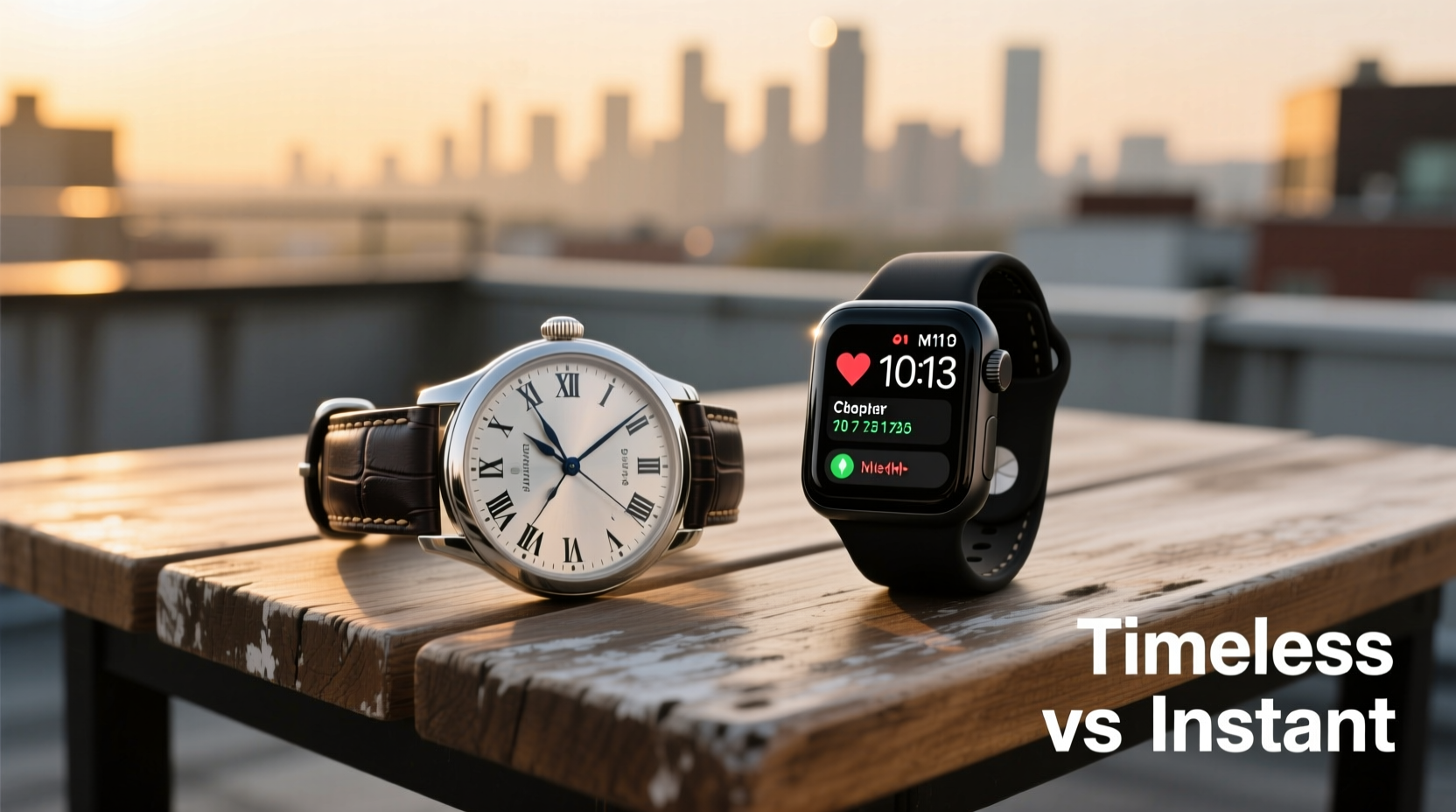
Analog watches are more than instruments; they are artifacts of precision engineering and design heritage. From the sweeping motion of the second hand to the subtle click of a mechanical movement, every detail speaks to craftsmanship. Brands like Rolex, Omega, and Jaeger LeCoultre have spent over a century refining their art, producing timepieces that can last generations with proper care.
Mechanical movements, whether manually wound or self-winding (automatic), operate through intricate systems of gears, springs, and rotors. These components require skilled assembly and regular servicing but offer a tactile connection to horological history. Even quartz analog watches, powered by batteries, often prioritize minimalist dials, polished cases, and premium materials like sapphire crystal and stainless steel.
Fashion-wise, analog watches complement formal attire effortlessly. A slim dress watch pairs elegantly with a suit, while a rugged diver model conveys adventure-ready confidence. Their silent operation and lack of distractions make them ideal for boardrooms, dinners, and moments when presence matters more than connectivity.
The Rise of the Smartwatch: Function Meets Future
Smartwatches, led by brands like Apple, Samsung, and Garmin, represent the convergence of technology and convenience. They don’t just display hours and minutes—they track heart rate, monitor sleep, deliver messages, control music, and even support contactless payments. For many, the smartwatch has replaced not only the traditional watch but also parts of their smartphone experience.
Timekeeping on a smartwatch is inherently precise, syncing automatically with atomic clocks via GPS or network signals. Unlike analog watches, which may gain or lose seconds per day, smartwatches maintain near-perfect accuracy without manual adjustment. However, their displays—especially digital ones—can feel impersonal compared to the fluid motion of hands sweeping across a dial.
Stylistically, smartwatches lean toward modern minimalism. Their rectangular or round OLED screens glow with customizable watch faces, allowing users to switch aesthetics daily. But despite advancements in materials, most still carry a tech-forward look that clashes with formalwear. Wearing a smartwatch to a black-tie event may signal practicality—but rarely sophistication.
“Watches are no longer just about time. They’re extensions of identity—one mechanical, one digital.” — Daniel Kim, Horology Curator at the Swiss Watch Institute
Comparative Analysis: Key Differences at a Glance
| Feature | Analog Watch | Smartwatch |
|---|---|---|
| Time Accuracy | ±5 to ±30 sec/month (mechanical); ±15 sec/month (quartz) | Near-perfect, synced via internet/GPS |
| Battery Life | 2–10 years (quartz); indefinite with winding (mechanical) | 1–7 days, depending on usage |
| Style Versatility | High—fits formal, casual, and luxury contexts | Limited—best with casual/athletic wear |
| Functionality | Time, date, chronograph (on some models) | Notifications, fitness tracking, apps, voice assistant |
| Lifespan | Decades with maintenance | 3–7 years before obsolescence |
| Emotional Value | Often heirloom-worthy, sentimental | Functional, rarely passed down |
This comparison underscores a fundamental truth: analog watches excel in permanence and emotional resonance, while smartwatches dominate in immediacy and interactivity. Choosing between them depends less on which is “better” and more on what role you want your wristwear to play.
When Style Tells the Story
Consider two scenarios:
- A CEO walks into a high-stakes negotiation wearing a vintage Patek Philippe. The watch says discretion, legacy, and understated power.
- A fitness coach checks her Apple Watch during a client session to review real-time heart rate data. The device signals efficiency, health focus, and technological fluency.
Both are appropriate—but for entirely different narratives. Analog watches communicate patience, refinement, and attention to detail. Their design language is rooted in symmetry, balance, and material quality. A well-chosen timepiece can elevate an outfit without drawing overt attention—its impact lies in subtlety.
Smartwatches, by contrast, broadcast engagement with the present moment. They’re tools for optimization, designed to keep users informed and active. Their aesthetic is utilitarian: clean lines, bright screens, interchangeable bands. While some models like the Apple Watch Hermès blend luxury elements, they still function primarily as tech devices—not jewelry.
Mini Case Study: James, the Investment Banker
James wears a slim Cartier Tank to work every day. It matches his tailored suits and complements his low-key demeanor. Clients notice it—not because it’s flashy, but because it feels intentional. During weekends, he swaps it for a Garmin Forerunner to track long runs. At home, he charges both: the analog in a wooden box, the smartwatch on a magnetic dock.
For James, each watch serves a purpose. The Cartier reinforces professionalism; the Garmin supports wellness. He doesn’t see them as rivals but as companions for different chapters of his life. His approach reflects a growing trend: dual-watch ownership, where function and form are separated rather than compromised.
Choosing What Works for You: A Practical Guide
Instead of declaring a winner, consider aligning your choice with lifestyle priorities. Here’s a step-by-step framework:
- Assess Your Daily Routine: Do you spend most days in meetings, or are you constantly moving between workouts, errands, and digital tasks?
- Evaluate Dress Code Needs: Is formal or business-casual attire standard? If yes, an analog watch integrates more seamlessly.
- Determine Tech Dependence: Do you rely on notifications, fitness tracking, or mobile payments from your wrist? If so, a smartwatch adds tangible value.
- Consider Long-Term Value: Are you investing in something that ages gracefully, or upgrading every few years anyway?
- Test Wearability: Try both types for a week. Note how each affects your behavior—do you check time more? Feel distracted by alerts?
Checklist: Questions to Ask Before Buying
- Will this watch be worn primarily for style or function?
- Do I need constant access to notifications or health data?
- How important is battery life and charging frequency?
- Does my wardrobe lean toward classic or contemporary?
- Am I willing to service or replace this piece regularly?
- Could this become a meaningful gift or heirloom?
FAQ: Common Questions Answered
Can a smartwatch ever be as stylish as an analog watch?
Some models come close—especially limited editions co-branded with luxury brands (e.g., TAG Heuer Connected). However, the glowing screen and frequent need to recharge limit their ability to project timeless elegance. They remain tech accessories first, fashion statements second.
Are analog watches outdated if they’re less accurate?
Not at all. While high-end quartz and mechanical watches may deviate slightly from perfect time, their deviation is consistent and often within acceptable ranges. More importantly, their value isn’t tied to millisecond precision but to craftsmanship, design, and cultural significance.
Is it okay to wear both?
Absolutely. Many professionals own multiple watches and rotate based on occasion. Just as you wouldn’t wear hiking boots to a gala, switching watches allows you to match your accessory to the moment.
Conclusion: Time Told, Stories Told
The question isn’t which watch tells better time—it’s which tells a better story. In raw precision, the smartwatch wins. It synchronizes globally, adjusts for time zones automatically, and never drifts. But timekeeping is only one dimension. The analog watch tells time through ritual: winding the crown, observing the sweep of the second hand, appreciating the sunburst dial under natural light. It invites slowness in a fast world.
Style, too, is shaped by intention. A beautifully finished case, a leather strap that molds to the wrist, the weight of solid metal—these details convey respect for detail and permanence. Meanwhile, the smartwatch champions responsiveness, health awareness, and digital integration. It’s the tool of the connected self.
Ultimately, the best choice reflects who you are—and who you aspire to be. If you value legacy, elegance, and quiet confidence, the analog watch remains unmatched. If you thrive on data, efficiency, and seamless connectivity, the smartwatch earns its place. And if you can’t choose? There’s no rule against wearing both—just change your wrist, and your story, when the moment calls for it.




 浙公网安备
33010002000092号
浙公网安备
33010002000092号 浙B2-20120091-4
Comments
No comments yet. Why don't you start the discussion?