
The smartwatch market has matured significantly over the past few years, with Apple and Samsung standing as dominant players. If you're currently using an Apple Watch Series 7 or a Galaxy Watch 4 and are considering a switch—or if you're reevaluating your wearable strategy in 2024—the decision isn't just about hardware. It's about ecosystem alignment, long-term software support, health tracking accuracy, and daily usability. While both devices were flagship wearables in their time, newer models have since launched. Still, many users continue to rely on these watches, making this comparison highly relevant for those deciding whether to upgrade, stay, or switch platforms.
Design and Build: Form Meets Function
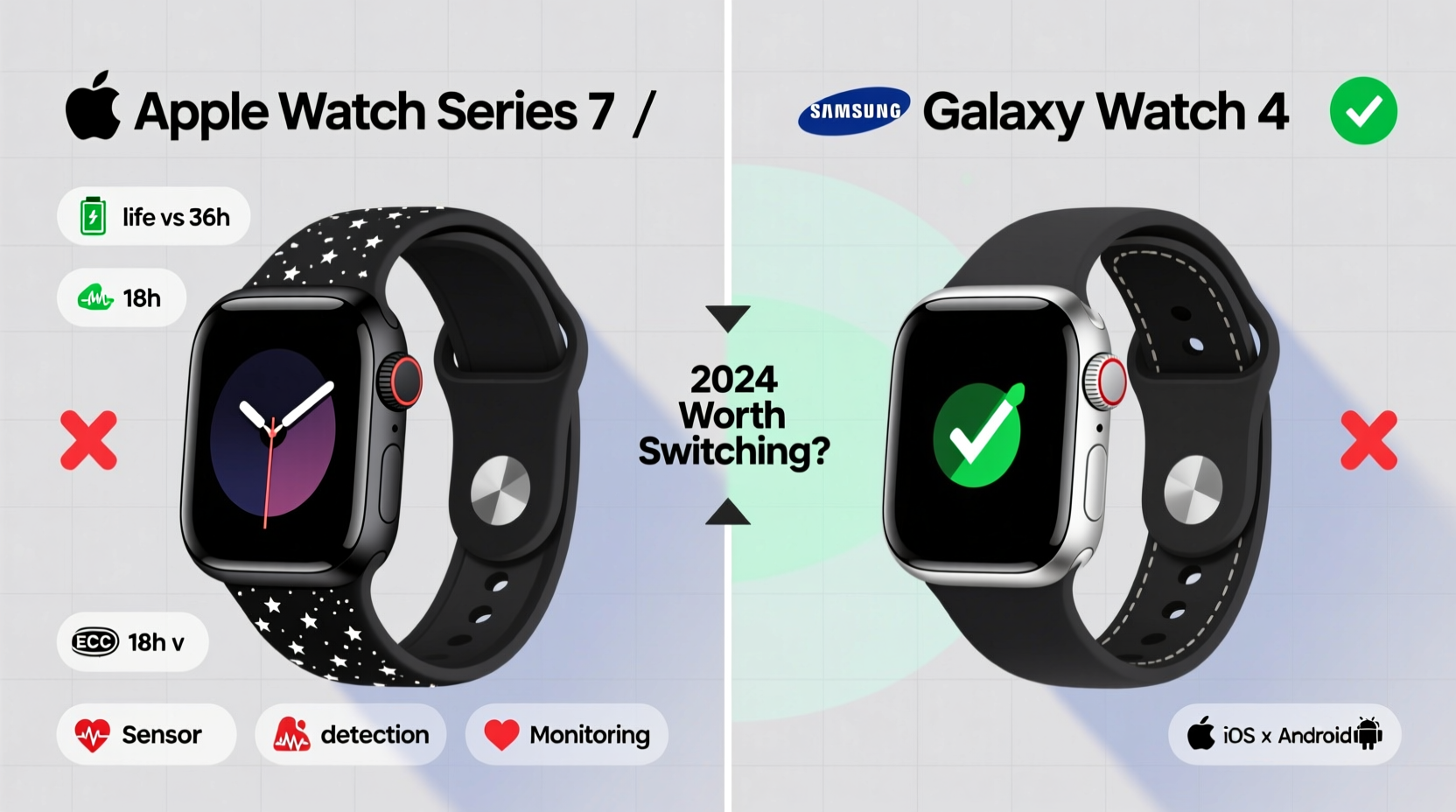
The Apple Watch Series 7 introduced a refined design with flatter edges, thinner bezels, and a larger display—making it one of the most visually striking updates in the Watch lineup. Its aluminum or stainless steel case options, paired with a bright Retina LTPO OLED display, deliver excellent visibility even in direct sunlight. The rounded square design remains consistent with previous generations, ensuring compatibility with older bands.
In contrast, the Galaxy Watch 4 adopted a more traditional circular face with a rotating bezel (digital on the standard model), giving it a classic watch aesthetic. Available in both 40mm and 44mm sizes, it uses Super AMOLED technology, which offers deep blacks and vibrant colors. Samsung also introduced bioactive sensor hardware into the chassis—a first for its wearables—integrating body composition analysis into the mix.
Ecosystem Integration: Where Your Phone Matters Most
No matter how capable a smartwatch is, its value is deeply tied to the smartphone it pairs with. This is where the divide becomes most apparent.
Apple Watch Series 7 works exclusively with iPhones. It leverages seamless integration with iOS—think iMessage replies, Siri shortcuts, Handoff for calls, and instant iCloud syncing. Notifications appear instantly, fitness data syncs automatically to the Health app, and emergency features like Fall Detection and Emergency SOS are deeply embedded in the system.
The Galaxy Watch 4 runs on Wear OS (powered by Samsung’s One UI Watch), and while it supports both Android and iOS, full functionality is only available when paired with a Samsung Galaxy phone. On non-Samsung Android devices, key features like ECG and blood pressure monitoring are disabled. When used with an iPhone, the experience is extremely limited—basic notifications and step tracking work, but much of the value disappears.
“Wearables are no longer standalone gadgets—they’re extensions of your digital identity. Switching ecosystems means rethinking how you interact with your data.” — Lena Patel, Wearable Tech Analyst at GadgetInsight
Performance and Software: Longevity in 2024
By 2024, both devices are three years old. That’s significant in tech terms, especially for software support timelines.
The Apple Watch Series 7 launched with watchOS 8 and is compatible up to watchOS 9. It will not receive watchOS 10 or beyond, meaning it has reached the end of its major update cycle. However, Apple typically provides security patches for several years after feature updates cease. Performance remains smooth for core tasks: heart rate monitoring, workouts, sleep tracking, and notifications.
The Galaxy Watch 4 shipped with Wear OS 3 and has received updates through Wear OS 4. Samsung promises up to four years of major OS updates, so the Watch 4 qualifies for all scheduled upgrades. This gives it a clear edge in long-term software relevance in 2024. Additionally, Google’s integration with Fitbit brings improved sleep staging, stress tracking, and workout auto-detection.
| Feature | Apple Watch Series 7 | Galaxy Watch 4 |
|---|---|---|
| Operating System (2024) | watchOS 9 (final major update) | Wear OS 4 (fully supported) |
| Battery Life | Up to 18 hours | Up to 40 hours (typical use) |
| ECG Support | Yes | Yes (Samsung phones only) |
| Blood Oxygen Monitoring | Yes | Yes |
| Body Composition Analysis | No | Yes (BIA sensor) |
| App Ecosystem | Large, optimized for Apple services | Growing, strong Google/Fitbit integration |
| Fast Charging | Yes (~45 min to 80%) | Yes (~60 min to 100%) |
Health and Fitness Tracking: Who Delivers More Value?
Both watches offer robust health monitoring, but their approaches differ.
The Series 7 continues Apple’s legacy of accurate optical heart rate sensing, irregular rhythm notifications, and comprehensive workout tracking across dozens of activity types. Its accelerometer and gyroscope enable fall detection and crash detection (on cellular models). Sleep tracking is functional but less detailed than some competitors—Apple focuses on duration and respiratory rate rather than deep sleep staging.
The Galaxy Watch 4 stands out with its BioActive Sensor, combining three health sensors into one module. It enables not only heart rate and SpO2 but also body composition measurement—estimating skeletal muscle, body fat, body water, and BMI via impedance analysis. While not medical-grade, it offers unique insights for fitness enthusiasts. Its sleep tracking, powered by Fitbit algorithms, provides REM, light, and deep sleep breakdowns, plus a Sleep Score.
For runners and gym-goers, both watches perform well. GPS accuracy is solid on both, though Apple tends to edge out slightly in dense urban environments. Samsung’s auto-workout detection is more aggressive and reliable, especially for mixed routines.
Real-World Example: A Cross-Ecosystem Switcher
Consider Mark, a long-time iPhone user who switched to a Pixel 7 in 2023. He loved his Apple Watch Series 7 but found himself frustrated by missed opportunities—Google Maps navigation to his wrist, lack of Wallet support, and delayed message syncing. After testing a Galaxy Watch 4, he noticed immediate improvements: faster Google Assistant responses, seamless Spotify control, and richer health data. Despite missing iMessage quick replies, the overall Android synergy made the switch worthwhile. His advice? “If your phone isn’t an iPhone anymore, holding onto the Apple Watch feels like driving a sports car in first gear.”
Should You Switch in 2024? A Step-by-Step Decision Guide
Deciding whether to switch isn’t just about specs—it’s about lifestyle alignment. Follow this timeline to evaluate your needs:
- Assess your smartphone: Are you using an iPhone or Android? If Android, especially Samsung, the Galaxy Watch 4 is the logical companion.
- Check software support: The Series 7 won’t get new watchOS versions. If future-proofing matters, the Watch 4 has an advantage.
- Evaluate battery needs: The Series 7 requires daily charging. The Watch 4 can stretch to two days, reducing charging fatigue.
- Review health priorities: Need ECG and FDA-cleared features? Both offer them, but Samsung adds body composition.
- Test app compatibility: Try essential apps (Strava, WhatsApp, banking) on both platforms to see which integrates better with your routine.
- Consider resale and cost: Used Series 7 models retain value better, but refurbished Watch 4s are often cheaper and more future-ready.
Frequently Asked Questions
Can I use a Galaxy Watch 4 with an iPhone effectively?
Limited functionality. You’ll get basic notifications, step counting, and music control, but critical features like ECG, BP monitoring, and full app support require a Samsung phone. Not recommended for primary use with iOS.
Is the Apple Watch Series 7 obsolete in 2024?
Not obsolete, but outdated. It still performs core functions reliably and securely, but lacks new software features and longer battery life. Ideal for casual users staying within the Apple ecosystem.
Which watch has better third-party app support?
The Apple Watch Series 7 has a more mature app ecosystem, with deeper optimization and broader developer support. However, Wear OS 3+ on the Galaxy Watch 4 has closed the gap significantly, especially for fitness and productivity tools.
Final Verdict: To Switch or Not to Switch?
For iPhone owners deeply invested in Apple’s ecosystem, sticking with the Series 7—or upgrading to a Series 8 or Ultra—is the natural path. The seamless integration, polished interface, and reliability make it hard to leave.
However, if you’ve moved to Android, particularly a Samsung device, or if you value longer software support, extended battery life, and innovative health tracking, switching to the Galaxy Watch 4 (or its successors) makes compelling sense in 2024. It’s not just a watch—it’s a gateway to a more integrated Android experience.
Ultimately, the best wearable is the one that fits your digital life without friction. Technology should serve you, not chain you to a platform. Evaluate your priorities, test where possible, and choose the tool that enhances your day—not complicates it.




 浙公网安备
33010002000092号
浙公网安备
33010002000092号 浙B2-20120091-4
Comments
No comments yet. Why don't you start the discussion?