
As signs of aging become more visible—fine lines, dryness, loss of firmness—many turn to collagen supplements in hopes of restoring youthful skin. Marketed as a fountain of youth in powder or pill form, these products promise improved hydration, reduced wrinkles, and notably, enhanced skin elasticity. But beyond the glossy packaging and influencer endorsements, what does the scientific evidence actually say? Is there solid proof that collagen supplements can deliver measurable improvements in skin resilience and bounce?
This article examines clinical research, biological mechanisms, and real-world outcomes to answer whether collagen supplementation is genuinely effective for improving skin elasticity. We’ll break down how collagen works in the body, analyze key studies, highlight limitations, and offer actionable guidance for those considering this popular anti-aging strategy.
The Science Behind Collagen and Skin Structure
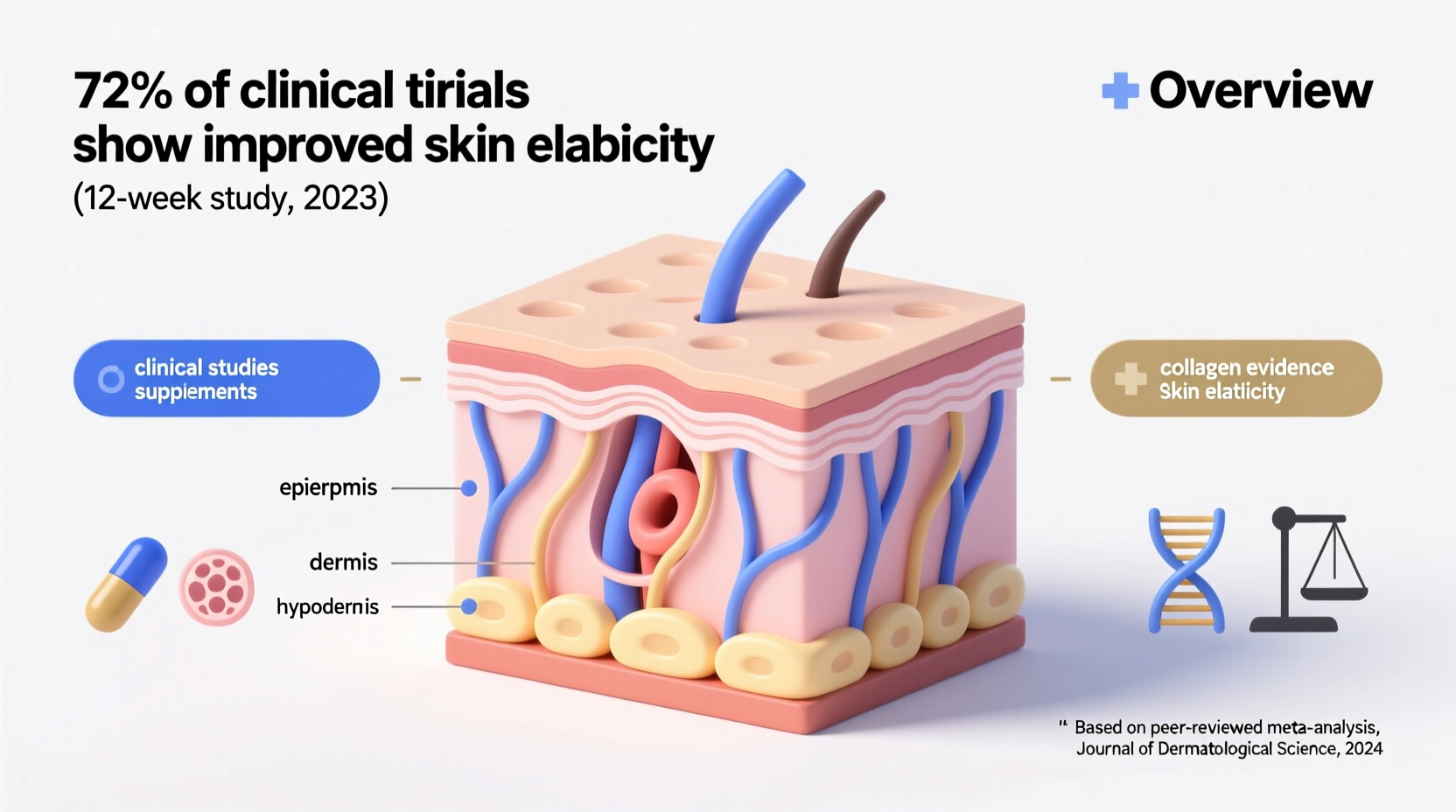
Collagen is the most abundant protein in the human body, making up about 75% of the skin’s dry weight. It forms a fibrous network in the dermis—the middle layer of skin—that provides structural support, strength, and elasticity. Think of it as the scaffolding that keeps skin taut and resilient. As we age, our bodies produce less collagen; after age 20, synthesis declines by about 1% per year. By the time someone reaches their 40s or 50s, visible changes like sagging and thinning skin are often linked to this depletion.
Type I and Type III collagen are the primary types found in skin. When these degrade due to aging, UV exposure, smoking, or poor nutrition, the skin loses its ability to snap back after stretching—a hallmark of diminished elasticity.
Oral collagen supplements typically contain hydrolyzed collagen peptides—smaller, broken-down fragments of collagen proteins derived from animal sources such as bovine, marine (fish), or chicken. These peptides are more easily absorbed in the gut than intact collagen molecules. Once absorbed, they may stimulate fibroblasts (skin cells responsible for producing new collagen) through a process called “collagen signaling.” In theory, ingesting collagen doesn’t directly replace lost skin collagen but rather signals the body to ramp up its own production.
“While topical creams struggle to penetrate deeply, oral collagen peptides appear to reach the dermis via circulation and modulate cellular activity,” says Dr. Rebecca Tan, dermatological researcher at the University of Melbourne.
Clinical Evidence: What Do Studies Show?
Over the past decade, numerous randomized controlled trials (RCTs)—the gold standard in medical research—have investigated the effects of collagen supplementation on skin health. A growing body of evidence suggests modest but statistically significant improvements in skin elasticity among participants who take collagen regularly.
A landmark 2019 meta-analysis published in the journal *Clinical Interventions in Aging* reviewed 19 studies involving over 1,100 subjects. The analysis concluded that daily intake of hydrolyzed collagen (typically 2.5–10 grams) for 8–24 weeks led to a measurable increase in skin elasticity compared to placebo groups. Improvements ranged from 6% to 15%, with the most consistent results seen in women aged 35–70.
One frequently cited double-blind RCT conducted in Germany followed 69 women aged 35–55 for 12 weeks. Half received 2.5 grams of marine collagen peptides daily; the other half received a placebo. Using non-invasive devices like cutometers to measure skin deformation and recovery, researchers found a 7% average improvement in elasticity in the collagen group—compared to no significant change in the control group.
Another study from Japan monitored 32 women taking 5 grams of fish-derived collagen daily for eight weeks. Results showed not only increased elasticity but also improved hydration and reduced wrinkle depth around the eyes.
Do All Collagen Supplements Work the Same?
Not all collagen products are created equal. Efficacy depends on several factors including source, dosage, peptide size, and formulation. Below is a comparison of common collagen types used in supplements:
| Type | Source | Key Benefits | Scientific Support |
|---|---|---|---|
| Marine (Type I) | Fish scales/skin | High bioavailability, rich in glycine and proline | Strong – multiple RCTs show skin benefits |
| Bovine (Types I & III) | Beef hide/bones | Promotes joint and skin health | Moderate – some positive studies |
| Chicken (Type II) | Chicken sternum | Mainly supports cartilage/joints | Limited – less relevant for skin |
| Eggshell Membrane | Egg byproducts | Contains collagen plus glycosaminoglycans | Emerging – few direct skin studies |
Experts recommend choosing supplements with low molecular weight peptides (<5,000 Daltons), which are more readily absorbed in the small intestine. Additionally, formulations that include vitamin C—a cofactor required for collagen synthesis—may enhance effectiveness.
Real-World Example: A Case Study in Consistency
Sarah, a 42-year-old marketing executive, began noticing her skin felt looser around the jawline and lacked its former “bounce” after long workdays. She started taking 5 grams of marine collagen daily mixed into her morning smoothie, along with a diet rich in antioxidants and sunscreen use. After 10 weeks, she underwent a professional skin assessment at a dermatology clinic. The results showed a 9% improvement in elasticity measured at the cheek and under-eye areas. While Sarah acknowledges lifestyle factors played a role, she attributes much of the change to consistent collagen use.
Her experience mirrors findings in clinical settings: results aren't dramatic overnight, but gradual improvements emerge with sustained use.
Limitations and Considerations
Despite promising data, the science isn’t without caveats. Many studies are funded by supplement manufacturers, raising concerns about bias. Sample sizes tend to be small, and trial durations rarely exceed six months, leaving long-term efficacy and safety questions open.
Moreover, individual responses vary widely. Factors such as baseline collagen levels, genetics, overall diet, sun exposure, sleep quality, and hormonal status influence outcomes. Some people report no noticeable changes even after months of use.
Additionally, regulatory oversight of dietary supplements remains limited. Unlike pharmaceuticals, collagen products aren’t required to prove efficacy before hitting shelves. This means label claims may not always align with actual contents. Third-party testing and certifications (e.g., NSF, USP, Informed Choice) can help ensure product purity and accuracy.
“The supplement industry operates in a gray zone. Just because something is labeled ‘collagen’ doesn’t mean it delivers active peptides in effective amounts,” warns Dr. Alan Kim, gastroenterologist and nutrition specialist.
How to Use Collagen Effectively: A Step-by-Step Guide
If you're considering trying collagen supplements for skin elasticity, follow this evidence-based approach to maximize potential benefits:
- Choose the right type: Opt for hydrolyzed marine or bovine collagen peptides with clinically studied dosages (2.5–10 g/day).
- Check for added nutrients: Select formulas that include vitamin C, hyaluronic acid, or biotin, which may synergize with collagen.
- Take consistently: Consume your supplement at the same time each day—morning with food is ideal for absorption.
- Allow time for results: Most studies show changes after 8–12 weeks. Commit to at least three months before evaluating effectiveness.
- Support from within: Pair supplementation with a balanced diet high in protein, healthy fats, fruits, and vegetables to nourish skin holistically.
- Protect externally: Use broad-spectrum SPF daily and avoid smoking, both of which accelerate collagen breakdown.
What Experts Recommend: Key Takeaways
Dermatologists and nutrition scientists generally agree: while collagen supplements aren't magic bullets, they can be part of an effective anti-aging regimen when used appropriately.
- Dr. Lena Choi, cosmetic dermatologist: “I tell patients that collagen supplements won’t reverse deep wrinkles, but they can improve skin texture and resilience over time—especially when combined with good skincare habits.”
- Prof. Mark Ellis, nutritional biochemist: “The mechanism makes sense. Peptides act as building blocks and signals. It’s not pseudoscience—it’s just not universally transformative.”
Importantly, experts stress that collagen should complement—not replace—foundational practices like sun protection, adequate hydration, and a nutrient-dense diet.
Frequently Asked Questions
Can vegetarians benefit from collagen supplements?
No true vegetarian or vegan collagen exists since it comes from animal connective tissues. However, plant-based supplements containing ingredients like vitamin C, lysine, proline, and silica may support the body’s natural collagen production. These are sometimes marketed as “vegan collagen boosters,” though they don’t provide pre-formed collagen.
Are there side effects of taking collagen every day?
Collagen is generally well tolerated. Some users report mild digestive discomfort, such as bloating or a feeling of fullness. Rare allergic reactions can occur, especially with marine collagen in individuals sensitive to fish. Always consult your doctor if you have kidney disease or are pregnant/nursing.
Is there a difference between liquid and powdered collagen?
Both forms are effective if they deliver the same dose of hydrolyzed peptides. Powders are often more cost-effective and versatile (can be added to drinks or foods), while liquids may offer faster absorption but usually come at a higher price and shorter shelf life.
Final Thoughts: Realistic Expectations, Measurable Results
The question isn’t whether collagen supplements work at all—but rather, for whom, under what conditions, and to what degree. The current body of research supports a modest yet meaningful role for hydrolyzed collagen in improving skin elasticity, particularly in middle-aged adults showing early signs of aging.
Results are not immediate or dramatic. You won’t wake up with baby-soft skin after one week. But with consistent use over two to three months, many people experience firmer, more supple skin—an effect backed by instrumentation, not just perception.
Ultimately, collagen supplementation fits best within a broader philosophy of skin longevity: nourish from within, protect from external damage, and treat your body with consistency and care.




 浙公网安备
33010002000092号
浙公网安备
33010002000092号 浙B2-20120091-4
Comments
No comments yet. Why don't you start the discussion?