
When it comes to illuminating outdoor greenery, few decorations create as much charm as lights draped over bushes and hedges. Whether for seasonal displays, garden ambiance, or landscape enhancement, choosing the right lighting format is essential. Among the most popular options are net lights and traditional string lights. While both can deliver beautiful results, their performance, ease of use, and aesthetic outcomes differ significantly. Understanding these differences helps ensure you select the best solution for your landscaping needs—without wasting time, money, or effort on a suboptimal setup.
Coverage and Uniformity: How Light Spreads Across Foliage
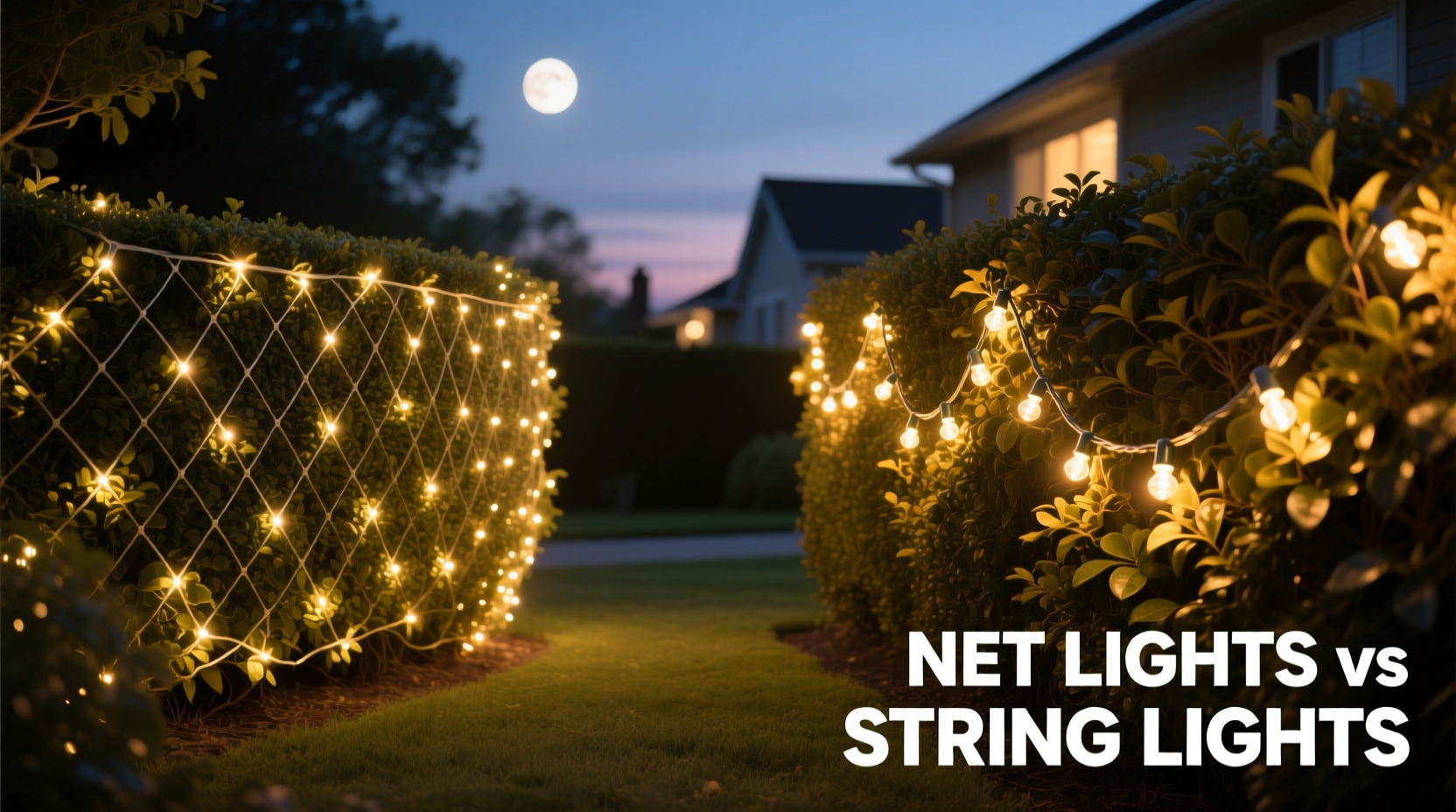
The primary advantage of net lights lies in their structured design. These lights are pre-wired into a grid pattern, typically spaced 3–6 inches apart across a mesh backing made of flexible plastic or wire. This configuration ensures even distribution of light points across the entire surface of a bush or hedge, creating a dense, twinkling effect that mimics stars scattered through foliage.
In contrast, string lights consist of individual bulbs attached along a single strand. When wrapped around or draped over plants, achieving uniform coverage requires careful spacing and multiple passes. Without precision, gaps may appear, resulting in uneven brightness and visible dark zones. For large, full hedges where seamless illumination is desired—such as boxwood rows or privet borders—net lights offer a clear edge in consistency.
However, string lights provide more flexibility in directional placement. If you want to highlight specific features like flowering branches or architectural shapes within a shrub, string lights allow targeted wrapping. They're also easier to customize when working with irregularly shaped or sparse vegetation where a rigid net might not conform well.
“Net lights excel at blanket coverage, while string lights give you artistic control. The choice depends on whether you prioritize even glow or sculpted highlighting.” — Marcus Lin, Outdoor Lighting Designer
Installation Ease and Time Efficiency
For homeowners seeking quick, hassle-free decoration—especially during busy holiday seasons—net lights are often the preferred option. Their ready-made layout allows them to be laid directly over bushes like a blanket. Most models come with corner clips or integrated hooks that secure the edges to branches, minimizing sagging and shifting due to wind or weather.
Consider this scenario: A homeowner has six medium-sized yew bushes lining their front walkway. Using net lights, each bush can be covered in under five minutes per plant. The grid aligns naturally, and minimal adjustment is needed once positioned. With string lights, the same task could take 10–15 minutes per bush, requiring winding motions up, down, and around to avoid clumping and maintain balance.
That said, string lights have advantages in adaptability. If your hedge extends beyond standard dimensions (e.g., wider than 6 feet), connecting multiple string light strands is simpler than piecing together several nets, which may leave visible seams. Additionally, string lights can extend vertically or horizontally without constraint, making them ideal for tall holly trees or sprawling junipers where a fixed-size net won’t reach.
Durability and Weather Resistance
Both net and string lights vary widely in quality, but construction plays a major role in long-term reliability. Most modern LED versions of both types are designed for outdoor use, featuring sealed sockets and UV-resistant wiring. However, because net lights have more connection points per unit area, they present more potential failure zones if manufactured poorly.
A low-cost net light set with thin wires and non-potted LEDs may degrade faster when exposed to moisture, particularly at junctions between the grid lines. In contrast, commercial-grade string lights with shatterproof bulbs and molded bases tend to withstand harsh conditions longer, especially when properly coiled and stored off-season.
Still, high-quality net lights from reputable brands now rival string lights in resilience. Look for products labeled “all-weather,” with dielectric coatings and reinforced nodes. Many premium models include built-in timers, remote controls, and color options, adding convenience without sacrificing durability.
One practical consideration: Repairability. If a section of a string light fails, it’s sometimes possible to replace just the faulty bulb or cut out a damaged segment (if using parallel-wired sets). Net lights, being a unified grid, usually require full replacement if a critical node fails or the mesh tears extensively.
Visual Impact and Design Flexibility
Aesthetics play a crucial role in outdoor lighting decisions. Net lights produce a distinctive \"glittering veil\" effect—ideal for soft, romantic ambiance or festive winter displays. Because the bulbs are closely spaced and evenly distributed, they create a luminous canopy that enhances texture without drawing attention to the wiring itself.
String lights, by comparison, allow greater creative expression. You can wrap them spirally, zigzag across faces, or cluster them near the base for upward casting. Different bulb styles—C7, C9, fairy, globe, or flame-tip—affect mood dramatically. Warm white strings evoke elegance; multicolor strands add playful energy.
Here’s how two homeowners approached similar landscapes differently:
Mini Case Study: Coastal Garden Makeover
Sarah, a homeowner in Newport, Rhode Island, wanted subtle evening lighting for her formal rosemary hedges flanking a stone patio. She chose warm-white net lights (6\" spacing) on black wire to blend into the foliage. From a distance, the plants appeared gently aglow, enhancing dinner gatherings without overpowering the space.
Meanwhile, James in Austin used C9 string lights in amber to outline the outer contours of his sprawling oleander row. By following the natural wave of the hedge line and leaving interior areas darker, he created a bold silhouette visible from the street—perfect for weekend entertaining.
Each achieved their goal, but with different tools tailored to intent: Sarah sought diffusion and subtlety; James aimed for definition and drama.
Comparison Table: Net Lights vs. String Lights
| Feature | Net Lights | String Lights |
|---|---|---|
| Coverage Uniformity | Excellent – consistent grid pattern | Variable – depends on installer skill |
| Installation Speed | Fast – lay and clip | Slower – requires wrapping |
| Customization | Limited – fixed size and shape | High – adaptable length and path |
| Durability | Good (quality-dependent) | Very good – easier to repair |
| Ideal For | Dense shrubs, holiday displays, soft glow | Tall/tapered hedges, accent lighting, dynamic effects |
| Storage | Flat folding possible but bulky | Easily coiled, compact |
Step-by-Step Guide: Choosing & Installing the Right Option
Follow this process to determine whether net or string lights suit your situation best:
- Assess Plant Size and Shape – Measure height, width, and depth. Compact, rectangular hedges favor net lights. Irregular or vertical forms lean toward string lights.
- Determine Desired Effect – Do you want an even shimmer (choose net) or defined outlines/highlights (choose string)?
- Check Power Access – Plan outlet proximity and extension cord routes. Both types need safe, grounded connections.
- Select Quality Product – Choose UL-listed, outdoor-rated LED sets with warranty. Avoid bargain-bin options prone to early burnout.
- Install During Daylight – Work in good light to avoid misplacement. Secure all connections before dusk testing.
- Test and Adjust – Turn on lights after installation. Fill any dark spots—add supplementary strands if needed.
- Seasonal Removal or Storage – If leaving up year-round, ensure product supports continuous exposure. Otherwise, remove carefully, coil neatly, and store in dry container.
Frequently Asked Questions
Can I use net lights on tall, narrow hedges?
It’s possible, but challenging. Standard net lights are square or rectangular (e.g., 3’x6’), so they may drape awkwardly on slender plants. Excess material can bunch at the base or fail to cover the top fully. For vertical hedges, consider linking multiple string lights vertically or purchasing specialty tall-format nets if available.
Do net lights consume more electricity than string lights?
Not inherently. Energy use depends on total number of bulbs and wattage per bulb, not layout. A 50-bulb net light uses roughly the same power as a 50-bulb string light—typically 4–6 watts for LED versions. Always compare specs rather than assuming one type is more efficient.
Are net lights safe for evergreen foliage?
Yes, provided they are LED-based and generate minimal heat. Incandescent lights can dry out needles over time, but modern LED net lights pose little risk. Avoid overtightening clips to prevent bark damage, and inspect periodically for trapped debris or moisture buildup beneath the mesh.
Final Checklist Before You Buy
- ✅ Measure your bushes accurately (height × width)
- ✅ Decide on warm white, cool white, or color-changing
- ✅ Confirm outdoor/indoor rating and IP/weatherproof level
- ✅ Check for timer, remote, or smart compatibility
- ✅ Ensure sufficient cord length to reach outlet
- ✅ Verify return policy in case of defects or fit issues
- ✅ Consider storage space for off-season keeping
Conclusion: Making the Right Choice for Your Landscape
There is no universal answer to whether net lights are better than string lights for bushes and hedges—the best choice hinges on your specific goals, plant characteristics, and maintenance preferences. Net lights deliver unmatched speed and evenness, making them ideal for rapid, repeatable installations on dense, uniformly shaped shrubs. They shine brightest in seasonal decor and ambient garden settings where a soft, immersive glow is desired.
String lights, meanwhile, offer superior versatility and longevity. They adapt to complex shapes, support creative designs, and are generally easier to maintain and repair over time. For permanent or semi-permanent installations, or when artistic expression matters most, string lights remain the go-to solution.
Ultimately, many experienced landscapers and decorators use both—combining net lights for background fill and string lights for accent lines. By understanding the strengths and limitations of each, you can craft outdoor lighting schemes that enhance your property’s beauty, improve curb appeal, and bring lasting enjoyment.




 浙公网安备
33010002000092号
浙公网安备
33010002000092号 浙B2-20120091-4
Comments
No comments yet. Why don't you start the discussion?