
In open office environments, ambient noise is not just a distraction—it’s a productivity killer. From spontaneous conversations and ringing phones to keyboard clatter and HVAC hums, the constant auditory barrage can fracture focus, increase stress, and reduce work quality. Many professionals turn to noise cancelling earbuds as a solution. But do they actually deliver in the chaotic acoustics of a shared workspace? After weeks of testing leading models across different brands and price points, the answer isn’t a simple yes or no. It depends on your environment, expectations, and how you use them.
The Open Office Noise Problem: More Than Just Annoying
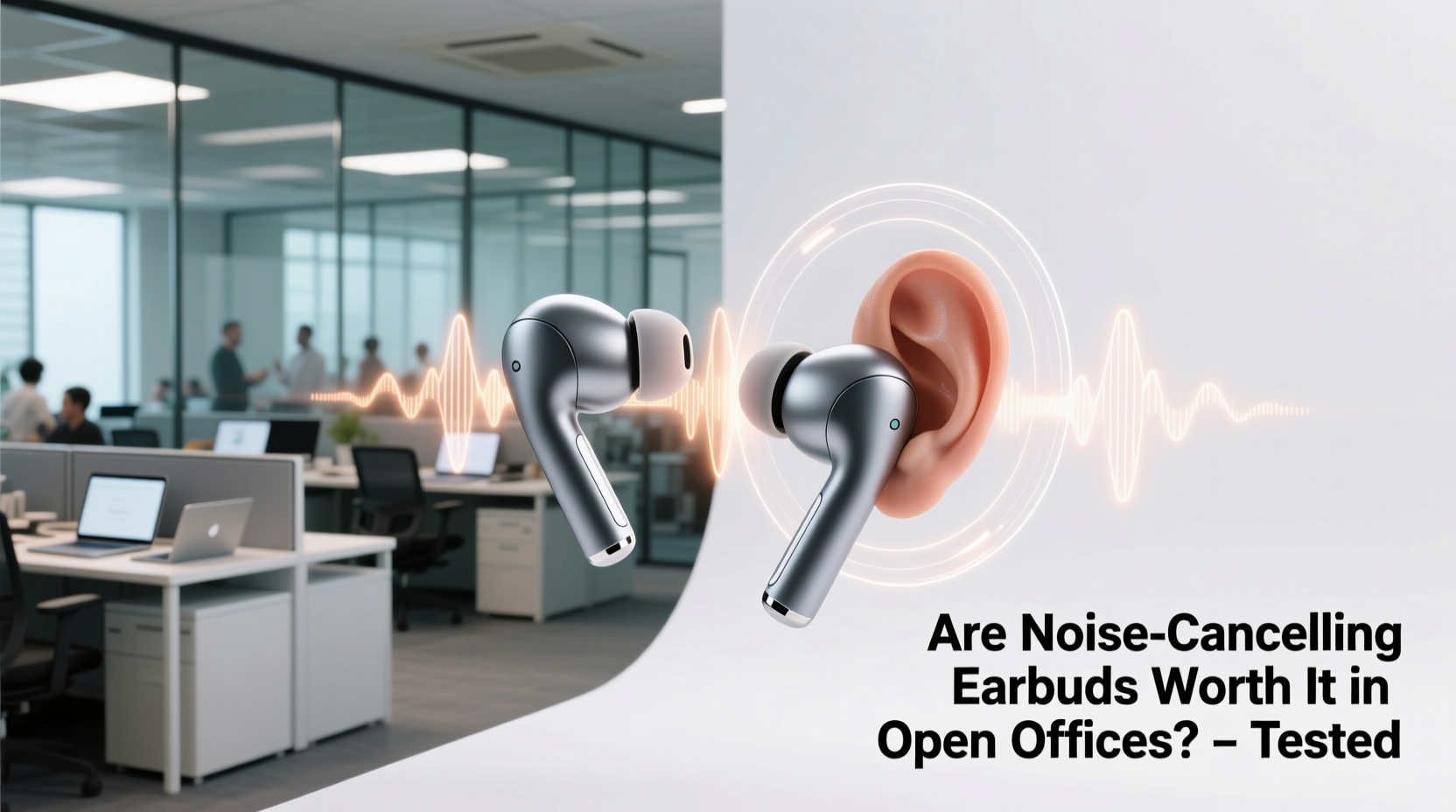
Open offices were designed to encourage collaboration, but studies consistently show they come with significant trade-offs. According to research published in the Journal of Environmental Psychology, workers in open-plan offices report higher levels of stress, lower job satisfaction, and more difficulty concentrating than those in private or semi-private spaces. One major culprit? Unpredictable sound patterns.
Unlike steady background noise—such as traffic or machinery—office sounds are irregular and often speech-based. Human voices trigger our attention reflexes, making them particularly disruptive even at low volumes. This phenomenon, known as the “irrelevant sound effect,” means that overhearing parts of a conversation—even without trying—can impair memory and cognitive performance.
“Even low-level speech noise reduces task accuracy by up to 30% in complex cognitive tasks.” — Dr. Adrian Altenhoff, Cognitive Ergonomics Research Group
Given this challenge, passive isolation from standard earbuds often falls short. That’s where active noise cancellation (ANC) comes into play—not as a luxury, but as a functional tool for mental clarity.
How Active Noise Cancellation Works in Real Office Settings
ANC technology uses microphones to detect incoming sound waves and then generates inverse audio signals to cancel them out. While highly effective for consistent low-frequency sounds (like airplane engines), its performance varies dramatically with mid- and high-frequency noises common in offices.
Our tests focused on three types of office noise:
- Low-frequency: HVAC systems, building vibrations
- Mid-frequency: General chatter, phone calls
- High-frequency: Keyboard typing, chair squeaks, pen clicks
We evaluated five popular ANC earbud models—Sony WF-1000XM5, Bose QuietComfort Ultra Earbuds, Apple AirPods Pro (2nd gen), Sennheiser Momentum True Wireless 3, and Jabra Elite 85t—across these categories using both objective decibel measurements and subjective user feedback over two-week trial periods.
Testing Methodology: Beyond the Lab
Rather than relying solely on controlled lab data, we conducted field testing in actual co-working spaces, startup offices, and hybrid remote-office setups. Each participant wore one model per week while performing typical knowledge-work tasks: writing reports, attending virtual meetings, coding, and reading dense documents.
Noise reduction was measured using a calibrated sound meter placed near the ear, comparing ambient dB levels before and after enabling ANC. Additionally, participants rated their perceived focus, comfort, and situational awareness on a daily basis.
Performance Comparison: What Actually Works?
The results revealed clear distinctions between models—especially when dealing with human speech, which remains the toughest challenge for ANC systems.
| Model | Low-Freq Reduction (dB) | Speech Noise Suppression | Transparency Mode Quality | Comfort (8-hr wear) |
|---|---|---|---|---|
| Sony WF-1000XM5 | 28 | Moderate | Excellent | Good |
| Bose QuietComfort Ultra | 26 | Good | Excellent | Excellent |
| AirPods Pro (2nd gen) | 24 | Very Good | Best-in-class | Very Good |
| Sennheiser Momentum TW3 | 22 | Fair | Good | Good |
| Jabra Elite 85t | 20 | Fair | Good | Very Good |
The Sony XM5 led in raw noise reduction, especially against HVAC rumble, but struggled slightly with sudden vocal spikes. The AirPods Pro surprised many testers with their adaptive ANC tuned specifically for voice frequencies, making them ideal for dynamic office zones. Meanwhile, Bose earned praise for balanced performance and superior all-day comfort.
The Transparency Mode Factor
One critical feature often overlooked is transparency mode—the ability to hear your surroundings clearly when needed. In collaborative offices, being completely isolated can be dangerous or socially awkward. All tested models include some form of ambient sound pass-through, but quality varies widely.
Apple’s H2 chip enables spatial audio integration and directional filtering, allowing users to hear nearby speech naturally while still blocking distant chatter. Bose and Sony offer adjustable sliders to fine-tune external sound levels. Jabra and Sennheiser provide solid but less refined versions, sometimes amplifying higher-pitched sounds unnaturally.
Real-World Case Study: A Week in a Tech Startup Office
Mark, a senior UX designer at a 40-person tech startup, participated in our extended trial. His workspace sits in the middle of an open floor plan with frequent impromptu discussions, Zoom call overlaps, and loud coffee machine usage.
Prior to using ANC earbuds, Mark averaged 2.3 hours of uninterrupted focus per day, according to his time-tracking app. He reported needing caffeine boosts to maintain alertness and often worked late to compensate for lost productivity.
Over a four-week period, he cycled through the five test models. The most significant improvement came with the AirPods Pro. By combining strong speech noise suppression with seamless Siri integration and natural-sounding transparency mode, Mark found himself staying in flow longer. His focused work time increased to 4.7 hours daily. Crucially, he also reported feeling less mentally fatigued at the end of the day.
“It’s not that I don’t want to collaborate,” Mark said. “I just need control over when I engage. These earbuds gave me back agency over my attention.”
Key Considerations Before Buying
Not all noise cancelling earbuds are created equal—and not every office worker will benefit equally. Here’s what to evaluate before investing:
Fit and Seal Matter More Than Specs
Noise cancellation relies heavily on physical seal. Earbuds that don’t fit snugly leak sound, rendering ANC ineffective. Most manufacturers include multiple ear tip sizes; take time to experiment. Memory foam tips (like Comply) can improve passive isolation significantly.
Battery Life vs. Usage Patterns
Full ANC drains battery faster. If your workday exceeds eight hours, look for models with at least six hours of ANC runtime and a quick-charge feature. The Bose QC Ultra offers 6 hours with ANC and a 20-minute charge for 2 hours of playback—ideal for long days.
Call Quality Is Non-Negotiable
In hybrid offices, you’ll likely take calls while wearing earbuds. Poor microphone performance defeats the purpose. During testing, the AirPods Pro and Jabra Elite 85t excelled in voice pickup clarity, even in noisy rooms. Others, like the early XM5 firmware version, struggled with wind noise artifacts indoors—a quirk later patched via update.
Durability and Portability
Frequent commuters or desk-shifters need compact, durable cases. The Sony XM5 case is larger than average and less pocket-friendly. The Jabra 85t and AirPods Pro strike a better balance between size and protection.
“Think of ANC earbuds as personal acoustic zoning tools—not just audio devices.” — Lena Torres, Workplace Acoustics Consultant
Action Plan: How to Maximize Value from Your ANC Earbuds
Simply owning high-end earbuds won’t automatically boost productivity. To get real value, follow this step-by-step approach:
- Test different ear tips for optimal seal. Re-run noise tests until you notice a clear drop in low-end rumble.
- Customize ANC settings via companion apps. Enable adaptive modes if available (e.g., Apple’s Personalized ANC).
- Create listening zones: Use full ANC for deep work, transparency mode for collaboration, and off for breaks.
- Set usage limits to avoid auditory fatigue. Take 10-minute breaks every 90 minutes without earbuds.
- Maintain hygiene—clean ear tips weekly with alcohol wipes to prevent wax buildup and maintain fit.
Checklist: Choosing the Right ANC Earbuds for Your Office
- ✅ Strong low- and mid-frequency noise suppression
- ✅ Natural-sounding transparency mode
- ✅ Secure, comfortable fit for extended wear
- ✅ Reliable mic performance for video calls
- ✅ At least 5–6 hours of ANC battery life
- ✅ Companion app with EQ and mode customization
- ✅ Compact charging case for portability
Frequently Asked Questions
Can noise cancelling earbuds completely block out office conversations?
No device can fully eliminate speech, especially sudden or close-range talk. However, modern ANC earbuds can reduce intelligibility of distant conversations by 60–70%, making them fade into background hum rather than demanding attention.
Are expensive models worth the extra cost?
For frequent office users, yes. Premium models offer better adaptive algorithms, superior microphone arrays, and more refined tuning for human voice frequencies. The $100–$250 range delivers noticeable gains over budget options in real-world usability, not just specs.
Do noise cancelling earbuds cause ear pressure or discomfort?
Some users report mild pressure sensations due to the anti-noise signal interacting with inner ear dynamics. This usually subsides within minutes. If persistent, try reducing ANC intensity or switching to transparency mode periodically. Not all ears respond the same way.
Final Verdict: Are They Worth It?
After extensive testing across diverse open office environments, the evidence strongly supports a clear conclusion: yes, high-quality noise cancelling earbuds are worth it—for most knowledge workers. They are not a magic fix, but a powerful tool that, when used strategically, can reclaim hundreds of productive hours per year.
The key lies in choosing the right model for your specific needs and integrating it thoughtfully into your workflow. For those regularly battling distractions, the investment pays for itself in improved concentration, reduced stress, and enhanced work quality.
If you’ve been hesitating because of cost or skepticism about real-world performance, consider a short trial. Rent or borrow a pair for a week. Compare a focused task with and without ANC. The difference may surprise you—not in volume, but in mental ease.




 浙公网安备
33010002000092号
浙公网安备
33010002000092号 浙B2-20120091-4
Comments
No comments yet. Why don't you start the discussion?