
Millions of people around the world solve Sudoku puzzles daily—on paper, in apps, or during morning coffee breaks. These number-based logic challenges are undeniably entertaining, but many also believe they sharpen the mind, delay cognitive decline, or even make you “smarter.” But is there real science behind these claims, or are we simply enjoying a clever distraction? The answer lies somewhere in between: while puzzle games like Sudoku aren’t magic brain tonics, they do offer measurable cognitive benefits under the right conditions.
This article examines the neuroscience of puzzle-solving, separates fact from marketing hype, and provides practical guidance on how to use games like Sudoku effectively for mental fitness—without overestimating their power.
The Cognitive Mechanics Behind Puzzle Games
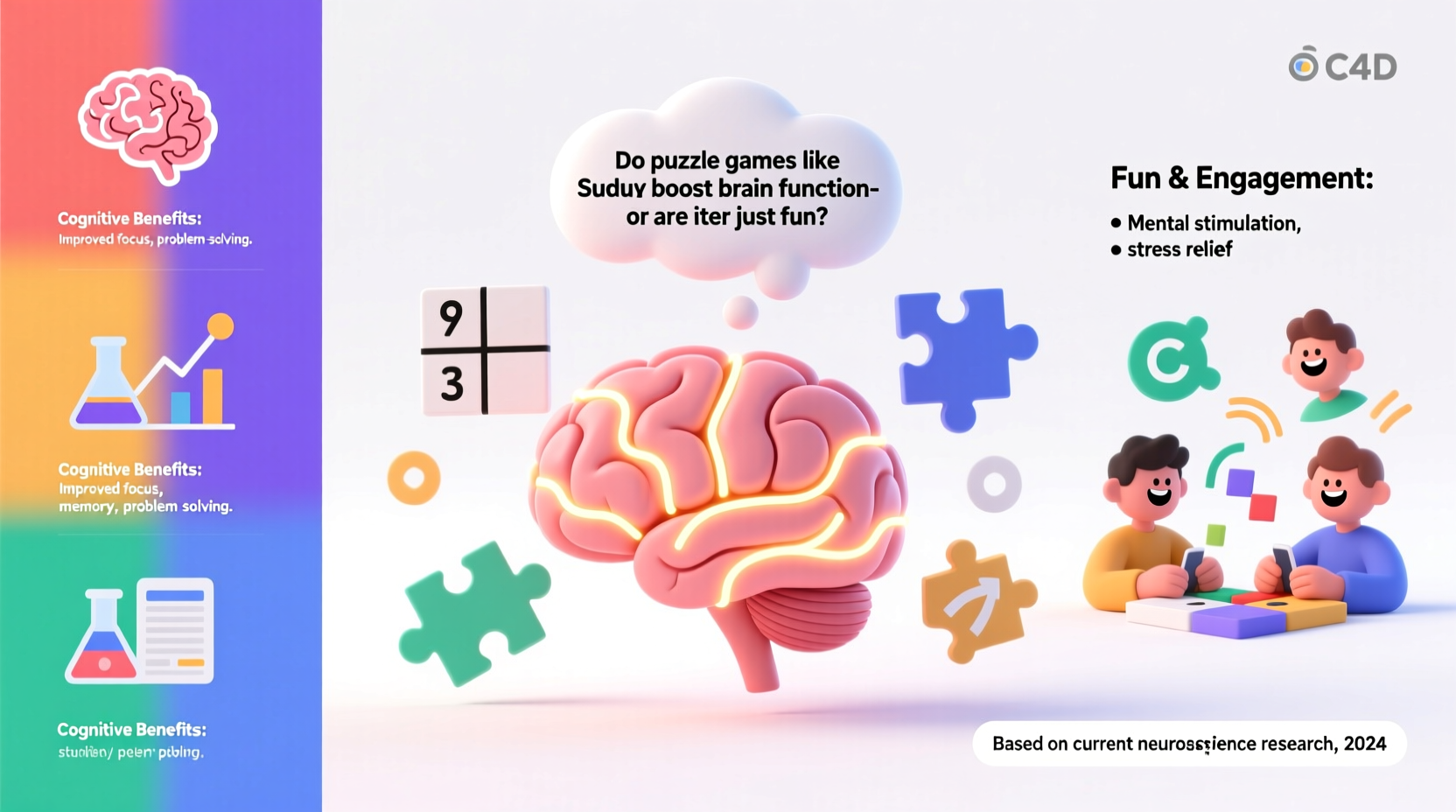
Sudoku, at its core, is a game of pattern recognition, logical deduction, and working memory. Each puzzle presents a 9x9 grid with partially filled numbers, requiring players to fill in the blanks using rules: each row, column, and 3x3 subgrid must contain all digits from 1 to 9 without repetition.
When you play Sudoku, several brain regions activate:
- Prefrontal cortex: Responsible for planning, decision-making, and problem-solving.
- Parietal lobe: Involved in spatial reasoning and numerical processing.
- Hippocampus: Engaged when recalling strategies or previously learned patterns.
Neuroimaging studies have shown that regular engagement in such tasks strengthens neural pathways associated with executive function—the brain’s command center for focus, self-control, and adaptability. However, this doesn’t automatically mean improved intelligence or long-term protection against dementia.
“Engaging in mentally stimulating activities like Sudoku can enhance fluid cognition in the short term, especially in middle-aged and older adults. But transfer to broader life skills is limited unless combined with varied challenges.” — Dr. Laura Martin, Cognitive Neuroscientist, University of Edinburgh
What Science Says About Brain Training Claims
The popularity of brain-training apps has surged over the past decade, often promising dramatic improvements in memory, IQ, or reaction time. Yet rigorous scientific reviews paint a more nuanced picture.
A landmark 2016 study published in *Nature* followed over 11,000 participants who played brain games for six weeks. The results? While players got better at the specific tasks they trained on, there was no significant improvement in general cognitive abilities like reasoning, memory, or attention compared to control groups doing unrelated activities.
In other words: practice makes you better at Sudoku—but not necessarily better at remembering names, solving work problems, or navigating new cities.
The Limits of Transfer Effects
The central issue in evaluating brain games is “transfer”—whether gains in one area (e.g., number placement) spill over into others (e.g., multitasking or learning new languages).
Most research suggests minimal far-transfer effects. For example, someone who becomes a Sudoku expert may complete puzzles faster but won’t automatically become more creative or emotionally intelligent. This mirrors physical exercise: running builds leg strength but doesn’t improve arm endurance unless you also train your upper body.
Still, near-transfer benefits exist. Regular puzzle solvers often show improved concentration, quicker information processing, and enhanced short-term memory within similar domains.
When Puzzles Help—and When They Don’t
Not all puzzle-playing experiences are equal. The impact on brain function depends heavily on how, when, and why you engage with them.
| Scenario | Benefit Level | Explanation |
|---|---|---|
| Solving easy puzzles daily out of habit | Low | Maintains baseline activity but offers little challenge or growth. |
| Progressing from easy to expert levels with focus | High | Encourages adaptive thinking and sustained effort. |
| Using puzzles as part of a diverse mental routine | High | Combined with reading, learning instruments, or social interaction, boosts overall cognitive reserve. |
| Replacing social or physical activity with hours of Sudoku | Negative | Isolation and sedentary behavior outweigh any mental gains. |
A Real Example: Maria’s Morning Routine
Maria, a 58-year-old librarian, started doing Sudoku after retirement to “keep her mind sharp.” Initially, she stuck to beginner puzzles and completed three per day in less than ten minutes. After two months, she noticed no real change in focus or memory.
Then, she shifted strategy: she moved to harder puzzles, limited herself to one per day, and timed her sessions to encourage progress tracking. She also joined a weekly book club and began learning basic Spanish online.
Within six months, Maria reported feeling more mentally alert, especially when multitasking at home or following complex plots in novels. Her experience illustrates a key principle: puzzles work best when they’re challenging, intentional, and part of a broader lifestyle of engagement.
Maximizing the Benefits: A Practical Guide
If you want to get real value from puzzle games like Sudoku, treat them like any form of exercise—structured, progressive, and balanced.
Step-by-Step Approach to Effective Puzzle Practice
- Start at your level: Choose puzzles that require effort but aren’t overwhelming. If you finish a Sudoku in two minutes without thinking, it’s too easy.
- Incorporate time pressure (optional): Try solving within a set window to boost processing speed and focus.
- Review mistakes: Analyze where you went wrong. Did you misread clues? Skip a candidate number? Learning from errors deepens cognitive engagement.
- Vary your tools: Switch between paper, apps, and collaborative formats. Physical writing activates different motor-memory pathways than tapping on screens.
- Track progress monthly: Note completion times, error rates, and perceived difficulty. Progress isn’t always linear, but trends reveal improvement.
- Limited duration: Aim for 15–30 minutes per session. Extended play leads to diminishing returns and mental fatigue.
Complementary Brain-Boosting Activities
No single activity can comprehensively strengthen the brain. Cognitive resilience comes from diversity in stimulation. Think of your mind like a muscle group: you wouldn’t only do bicep curls and expect full-body fitness.
Here’s a checklist of proven activities to combine with puzzle games:
- ✅ Learn a new language or musical instrument
- ✅ Engage in face-to-face conversations regularly
- ✅ Read complex material (nonfiction, philosophy, technical topics)
- ✅ Practice mindfulness or meditation for attention regulation
- ✅ Stay physically active—walking, swimming, or dancing all support brain health
- ✅ Get consistent, high-quality sleep (critical for memory consolidation)
These activities stimulate different neural networks than Sudoku. Together, they build what neuroscientists call “cognitive reserve”—a buffer against age-related decline and neurological disease.
“The most resilient brains aren’t those that do one thing perfectly, but those exposed to a wide range of challenges. Variety is the key to long-term mental vitality.” — Dr. Rajiv Mehta, Director of Aging & Cognition Research, Toronto Institute
Frequently Asked Questions
Can Sudoku prevent Alzheimer’s disease?
There is no conclusive evidence that Sudoku prevents Alzheimer’s. However, lifelong engagement in mentally stimulating activities is associated with delayed onset of symptoms. It’s one protective factor among many, including cardiovascular health, diet, and genetics.
How often should I play Sudoku to see benefits?
For meaningful engagement, aim for 3–5 sessions per week lasting 15–30 minutes each. Consistency matters more than frequency. Daily play without progression yields minimal gains.
Are digital puzzle apps better than paper ones?
Both have advantages. Apps provide instant feedback, adaptive difficulty, and portability. Paper puzzles reduce screen strain, promote slower, deeper thinking, and involve fine motor skills. Rotate between both for balanced stimulation.
Conclusion: Fun With Functional Benefits
Puzzle games like Sudoku are neither miracle brain boosters nor mere time-wasters. They occupy a valuable middle ground: enjoyable activities that, when used thoughtfully, contribute to sharper focus, better working memory, and sustained mental agility.
Their true power emerges not in isolation, but as part of a holistic approach to brain health—one that values novelty, challenge, social connection, and physical well-being equally. So keep solving puzzles, but don’t stop there. Let Sudoku be the warm-up, not the entire workout.




 浙公网安备
33010002000092号
浙公网安备
33010002000092号 浙B2-20120091-4
Comments
No comments yet. Why don't you start the discussion?