
Sleep is foundational to health—impacting everything from cognitive function to immune resilience. As awareness grows, so does demand for tools that help us understand and optimize our rest. Enter sleep trackers: wrist-worn devices, smart rings, and bedside monitors promising insights into sleep duration, quality, and stages. But how much of this data is scientifically sound, and how much is digital noise? More importantly, can these gadgets genuinely improve your sleep—or are they just collecting metrics with little practical use?
The answer isn’t binary. While modern sleep trackers have made strides in usability and pattern recognition, their accuracy varies widely based on technology, placement, and individual physiology. Yet even imperfect data can spark meaningful behavioral changes if interpreted wisely. The real question isn't whether sleep trackers are perfectly accurate—it's whether they're useful.
How Sleep Trackers Work: The Science Behind the Sensors
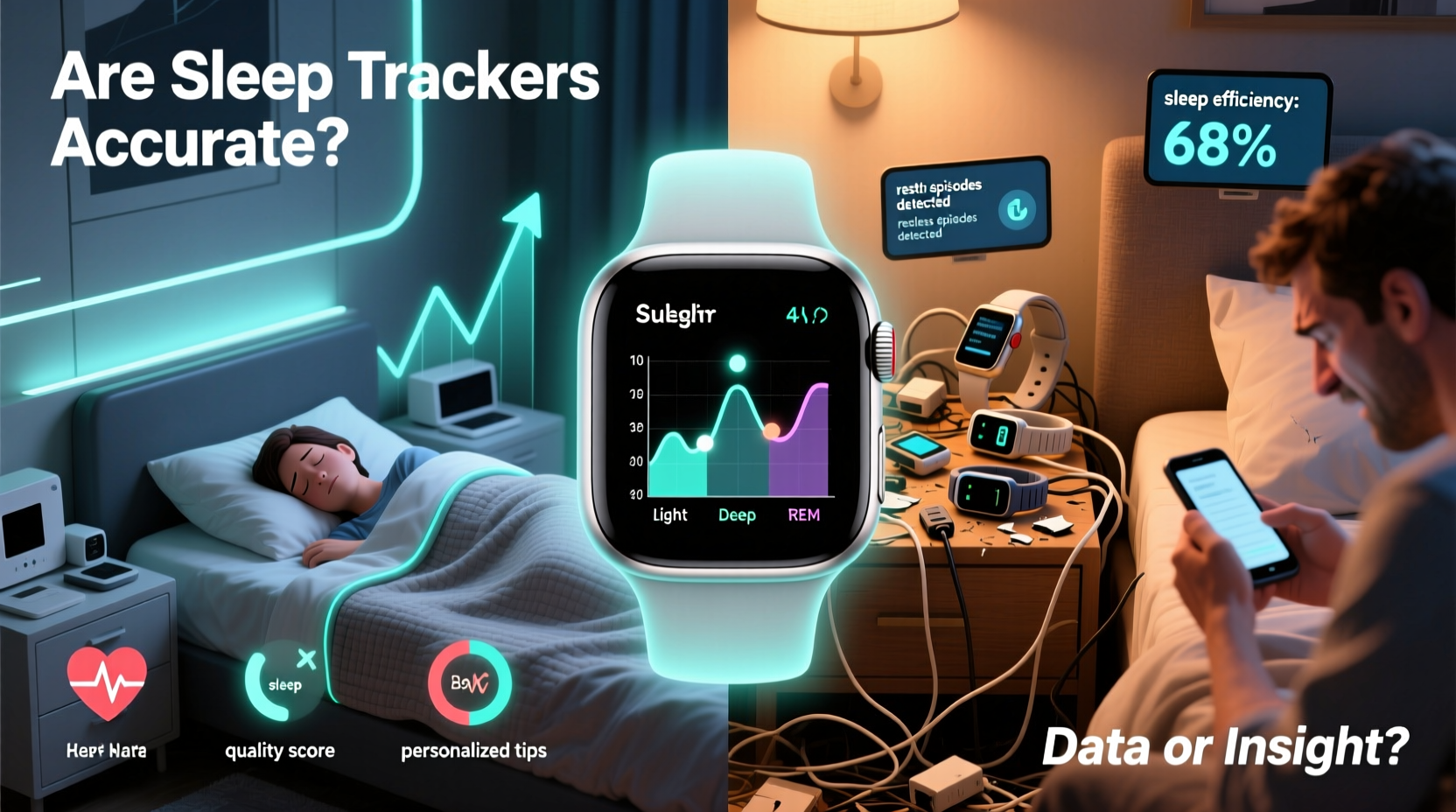
Sleep tracking devices primarily rely on a combination of accelerometry, heart rate monitoring (via photoplethysmography or PPG), and sometimes respiratory rate or skin temperature. These inputs feed algorithms trained to infer sleep stages—light, deep, and REM—based on movement patterns and physiological signals.
For example, reduced movement combined with lowered heart rate and increased heart rate variability typically suggests deeper sleep. Sudden spikes in heart rate may indicate REM cycles, where dreaming occurs. However, unlike polysomnography—the gold standard used in sleep labs—consumer devices don’t measure brainwave activity (EEG), eye movements (EOG), or muscle tone (EMG).
This limitation is significant. EEG readings provide definitive evidence of sleep onset and stage transitions. Without them, trackers must estimate based on indirect proxies. As Dr. Cathy Goldstein, associate professor of neurology at the University of Michigan, explains:
“Actigraphy and heart rate-based estimation can give you a ballpark idea of your sleep patterns, but they’re not diagnostic tools. They’re more like weather forecasts—sometimes precise, often directional.” — Dr. Cathy Goldstein, Sleep Neurologist
In clinical settings, discrepancies between tracker data and lab results are common. A 2020 study published in *Sleep Medicine Reviews* found that while most wearables accurately detect total sleep time (within 10–15 minutes), they struggle with differentiating light and deep sleep, often overestimating deep sleep by as much as 40%.
Accuracy vs. Utility: What Really Matters?
Perfect accuracy would mean a device mirrors polysomnography results exactly—but that’s neither feasible nor necessary for most users. What matters more is whether the data leads to better decisions.
Consider this: if your tracker consistently shows you’re getting only five hours of sleep per night, and you feel fatigued during the day, the specific breakdown of sleep stages becomes secondary. The actionable insight—that you’re chronically underslept—is valid regardless of algorithmic precision.
However, overreliance on inaccurate stage data can backfire. Some users obsess over “low deep sleep” percentages reported by their devices, leading to anxiety that worsens actual sleep quality—a phenomenon known as orthosomnia, or the obsession with achieving perfect sleep metrics.
Comparing Devices: Who Gets It Right (and Wrong)?
Not all trackers are created equal. Accuracy depends heavily on sensor quality, algorithm sophistication, and fit on the body. Below is a comparison of popular consumer devices based on independent studies and peer-reviewed evaluations.
| Device | Total Sleep Time Accuracy | Deep/REM Detection | Best For |
|---|---|---|---|
| Fitness Bands (e.g., Fitbit Charge) | High (±10 min) | Moderate (overestimates deep) | General trend tracking |
| Smartwatches (e.g., Apple Watch) | Good (±15 min) | Fair (limited by motion artifacts) | Daily integration & alerts |
| Smart Rings (e.g., Oura Ring) | Very High (±8 min) | Good (better HR stability) | Long-term wellness trends |
| Bedside Monitors (e.g., Withings Sleep Analyzer) | High (no movement bias) | Fair (infers via breathing) | Non-wearable option |
| Cheap Wearables (generic brands) | Poor (±30+ min) | Low (unverified algorithms) | Budget users (with caution) |
The Oura Ring, for instance, has been cited in multiple research papers for its relatively high correlation with actigraphy and lab results, thanks to stable finger-based PPG readings and advanced machine learning models. Meanwhile, wrist-based devices can suffer from motion artifacts—especially if worn loosely—or signal loss during rapid movements.
Real-World Impact: Can Trackers Actually Improve Sleep?
Data alone doesn’t change behavior. But when integrated into a broader strategy, sleep trackers can be powerful catalysts for improvement.
Take the case of Maria, a 34-year-old project manager struggling with fatigue despite sleeping seven hours nightly. Her Oura Ring revealed frequent nighttime awakenings and low HRV, suggesting poor sleep efficiency. Alarmed by the consistency of the data over two weeks, she consulted a sleep specialist. Testing uncovered undiagnosed mild sleep apnea. After starting treatment, her tracked sleep efficiency improved from 78% to 92%, and daytime energy returned.
In Maria’s story, the tracker didn’t diagnose—but it raised red flags that prompted action. This is where utility shines: not in replacing medicine, but in enabling early detection and self-awareness.
Other benefits include:
- Identifying bedtime inconsistencies (e.g., weekend drift)
- Revealing the impact of alcohol or caffeine on sleep fragmentation
- Validating improvements after lifestyle changes (e.g., meditation, cooler room temperature)
Still, the danger lies in misinterpretation. One user might see a “low deep sleep” score and resort to unproven supplements, while another may develop insomnia due to performance pressure around sleep metrics.
Using Sleep Trackers Wisely: A Step-by-Step Guide
To extract real value from your device without falling into data traps, follow this structured approach:
- Establish a Baseline (Week 1–2): Wear the tracker every night without changing habits. Note bedtime, wake time, perceived restfulness, and any symptoms like grogginess.
- Look for Patterns: After two weeks, review trends. Are you consistently under-slept? Do certain days show worse recovery?
- Correlate with Behavior: Cross-reference data with lifestyle factors. Did drinking wine before bed coincide with lower sleep scores? Did exercising late increase nighttime awakenings?
- Make One Change at a Time: Adjust a single variable—like going to bed 30 minutes earlier—and track results for another week.
- Validate Subjectively: Ask yourself: Do I feel more alert? Is concentration better? Objective data should align with subjective experience.
- Kick the Device Occasionally: Take a week off tracking to avoid obsession. If sleep worsens without feedback, you may be overly reliant on external validation.
Checklist: Maximizing Value from Your Sleep Tracker
Before relying on your device, ensure you're using it effectively:
- ✅ Charge it nightly to avoid gaps in data
- ✅ Wear it snugly (but comfortably) to reduce motion noise
- ✅ Sync data regularly and review weekly summaries
- ✅ Compare tracked sleep with how you actually feel
- ✅ Avoid checking scores immediately upon waking—wait an hour to prevent mood disruption
- ✅ Use companion apps to identify long-term trends, not daily extremes
- ✅ Consult a healthcare provider if data suggests chronic disruption (e.g., regular <6 hours, frequent awakenings)
FAQ: Common Questions About Sleep Trackers
Can sleep trackers detect sleep disorders like apnea?
No consumer device can definitively diagnose sleep apnea. However, some—like the Apple Watch with third-party apps or Withings Sleep Analyzer—can detect breathing disturbances and snoring that may suggest risk. Always follow up with a sleep study for confirmation.
Why does my tracker say I was asleep when I was lying awake?
This is common with low-movement periods. If you’re reading or meditating in bed without moving, the device may误classify it as sleep. To improve accuracy, manually log wake times in the app or use a \"sleep diary\" mode if available.
Should I trust my tracker more than how I feel?
No. If your device says you had “excellent” sleep but you feel exhausted, trust your body. Sleep quality includes subjective restoration, which algorithms cannot fully capture. Data should support, not override, personal experience.
Conclusion: Tools, Not Truths
Sleep trackers aren’t medical instruments, nor should they be treated as such. Their strength lies not in pixel-perfect accuracy, but in democratizing access to personal sleep patterns. When used mindfully, they can reveal hidden disruptions, reinforce healthy routines, and prompt timely interventions.
But they are only as good as the context they’re used in. Raw data without interpretation, or worse, obsessive fixation on metrics, can do more harm than good. The goal isn’t to achieve a perfect sleep score—it’s to feel rested, focused, and resilient each day.
If your tracker helps you notice that late-night scrolling ruins your rest, or that a cooler room improves deep sleep, then it’s already earned its place on your wrist or nightstand. Just remember: the best sleep tool ever invented is still a consistent routine, a dark room, and the willingness to listen to your body—even when the data disagrees.




 浙公网安备
33010002000092号
浙公网安备
33010002000092号 浙B2-20120091-4
Comments
No comments yet. Why don't you start the discussion?