
Lighting accounts for nearly 15% of household electricity use, making it one of the most visible and frequent touchpoints in home energy consumption. Over the past decade, LED bulbs have replaced incandescent and CFL lighting as the standard due to their efficiency and longevity. Now, a new contender has entered the space: smart bulbs. These Wi-Fi- or Bluetooth-enabled lights promise automation, voice control, and dynamic color options. But with prices often five to ten times higher than standard LED bulbs, many consumers ask: are smart bulbs worth the cost compared to regular LEDs?
The answer isn't a simple yes or no. It depends on your lifestyle, priorities, and how much value you place on convenience, ambiance, and integration with other smart devices. To make an informed decision, it's essential to compare not just upfront costs but also long-term benefits, energy use, functionality, and real-world usability.
Understanding the Core Differences
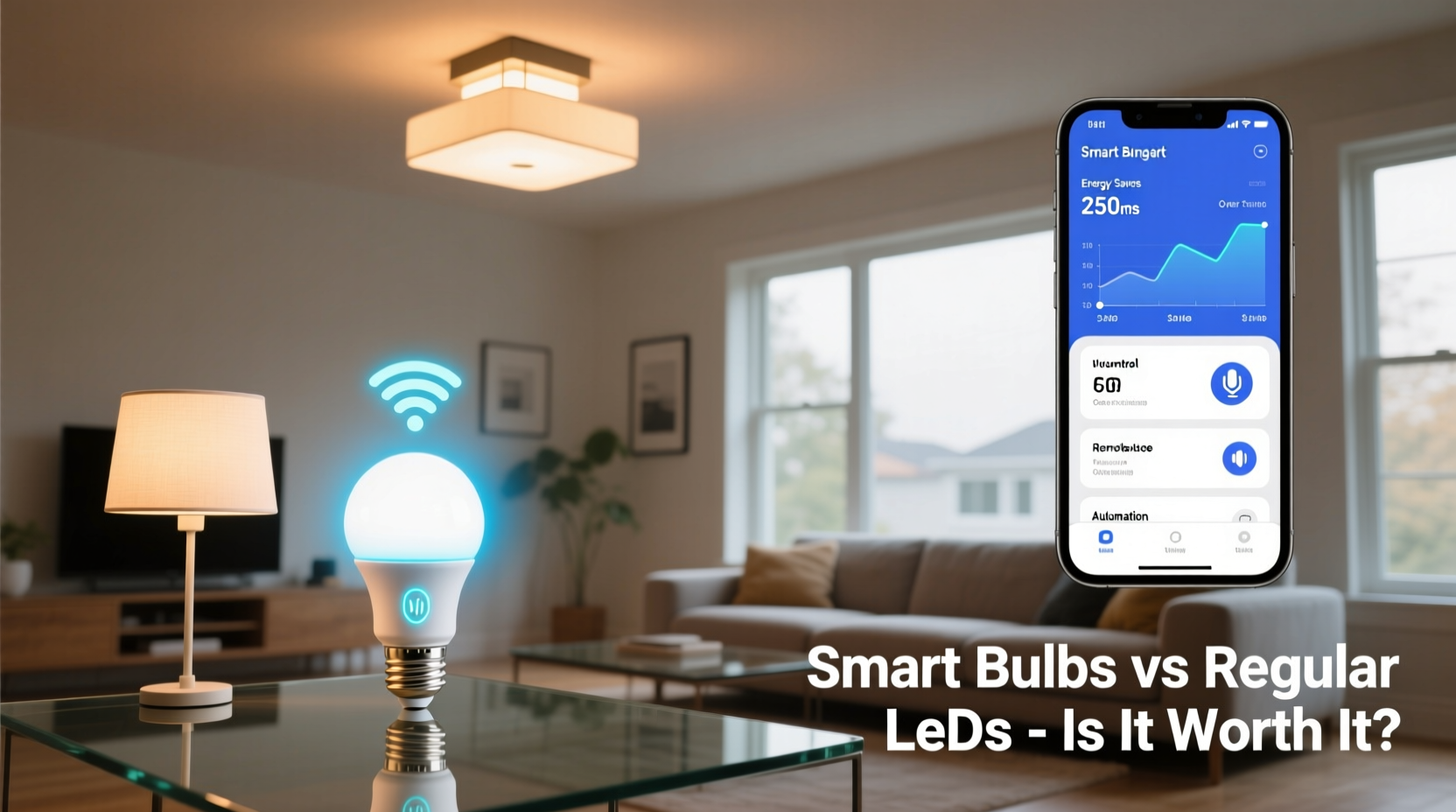
At their core, both smart bulbs and regular LED bulbs use light-emitting diodes to produce illumination far more efficiently than older technologies. However, the similarities largely end there.
Standard LED bulbs are designed for one purpose: to turn on and off reliably while consuming minimal power. They come in various color temperatures (warm white, cool white, daylight) and brightness levels (measured in lumens), but their behavior is fixed unless paired with a dimmer switch. Once installed, they require no setup beyond screwing them into a socket.
Smart bulbs, by contrast, integrate microprocessors, wireless radios (usually Wi-Fi, Zigbee, or Bluetooth), and sometimes full-color RGB LEDs. This allows them to be controlled remotely via smartphone apps, voice assistants like Alexa or Google Assistant, or automated routines. You can schedule them to turn on at sunset, change colors during movie night, or flash when your phone receives a notification.
These added capabilities come at a price — literally and figuratively. Smart bulbs cost more to manufacture, consume slightly more standby power, and may require additional infrastructure like hubs or stable internet connections.
Cost Comparison: Upfront vs. Long-Term
The most immediate barrier to adopting smart bulbs is their price. A typical A19-shaped LED bulb from a major brand like Philips or GE costs between $2 and $5. In contrast, a comparable smart bulb starts around $10 and can go up to $25 or more for premium models with advanced features like tunable white light or enhanced color accuracy.
To illustrate the difference, consider outfitting a modest home with 30 light fixtures:
| Bulb Type | Average Price per Bulb | Total Cost (30 bulbs) | Lifespan (hours) | Wattage (equivalent to 60W incandescent) |
|---|---|---|---|---|
| Regular LED | $3.50 | $105 | 15,000–25,000 | 8–10W |
| Smart LED (e.g., Philips Hue, LIFX) | $15.00 | $450 | 15,000–25,000 | 9–12W |
As shown, equipping a full house with smart bulbs can cost over four times more upfront. While both types last roughly the same amount of time under normal usage (about 15–20 years at three hours per day), the energy consumption difference is negligible — smart bulbs use only slightly more power, mostly due to maintaining network connectivity even when \"off.\"
However, smart bulbs can contribute to indirect savings through automation. For example, setting lights to turn off automatically when rooms are unoccupied reduces wasted energy. One study by the American Council for an Energy-Efficient Economy found that homes using occupancy-based lighting controls reduced lighting energy use by 24–38%.
Functionality and Lifestyle Benefits
Where smart bulbs truly differentiate themselves is in functionality. Regular LEDs serve a utilitarian role: providing illumination. Smart bulbs expand that role into ambient design, security, and integration with broader smart home ecosystems.
- Remote Control: Turn lights on or off from anywhere using a smartphone app, useful if you forget to switch off before leaving home.
- Voice Activation: Works seamlessly with Amazon Alexa, Google Assistant, or Apple HomeKit for hands-free operation.
- Scheduling & Automation: Lights can follow sunrise/sunset patterns, turn on during vacations to simulate presence, or dim gradually to support circadian rhythms.
- Color Tuning: Many smart bulbs offer millions of colors and adjustable white tones, enabling personalized atmospheres for relaxation, focus, or entertainment.
- Scene Integration: Combine multiple bulbs into scenes (e.g., “Movie Night” dims all lights to warm amber) and trigger them with a single command.
For individuals with mobility challenges or busy lifestyles, these features aren’t just conveniences—they’re meaningful quality-of-life improvements. A parent juggling children at bedtime can dim all upstairs lights with a voice command. Someone working late can wake up a dark house remotely before arriving.
“Smart lighting isn’t just about turning lights on and off—it’s about creating environments that adapt to human needs.” — Dr. Lena Patel, Smart Home Researcher at MIT Media Lab
Real-World Example: The Smith Family’s Smart Lighting Upgrade
The Smiths, a family of four in suburban Denver, replaced eight key bulbs in their home with smart LEDs over a six-month period. They started with two bedside lamps, the living room ceiling fixture, and outdoor porch lights.
Initially skeptical about the cost, they quickly noticed behavioral changes. The kids began using voice commands to turn off lights instead of ignoring reminders. The porch light was scheduled to turn on at dusk and off at midnight, improving neighborhood safety without manual intervention. During a two-week vacation, they used randomization schedules to simulate occupancy, giving peace of mind.
After one year, they calculated a 12% reduction in lighting-related energy use—not because the bulbs were more efficient, but because fewer lights were left on accidentally. More importantly, they reported improved sleep hygiene after programming bedroom lights to shift to warmer tones in the evening.
While the initial investment totaled $120, they felt the convenience, security, and wellness benefits justified the expense—especially since they didn’t need to upgrade the remaining 12 bulbs in less-used areas like closets and garages.
Key Considerations Before Buying Smart Bulbs
Not every home or user will benefit equally from smart lighting. Before making the leap, consider the following checklist to determine if smart bulbs align with your needs:
Smart Bulb Readiness Checklist
- ✅ Do you have a reliable Wi-Fi network throughout your home?
- ✅ Do you own or plan to use a voice assistant (Alexa, Google Assistant, Siri)?
- ✅ Are there specific lighting scenarios where automation would save time or enhance comfort?
- ✅ Are you comfortable downloading apps and managing device settings?
- ✅ Will you use advanced features like color changing or scheduling regularly?
- ❌ Are you looking for a plug-and-forget solution with zero maintenance?
If most answers are “yes,” smart bulbs could be a worthwhile investment. If you answered “no” or “uncertain” to several items, sticking with regular LEDs—or reserving smart bulbs for select fixtures—may be smarter.
Common Drawbacks and Limitations
Despite their advantages, smart bulbs come with trade-offs that affect long-term satisfaction:
- Dependence on Internet/Apps: If your Wi-Fi goes down, remote control fails. Some bulbs won’t work at all without cloud connectivity.
- Compatibility Issues: Not all smart bulbs work with every platform. Zigbee-based bulbs (like Philips Hue) require a hub, while others may not support Apple HomeKit or Matter protocol.
- Standby Power Consumption: Even when off, smart bulbs draw 0.2–0.5 watts to stay connected—adding up across multiple units.
- Obsolescence Risk: As standards evolve (e.g., the rollout of Matter), older models may lose functionality or support.
- Complexity: Setting up routines, naming devices, and troubleshooting connection issues can frustrate non-tech-savvy users.
Additionally, some users report dissatisfaction when smart bulbs fail prematurely due to overheating in enclosed fixtures—a risk shared with standard LEDs but exacerbated by internal electronics generating extra heat.
Frequently Asked Questions
Can I use smart bulbs with a regular light switch?
Yes, but with caveats. Turning off a smart bulb at the wall switch cuts power, disabling its smart functions. The bulb will still work when switched back on, but you may need to reset schedules or reconnect to Wi-Fi. For best results, leave switches on and control bulbs exclusively through apps or voice.
Do smart bulbs increase my electric bill significantly?
No. While smart bulbs use slightly more energy than regular LEDs (mainly in standby mode), the difference is minimal—typically less than $1 extra per bulb per year. Any inefficiency is often offset by better usage habits enabled by automation.
Are smart bulbs secure?
Most reputable brands use encryption and regular firmware updates to protect against hacking. However, any internet-connected device carries some risk. To minimize exposure, keep firmware updated, use strong passwords, and isolate smart devices on a separate network if possible.
Conclusion: Balancing Value, Convenience, and Practicality
Smart bulbs are not universally “worth it,” but for many modern households, they offer tangible benefits that justify the higher price tag. They transform lighting from a passive utility into an active component of home wellness, security, and personalization. The ability to automate routines, enhance ambiance, and integrate with other smart systems adds layers of convenience that standard LEDs simply can’t match.
That said, blanket replacement of all household bulbs with smart versions is rarely cost-effective. A strategic approach—targeting high-impact areas like bedrooms, living rooms, and entryways—delivers maximum benefit without overspending. Advances in interoperability standards like Matter are also reducing compatibility headaches, making today’s smart bulbs more future-proof than ever.
If you value control, customization, and seamless technology integration, investing in a few well-placed smart bulbs can elevate your daily experience. For everyone else, regular LEDs remain an excellent, low-maintenance choice that delivers 90% of the energy savings at a fraction of the cost.




 浙公网安备
33010002000092号
浙公网安备
33010002000092号 浙B2-20120091-4
Comments
No comments yet. Why don't you start the discussion?