
For over a decade, GoPro has dominated the action camera market with its rugged, high-performance devices designed for extreme sports, travel vlogging, and immersive storytelling. But a new contender is emerging — not as a handheld or helmet-mounted device, but as something worn directly on the face: smart glasses. From athletes to urban adventurers, users who once relied exclusively on GoPros are now turning to smart glasses like Ray-Ban Meta, XREAL Air 2, and future iterations of Google Glass-style wearables. The shift isn’t just about convenience — it’s about a fundamental change in how we capture, interact with, and share experiences.
The Rise of Smart Glasses in Action Capture
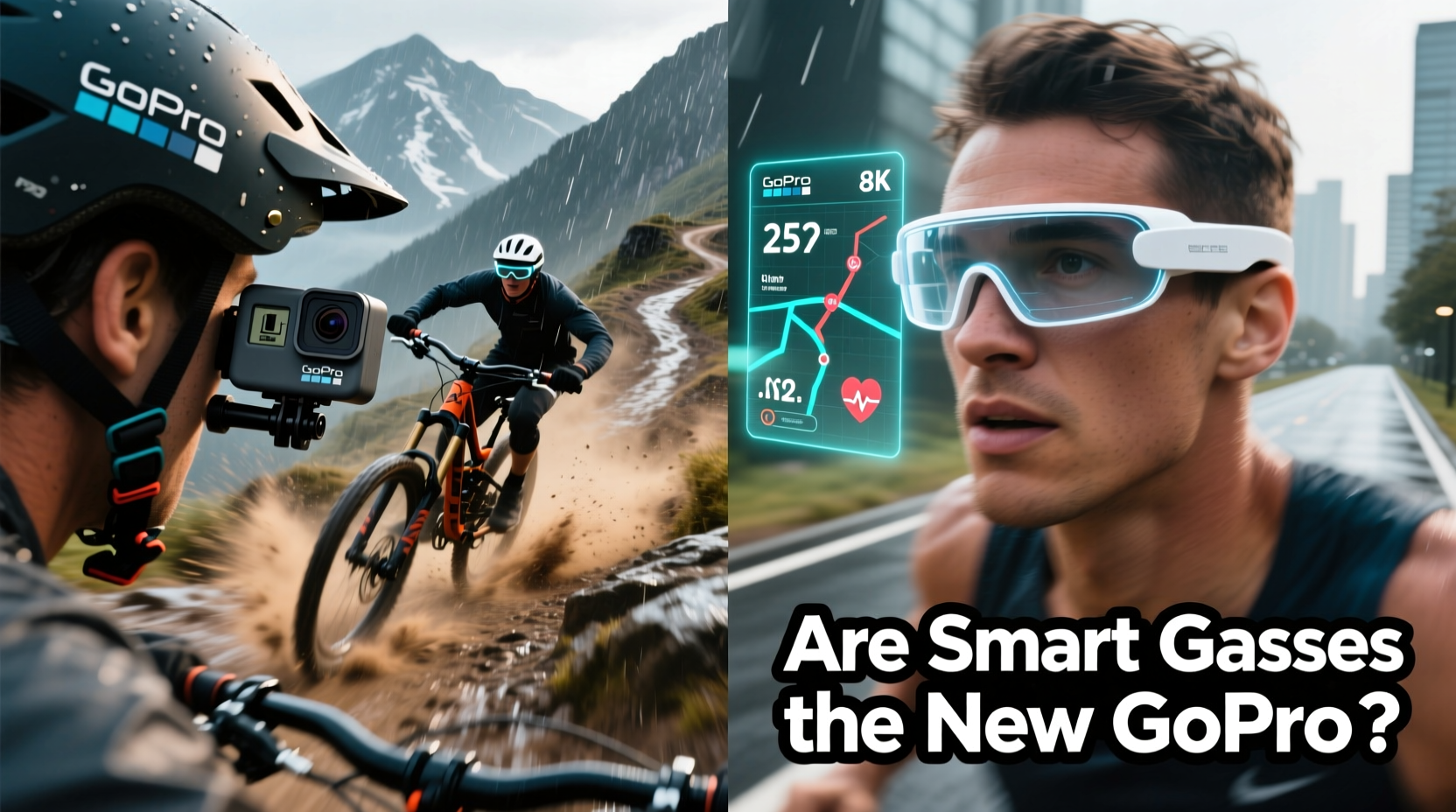
Smart glasses have evolved from clunky prototypes into sleek, functional wearables that blend seamlessly into daily life. Unlike traditional action cameras, which require mounting, setup, and often post-capture editing, smart glasses offer instant access to recording, live streaming, navigation, and augmented reality overlays — all without lifting a finger.
This immediacy is transforming how people document their lives. A mountain biker can start recording with a voice command while navigating a trail. A traveler can translate street signs in real time through AR subtitles. A fitness enthusiast can receive performance feedback via audio cues mid-run. These capabilities go beyond what even the most advanced GoPro can do — not because they outperform in video specs alone, but because they integrate into the user’s sensory experience.
Why Users Are Making the Switch
The migration from standalone action cameras to smart glasses is driven by several key advantages:
- Hands-free operation: No need to adjust mounts or press buttons; everything is controlled via voice or touchpad.
- Natural point-of-view (POV) footage: Since the camera sits at eye level, recordings reflect exactly what the user sees — more authentic than helmet or chest mounts.
- Real-time data integration: GPS, heart rate monitoring, translation, and object recognition enhance utility beyond mere video capture.
- Social sharing on the fly: Many models allow direct livestreaming or instant uploads to social platforms.
- Discreet design: They look like regular sunglasses, making them suitable for urban environments where overt tech gear might draw attention.
“We’re seeing a generational shift,” says Dr. Lena Torres, wearable technology researcher at MIT Media Lab.
“Users no longer want to carry multiple devices. They want one tool that captures, connects, and assists — and smart glasses are finally delivering that promise.”
Comparing Capabilities: Smart Glasses vs. GoPro
While smart glasses offer compelling benefits, they don’t yet match GoPros in every technical aspect. Here's how they stack up across critical categories:
| Feature | Smart Glasses (e.g., Ray-Ban Meta) | GoPro Hero 12 |
|---|---|---|
| Video Resolution | Up to 1080p | 5.3K at 60fps, 4K at 120fps |
| Field of View | ~80° (narrower, natural perspective) | Ultra-wide (up to 150°) |
| Water Resistance | Limited (splash-resistant only) | Fully waterproof up to 33ft (with housing) |
| Battery Life (Recording) | Approx. 1–2 hours | Over 2 hours (extended with mods) |
| Audio Quality | Built-in mics with noise filtering | Advanced wind reduction, external mic support |
| Connectivity & AI Features | Live streaming, AR overlays, voice assistant | Wi-Fi/Bluetooth, app control, basic voice commands |
| Portability & Wearability | Always on, lightweight, stylish | Requires mounting, adds bulk |
The table shows a trade-off: GoPros still lead in raw performance, especially for professional-grade footage and extreme conditions. However, smart glasses excel in accessibility, usability, and contextual intelligence — qualities increasingly valued by everyday creators.
A Real-World Shift: From Ski Slopes to City Streets
Consider the case of Maya Chen, an adventure vlogger based in Colorado. For years, she used a GoPro mounted on her helmet to film ski runs and backcountry hikes. But last winter, she switched to Ray-Ban Meta glasses after realizing her audience responded more to first-person interactions than wide-angle stunts.
“People weren’t just watching my descents — they wanted to feel like they were skiing with me. With smart glasses, I could narrate turns, point out hazards, and even answer questions mid-run using voice notes. My engagement doubled within three months.”
Maya now uses her GoPro only for cinematic drone-assisted shots, reserving her glasses for real-time storytelling. Her experience reflects a broader trend: content is becoming less about spectacle and more about immersion and connection.
Step-by-Step: How to Transition from GoPro to Smart Glasses
If you're considering making the switch, follow this practical timeline to ensure a smooth transition:
- Evaluate your use cases: Determine whether your needs prioritize mobility and POV authenticity over ultra-HD resolution.
- Test different models: Try options like Ray-Ban Meta, XREAL Air 2, or Rokid Max to assess comfort, field of view, and battery life.
- Master voice controls: Practice issuing commands like “Hey Facebook, record a video” or “Start livestream” until they become second nature.
- Optimize lighting conditions: Record during daylight hours initially, as low-light performance on most smart glasses is still limited.
- Integrate with your workflow: Set up automatic cloud backups and edit clips using mobile apps before publishing.
- Combine with existing gear: Use smart glasses for primary POV footage and GoPro for supplemental angles or water-based activities.
Actionable Checklist Before You Switch
Before replacing your GoPro with smart glasses, ask yourself:
- ✅ Do I frequently shoot in environments where hands-free operation matters?
- ✅ Is natural eye-level perspective more valuable than ultra-wide framing?
- ✅ Am I comfortable with slightly lower video quality for greater convenience?
- ✅ Will I benefit from AR features like navigation, translation, or real-time stats?
- ✅ Can I manage shorter battery life with portable charging solutions?
Frequently Asked Questions
Can smart glasses replace a GoPro entirely?
Not completely — not yet. If you're filming underwater, in heavy rain, or need cinematic 5K footage, a GoPro remains superior. However, for daily adventures, urban exploration, and social-first content, smart glasses can serve as a primary device.
Are there privacy concerns with recording via smart glasses?
Yes. Because recording is discreet, some jurisdictions require visible indicators or verbal disclosure when capturing video in public. Always check local laws and be transparent with others around you.
How good is the audio quality on smart glasses?
Most modern models include beamforming microphones that isolate your voice and reduce wind noise. While not studio-grade, the audio is clear enough for vlogs, interviews, and real-time commentary.
Conclusion: The Future Is Worn, Not Held
Smart glasses aren't just the \"new GoPro\" — they represent a new philosophy of documentation. Where GoPro championed durability and high-octane visuals, smart glasses promote continuity, context, and connectivity. They don’t eliminate the need for dedicated action cameras, but they redefine what it means to capture a moment.
As display technology improves, batteries get denser, and AI becomes more intuitive, the gap between smart glasses and traditional action cams will continue to narrow. For early adopters, the choice isn’t about abandoning GoPro — it’s about expanding their toolkit with a device that sees the world through their eyes, literally and figuratively.




 浙公网安备
33010002000092号
浙公网安备
33010002000092号 浙B2-20120091-4
Comments
No comments yet. Why don't you start the discussion?