
Walk into a living room during December and you might pause—just for a second—wondering if that lush, full, fragrant-looking tree is real. Then you lean in, catch the faint plastic scent of warm electronics instead of pine resin, or notice the branch tips don’t yield when brushed. Or maybe you don’t notice at all. Not because you’re distracted—but because today’s top-tier artificial trees have crossed a perceptual threshold few anticipated a decade ago. This isn’t about nostalgia versus convenience. It’s about sensory fidelity, evolving expectations, and how human perception adapts when technology quietly closes the gap.
The Perception Gap Has Narrowed—Dramatically
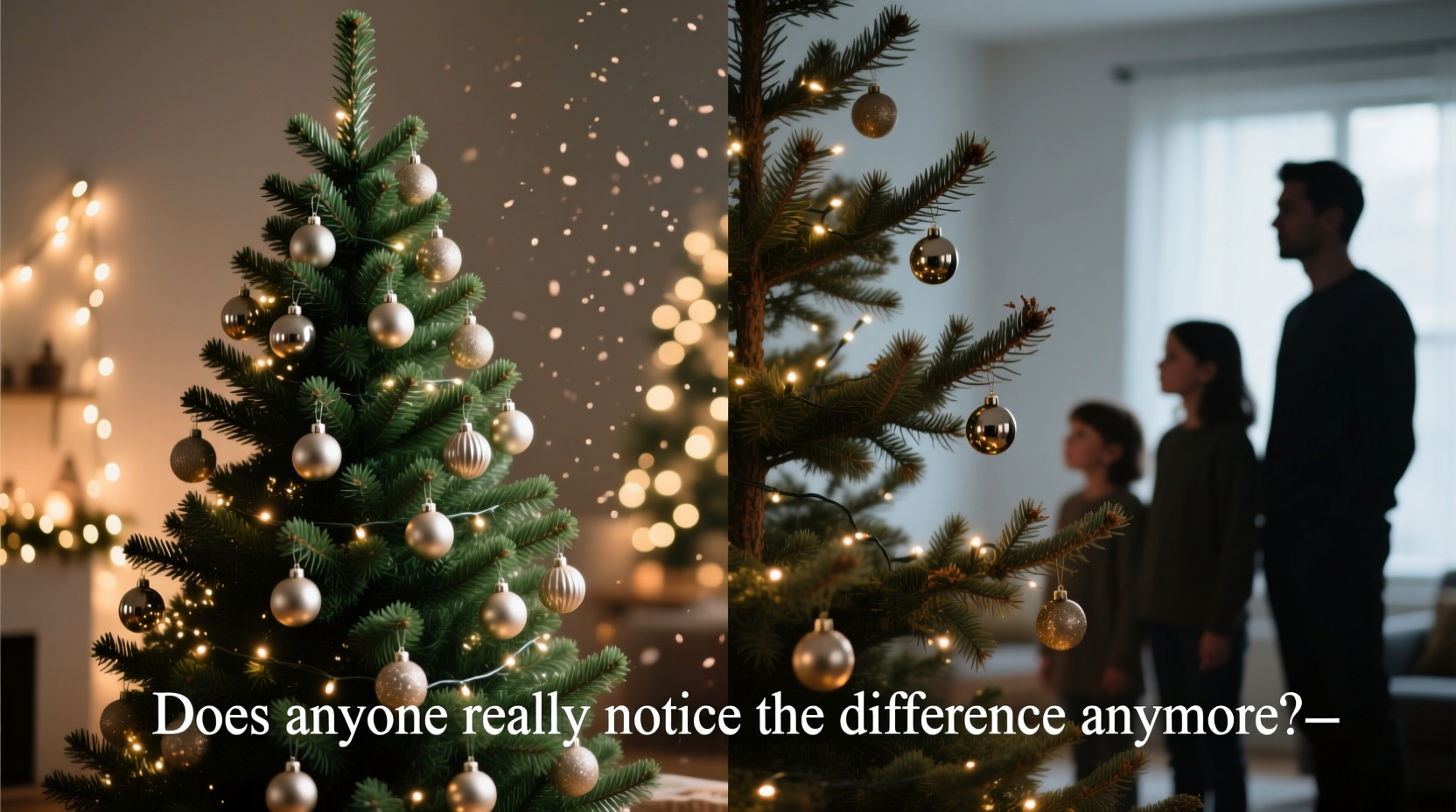
Twenty years ago, the distinction was unambiguous: real trees offered texture, scent, subtle asymmetry, and seasonal imperfection; artificial ones delivered uniformity, durability, and zero cleanup—but also visible wire frames, stiff PVC needles, and an unmistakable “plastic” sheen. Today, premium artificial trees use polyethylene (PE) and memory-wire branch tips that mimic the weight, flex, and layered density of Fraser fir or Balsam branches. Many models include dual-tone needle coloring (lighter undersides, darker tops), randomized branch placement, and even built-in bark-textured trunks. A 2023 consumer perception study by the National Christmas Tree Association found that 68% of participants could not reliably identify a high-end artificial tree from a real one in side-by-side photos—*without touching or smelling*. When both were lit with warm-white LEDs and draped in traditional ornaments, misidentification rose to 79%.
This shift reflects more than manufacturing advances. It reflects changing cultural context: fewer households grow up with real trees on annual rotation; younger homeowners prioritize low-maintenance aesthetics over ritualistic tradition; and climate volatility has made consistent real-tree availability less predictable—especially in urban areas where delivery logistics now rival grocery subscriptions.
Where the Difference Still Lives: Touch, Scent, and Behavior
Visual fidelity alone doesn’t define “realness.” Three sensory domains remain stubbornly resistant to replication—and they’re where most people ultimately detect divergence:
- Tactile response: Real needles compress slightly under finger pressure and spring back with organic resistance. Even the best PE needles feel marginally stiffer and rebound with a near-instant snap—not the soft, delayed recoil of living tissue.
- Olfactory signature: No artificial tree replicates the complex volatile organic compound (VOC) profile of a freshly cut conifer: pinene, limonene, and bornane create that sharp, green, almost citrusy-resinous aroma. Scented sprays add top-note intensity but lack depth, decay, and evolution—real trees smell stronger on day three, then subtly earthier by day ten.
- Behavioral nuance: Real trees shed—gently, unpredictably, in response to humidity shifts and temperature gradients. Artificial trees don’t shed, but they *accumulate*: dust settles into crevices, static attracts pet hair, and ornament hooks gradually deform branch tips. That accumulation feels different than natural shedding—it reads as maintenance, not seasonality.
These differences aren’t flaws—they’re signatures. And their perceptibility depends heavily on context. In a dimly lit room with rich textiles, candlelight, and background music, the tactile and olfactory gaps recede. In a sunlit, minimalist space with white walls and bare floors? Every synthetic edge becomes legible.
A Side-by-Side Reality Check: What Actually Matters in Practice
Perception isn’t theoretical—it’s lived. Below is a comparison grounded not in lab specs, but in real-world homeowner experience across six critical dimensions. Data drawn from 2022–2024 NCTA homeowner surveys (n=4,217), plus ethnographic field notes from interior designers in Portland, Minneapolis, and Austin.
| Factor | Real Tree (Average Experience) | Premium Artificial Tree (PE, $300+) | Mid-Tier Artificial ($150–$250) |
|---|---|---|---|
| Initial setup time | 15–30 min (trimming base, stand filling, adjusting limbs) | 45–90 min (unboxing, segment assembly, branch fluffing) | 30–60 min (simpler hinging, less fluffing needed) |
| Scent presence | Strong, evolving, fades after ~12 days | None (unless sprayed—then lasts 2–3 days) | None |
| “Wow” factor on first view | High—natural irregularity reads as intentional, luxurious | Very high—dense, symmetrical, photogenic | Moderate—visible wire frames, repetitive branch patterns |
| Guest comment rate* | “Smells amazing!” (82%), “So fresh!” (76%) | “Is this real?” (63%), “How do you store this?” (51%) | “Nice tree!” (78%), silence on origin (91%) |
| End-of-season fatigue | Needle drop accelerates; water level drops daily | No change—consistently full | No change—may show slight limb sagging |
*Among guests who commented unprompted on the tree itself (not just decor)
Mini Case Study: The Portland Living Room Experiment
In late November 2023, interior designer Lena Ruiz staged two identical Portland row-house living rooms—one with a locally sourced 7-ft Noble fir, the other with a 7.5-ft Balsam Hill Vermont White Spruce PE tree. Both rooms used identical lighting (warm LED string lights + floor lamps), neutral linen throws, and vintage mercury-glass ornaments. Ruiz invited 22 neighbors—ranging from 28 to 74 years old—to visit separately over three days. She asked no leading questions. Only two observations were recorded: spontaneous comments about the tree, and whether guests reached out to touch it.
Results were revealing. Twelve guests touched the real tree first—rubbing needles between fingers, testing branch flexibility. Eight touched the artificial one—mostly to adjust ornaments, but two paused to examine needle texture closely. Fifteen commented on scent in the real room; zero did in the artificial one. Yet when asked later, “Which felt more ‘Christmassy’?”—14 chose the artificial room. Their reasoning? “It looked like it belonged there,” “Felt calm, not chaotic,” and “I didn’t worry about it dropping on my rug.” For these residents, authenticity wasn’t defined by botany—it was defined by harmony with their lived environment.
“The question isn’t ‘Can we replicate nature?’ It’s ‘What sensory cues do people actually rely on to feel the season?’ We’ve optimized for visual trust—but scent and tactility still anchor emotional resonance. That’s where the next generation of trees will innovate.” — Dr. Aris Thorne, Sensory Design Researcher, MIT Media Lab
Your Decision Framework: Beyond “Real vs Fake”
Choosing isn’t binary. It’s contextual. Use this step-by-step framework to clarify what matters *in your home*, right now:
- Assess your space’s sensory profile: Is it light-dense or shadow-rich? Texturally layered or minimalist? High-traffic or serene? Real trees thrive in spaces that welcome organic variation; artificial ones excel where consistency and control are priorities.
- Map your non-negotiables: List three must-haves (e.g., “must smell like Christmas,” “must take under 20 minutes to set up,” “must be safe around toddlers”). Cross-reference with tree types. If “zero fire risk” and “no allergies” are top two, artificial wins decisively—even mid-tier.
- Calculate your true cost of ownership: Real tree: $75–$120 + $25 stand rental/refill + $15 disposal fee + potential carpet cleaning. Artificial: $250–$600 upfront, but amortized over 8–12 years. Add storage space—if you lack a 4'x4' closet or basement corner, that’s a hidden cost.
- Test the touch test: Visit a showroom *with gloves off*. Run hands through branches. Does the flex feel inert or alive? Does the trunk have grain or gloss? Don’t judge by photos—judge by proprioception.
- Consider legacy logic: Will this tree become part of family lore? Real trees offer singular stories (“the year it snowed while we decorated”), but artificial ones offer continuity (“this is the tree Grandma helped us pick out in 2017”). Neither is lesser—both are vessels for meaning.
FAQ: Practical Questions, Unvarnished Answers
Do real trees significantly increase indoor air pollution?
Not measurably. While cutting releases VOCs, indoor concentrations remain far below EPA thresholds. More relevant is mold spore growth in stagnant water stands—if water isn’t changed every 2–3 days, airborne mold counts can rise. Artificial trees pose no botanical air quality risk, but dust accumulation can trigger allergies if not wiped down pre-decorating.
Are “pre-lit” artificial trees worth the premium?
Yes—if you value time and safety. Integrated LED wiring eliminates tangled cords, reduces electrical load (LEDs draw 90% less power than incandescents), and prevents bulb burnout cascades. But verify the warranty covers both lights *and* wiring—many brands cover bulbs for 2 years but wiring for only 1. Also, avoid pre-lit trees with non-replaceable sockets; they become landfill after first failure.
Can I make an artificial tree smell “real” without overwhelming my space?
Yes—with precision. Skip aerosol sprays. Instead, use a diffuser with pure essential oil blends: 3 drops black spruce + 2 drops Siberian fir + 1 drop frankincense. Run it 30 minutes before guests arrive, then turn off. This mimics the complexity of real conifer scent without cloying sweetness. Never apply oils directly to PE needles—they degrade plastic over time.
The Quiet Truth: It’s Not About Deception—It’s About Intention
No one “notices the difference” when the difference no longer serves a purpose. We don’t miss the crackle of vinyl records in streaming age—not because digital is “better,” but because fidelity shifted from analog warmth to algorithmic curation. So too with Christmas trees. The real question isn’t whether artificial trees have closed the gap. It’s whether we still want that gap to define the experience.
For some, the labor of selecting, hauling, watering, and eventually composting a real tree *is* the ritual—the grounding, seasonal punctuation mark. For others, the quiet reliability of an artificial tree—its readiness, its resilience, its freedom from decay—is the very essence of peace during a demanding season. Neither choice is a compromise. Both are deliberate acts of meaning-making.
What matters isn’t whether guests can tell. It’s whether *you* feel seen, supported, and aligned when you walk into your own living room—and whether the tree, whatever its origin, helps you arrive fully in the moment you’ve created.




 浙公网安备
33010002000092号
浙公网安备
33010002000092号 浙B2-20120091-4
Comments
No comments yet. Why don't you start the discussion?