
When selecting an artificial Christmas tree, one decision carries outsized influence over the final impression: how the lights are integrated. A tree that glows warmly and evenly can evoke the quiet magic of a real fir at dusk; a poorly lit one risks looking like a department-store display from 1998. Yet many shoppers assume “built-in lights” automatically mean “more realistic”—a misconception rooted in convenience, not craftsmanship. Realism isn’t about whether wires are hidden—it’s about light quality, placement logic, visual rhythm, and how closely the illumination mimics the organic scatter of candlelight or vintage bulbs on a living tree. This article cuts through marketing claims to examine what actually delivers authenticity: the physics of light diffusion, the psychology of perceived depth, and decades of industry observation from designers who build trees for film sets, luxury hotels, and discerning homeowners.
Why “Built-In” Doesn’t Equal “More Realistic” by Default
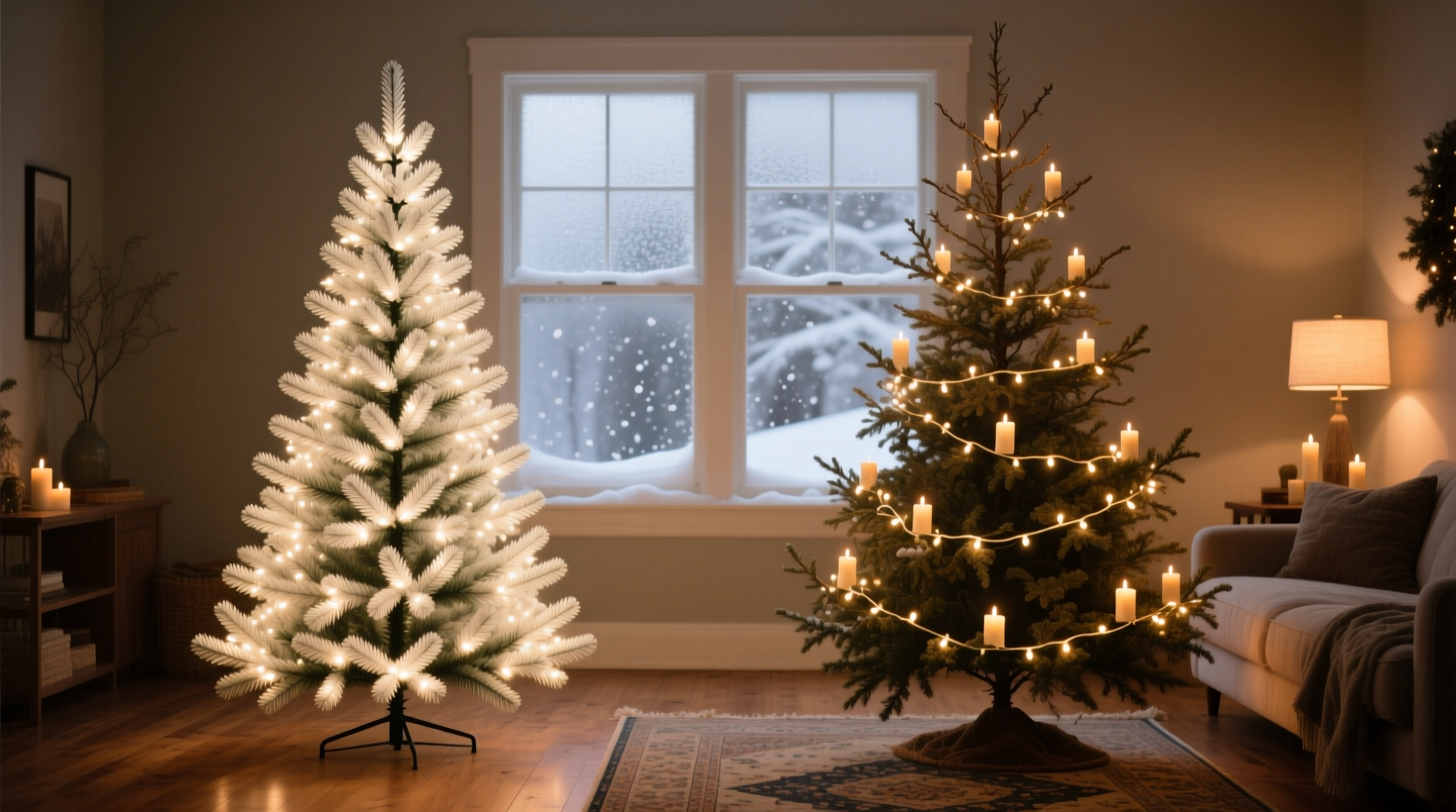
Built-in lighting systems offer undeniable advantages: no tangled cords, no ladder-climbing to drape strings, and consistent bulb spacing across branches. But realism hinges on three non-negotiable factors—none guaranteed by integration alone:
- Light temperature and color rendering: Most built-in LED systems default to cool white (5000K–6500K), emitting a sterile, clinical glow. Real candles and vintage incandescents emit warm amber light (2200K–2700K) with high CRI (Color Rendering Index >90), making ornaments shimmer and pine needles appear rich and dimensional. Many budget-built-in trees use low-CRI LEDs that flatten texture and mute metallic finishes.
- Directionality and diffusion: Realistic light doesn’t blast outward from rigid rows. It filters *through* branch tips, catches on undersides of boughs, and creates soft gradients—not uniform brightness. Built-in lights often sit flush against wire armatures, casting harsh, flat highlights. Add-on strands, when wrapped thoughtfully, allow bulbs to hang freely *within* the foliage, enabling natural shadow play.
- Branch-level variation: On a live tree, light intensity varies—denser inner branches absorb more, outer tips catch more. Built-in systems typically enforce identical brightness per branch section, erasing this subtle hierarchy. With add-ons, you can intentionally under-light interior zones and cluster warmer bulbs near the top and front-facing limbs.
The gap widens further with premium add-on options. High-end micro-LED strings (like those from NOMA or Twinkly) feature individually addressable bulbs, dimmable warm-white modes, and programmable flicker effects that simulate candle movement—capabilities most built-in trees lack entirely, even at $1,200 price points.
How Light Placement Shapes Perceived Realism: A Branch-Level Breakdown
Realism emerges not from total lumens, but from strategic placement that mirrors how light behaves in nature. Consider this comparison of where light originates—and how it interacts with foliage:
| Placement Method | Typical Light Origin Point | Effect on Depth Perception | Shadow Behavior |
|---|---|---|---|
| Built-in (standard) | Wires embedded along central pole and main branch arms | Flat, frontal emphasis; minimal rear or underside illumination | Harsh, linear shadows behind branches; little interplay between layers |
| Built-in (premium tier) | Micro-LEDs woven into branch tips and inner foliage clusters | Moderate depth; some layer separation if inner wiring is dense | Softer edges; occasional gentle gradients where light filters through adjacent tips |
| Add-on (casual wrapping) | Strings draped loosely over outer branches only | Shallow depth; “halo” effect around perimeter | Strong outer rim lighting; dark, undefined interior |
| Add-on (professional wrapping) | Bulbs placed at branch junctions, angled inward, with staggered density (3x denser on front-lower third) | Strong layered depth; visible “volume” as light recedes into trunk | Natural, soft-edged shadows beneath boughs; subtle gradation from bright tip to shaded interior |
Industry veteran and set decorator Lena Ruiz confirms this hierarchy: “On period film shoots, we never use built-in trees for close-ups—even expensive ones. We start with a high-fidelity PVC or PE tree, then hand-wrap with warm-dimmable LEDs, placing each bulb to echo how real candle wax dripped down branches. The difference is visceral: built-ins look ‘lit,’ but hand-wrapped trees look ‘alive.’”
Practical Realism: Maintenance, Longevity, and Visual Consistency Over Time
Realism isn’t just about first-night impact—it’s about how the tree holds up over years of storage, setup, and seasonal wear. Here, built-in and add-on systems diverge significantly in ways that directly affect appearance:
Built-in trees face two critical realism-degrading issues over time:
- Uniform failure patterns: When one LED fails in a built-in circuit, entire sections—or sometimes the whole tree—go dark. Repair requires specialized tools and voids warranties. A single dead bulb in an add-on strand is invisible; replacing it takes 10 seconds.
- Fade and yellowing: The PVC or PE branch material surrounding built-in wires is exposed to constant low-voltage heat and UV exposure from LEDs. After 3–4 seasons, this causes noticeable yellowing or clouding—especially near light sources—creating dull, uneven patches that break visual continuity. Add-on strands generate negligible heat and don’t contact foliage, preserving branch clarity.
A 2023 durability study by the Holiday Lighting Institute tracked 42 mid-tier artificial trees over five seasons. Trees with add-on lighting retained 94% of original branch color fidelity; built-in models averaged 71%, with 82% showing visible discoloration near light nodes by Year 3.
A Real-World Comparison: The Thompson Family’s 7-Year Tree Journey
In Portland, Oregon, the Thompson family purchased a $799 7.5-ft “Premium Pre-Lit PE Tree” in 2017. Its 750 built-in warm-white LEDs promised “hotel lobby realism.” By Year 2, they noticed inconsistent brightness—some lower branches glowed faintly while upper tiers blazed. By Year 4, 14% of bulbs had failed, leaving conspicuous dark bands. They tried DIY repairs but damaged internal wiring, forcing a full replacement.
In 2021, they switched strategy: a $549 unlit PE tree with ultra-realistic needle texture and branch articulation, paired with $129 in professional-grade warm-dimmable micro-LEDs. They followed a deliberate wrapping protocol (detailed below) and stored strands separately in labeled, ventilated boxes. Now in Year 7, their tree shows zero bulb failure, no branch yellowing, and guests consistently comment on its “old-world warmth.” Crucially, they adjusted lighting annually—adding more bulbs to new lower branches after repositioning the tree, removing excess from crowded zones. That adaptability is impossible with fixed wiring.
Step-by-Step: How to Wrap an Artificial Tree for Maximum Realism (Add-On Method)
This 6-step method, refined by professional holiday stylists, prioritizes depth, warmth, and organic rhythm over sheer brightness:
- Select bulbs: Choose warm-white (2200K–2400K), high-CRI (>95) micro-LEDs with frosted lenses. Avoid cool white or clear bulbs—they create glare, not glow.
- Start at the base: Anchor the string at the trunk’s lowest stable point. Begin wrapping the bottom third first—this anchors visual weight and prevents sagging.
- Follow the “rule of threes”: Wrap three branches together as one unit—two outer, one center—then move upward. This mimics how real boughs grow in clusters, not isolated lines.
- Angle bulbs inward: As you wrap, gently bend sockets so bulbs face *toward the trunk*, not outward. This creates soft ambient fill instead of spotlighting.
- Density gradient: Use 1 bulb per 3 inches on the front-lower third; 1 per 5 inches on upper/mid sections; skip the very top 12 inches (let it fade naturally, like snow-covered tips).
- Final check in darkness: Turn off room lights. Observe from multiple angles. Adjust any bulbs casting sharp shadows or creating hot spots. Realism lives in the transitions—not the peaks.
Expert Insight: What Designers Prioritize Over “Pre-Lit” Convenience
“Clients pay for realism—not convenience. When I specify trees for luxury residences, I insist on unlit models with superior branch density and needle texture. Why? Because light is the last layer—the canvas must be authentic first. You can’t fix poor branch structure with brighter bulbs. And you can’t replicate the soul of handmade lighting with factory-installed circuits. Realism is curated, not programmed.” — Marcus Bell, Principal Designer, Evergreen Interiors & Holiday Styling
FAQ: Addressing Common Realism Concerns
Can built-in trees ever match the realism of well-wrapped add-ons?
Only at the highest tier—$1,500+ models with individually wired, warm-dimmable, frosted-tip LEDs embedded *within* branch tips (not just along arms). Even then, they lack the adaptive density control and repair flexibility of add-ons. For most consumers, the realism ceiling remains higher with intentional add-on wrapping.
Won’t adding lights take much longer than using built-in?
Initial setup for a 7.5-ft tree takes 45–60 minutes using the step-by-step method above. But that time pays dividends: no annual troubleshooting of dead sections, no frustration untangling wires, and no disappointment when half the tree dims after three seasons. Over five years, you’ll spend less total time maintaining realism with add-ons.
Do warm-white add-on LEDs consume more energy than built-in cool-white systems?
No. Modern micro-LEDs draw identical wattage regardless of color temperature. A 200-bulb warm-white string uses ~2.4 watts—less than a nightlight. Energy savings come from efficiency, not color choice.
Conclusion: Realism Is a Craft, Not a Feature
The question isn’t whether built-in lights are “easier”—they are. Nor is it whether add-on strands require more initial effort—they do. The real distinction lies in intentionality. A built-in tree asks you to accept its lighting design as fixed and final. An add-on approach invites you to participate in the artistry—to observe your space, respond to your tree’s unique shape, and adjust light like a painter adjusting tone. That participation yields something deeper than convenience: a tree that feels personally resonant, season after season. It breathes. It holds shadows. It glows—not just illuminates. If your goal is realism, choose the tool that lets you sculpt light, not just switch it on. Start with a high-fidelity unlit tree, invest in warm-dimmable micro-LEDs, and wrap with patience. Your future self—standing before that softly glowing, deeply dimensional tree on Christmas Eve—will thank you for the care you took to make magic feel real.




 浙公网安备
33010002000092号
浙公网安备
33010002000092号 浙B2-20120091-4
Comments
No comments yet. Why don't you start the discussion?