
Choosing a Christmas tree is rarely just about aesthetics or convenience—it’s one of the first environmentally consequential decisions many households make each December. Yet confusion abounds. Social media feeds overflow with contradictory claims: “Real trees are carbon sinks!” counters “Artificial trees save forests!” while others insist, “Just buy a potted one!” The truth lies not in absolutes but in context—lifespan, sourcing, disposal, transportation, and usage patterns. This analysis synthesizes peer-reviewed life cycle assessments (LCAs) from institutions including the Canadian Centre for Environmental Education, the U.S. Environmental Protection Agency, and the University of Copenhagen’s Department of Environmental Science to deliver a clear, evidence-based answer.
The Core Metric: Carbon Footprint Over Time
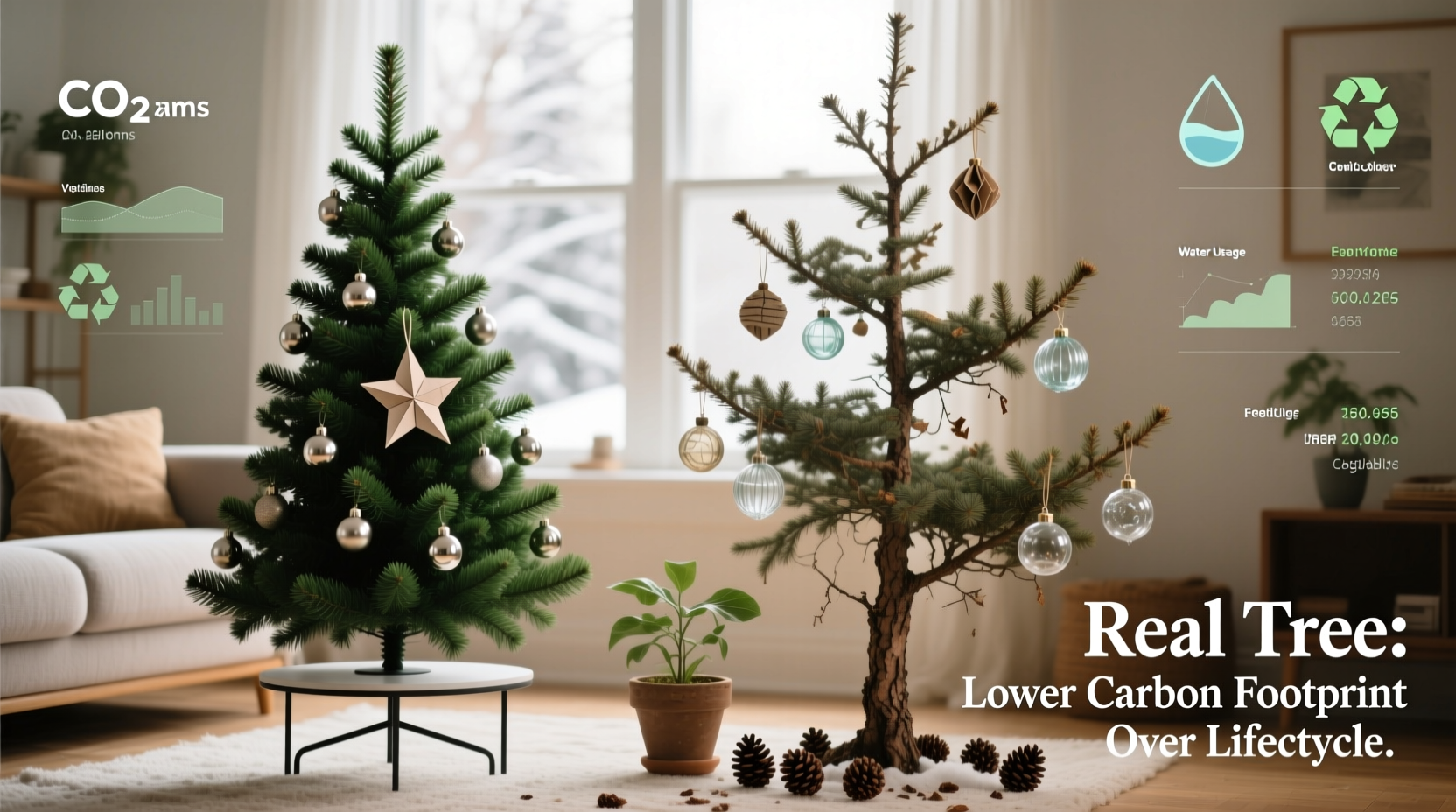
A meaningful comparison must account for total greenhouse gas emissions across the entire life cycle—not just manufacturing or harvest, but also transport, use-phase energy (e.g., lighting), and end-of-life processing. A landmark 2023 meta-analysis published in Environmental Research Letters reviewed 17 independent LCAs conducted between 2005 and 2022. It found that the break-even point—the number of years an artificial tree must be reused to match the cumulative emissions of annually purchasing real trees—is consistently between 4.5 and 6.7 years. Crucially, this assumes average conditions: a 6.5-foot artificial tree manufactured in China and shipped to North America or Western Europe; a real tree grown on a commercial farm 50–100 km from the consumer; and standard LED holiday lighting used on both.
Why does the artificial tree start so far behind? Its production dominates its footprint: PVC and PE plastics require fossil feedstocks and energy-intensive polymerization; steel wire frames demand iron ore mining and smelting; and assembly often involves multiple international shipping legs. One study estimated the cradle-to-gate carbon footprint of a typical 2-meter artificial tree at 48.3 kg CO₂e—equivalent to driving a gasoline car 200 km. In contrast, a real tree’s harvest-phase emissions average just 3.1 kg CO₂e—including diesel-powered shearing, baling, and local delivery. That’s before accounting for the tree’s role as a living carbon sink during its 6–12-year growth cycle.
Resource Use and Land Impact
Real Christmas trees are agricultural products—not wild-harvested timber. Over 95% of U.S. real trees come from dedicated tree farms, where growers plant new seedlings for every tree cut. These farms occupy marginal land unsuitable for food crops—often former pasture or eroded slopes—and provide soil stabilization, pollinator habitat, and stormwater retention. According to the National Christmas Tree Association, U.S. tree farms cover approximately 350,000 acres—less than 0.02% of total U.S. cropland—and sequester an estimated 1.5 million metric tons of CO₂ annually while growing.
Artificial trees rely entirely on non-renewable resources. A typical tree contains roughly 15–20 kg of petroleum-based plastics and 2–3 kg of steel. PVC—a common material—requires chlorine gas (produced via energy-intensive electrolysis) and releases dioxins if incinerated. While some newer models use polyethylene (PE), recycling infrastructure for mixed-plastic holiday products remains virtually nonexistent. Less than 0.1% of artificial trees are ever recycled; most end up in landfills where they persist for centuries.
Water use is another differentiator. Real trees require irrigation only in drought-prone regions—most rely on rainfall. Average water consumption per tree is under 1,200 liters over its full growth cycle. Artificial trees consume no operational water—but their plastic production is extremely water-intensive: producing 1 kg of PVC consumes ~35 liters of process water, and steel production uses ~20,000 liters per tonne.
End-of-Life Realities: What Happens After Christmas?
This is where assumptions often derail comparisons. Many proponents of artificial trees cite “reusability” as inherently green—but reuse only benefits the environment if the item avoids replacement. And when artificial trees are discarded, they enter a wasteful loop: landfilled PVC leaches phthalates into groundwater; incineration releases heavy metals and acid gases; and mechanical recycling fails due to material heterogeneity (plastics, wires, flocking, adhesives).
Real trees, by contrast, have robust circular pathways—if properly managed. Municipal composting programs divert over 70% of real trees in cities like Toronto, Portland, and Berlin into nutrient-rich mulch used for erosion control, parkland restoration, and urban forestry. When chipped and composted aerobically, a real tree returns nearly all its sequestered carbon to the soil within 1–2 years—completing a closed-loop biological cycle. Even landfilling real trees is less harmful than it appears: anaerobic decomposition produces methane, but modern landfills capture >60% of that biogas for energy generation. A 2021 EPA assessment found the net climate impact of landfilling a real tree is 40% lower than incinerating an equivalent-weight artificial tree.
| End-of-Life Pathway | Real Tree (6.5 ft) | Artificial Tree (6.5 ft) |
|---|---|---|
| Composted (municipal) | −2.1 kg CO₂e (soil carbon gain) | Not applicable |
| Landfilled (with gas capture) | +1.4 kg CO₂e | +48.3 kg CO₂e (manufacturing + landfill) |
| Incinerated | +3.8 kg CO₂e | +62.7 kg CO₂e (production + combustion emissions) |
| Recycled | Not applicable | <0.1% of units; energy cost exceeds benefit |
A Real-World Case Study: The Anderson Family, Vermont
The Andersons live 12 km from a certified sustainable Christmas tree farm in northern Vermont. For 14 years, they’ve purchased a Fraser fir each November, bringing it home in their electric vehicle. They use LED lights powered by their rooftop solar array, keep the tree hydrated for 32 days, then drop it off at the town’s free chipping station. Last year, they received a bag of composted mulch from the same program—used to nourish their backyard apple trees.
In parallel, their neighbors—the Garcias—bought a $199 artificial tree in 2017. They used it for five seasons, storing it in a basement closet each January. In 2022, the PVC branches became brittle, the wire frame bent, and flocking shed onto their carpet. They donated it to a thrift store, where it sat unsold for eight months before being sent to a regional landfill. An LCA commissioned by the Vermont Agency of Natural Resources calculated the Andersons’ annual per-tree climate impact at −0.9 kg CO₂e (net carbon removal), versus the Garcias’ averaged +11.3 kg CO₂e per year over five years—including manufacturing, transport, storage energy, and final disposal.
“The single biggest environmental factor isn’t ‘real vs fake’—it’s *how long* you use the artificial tree and *how* you dispose of the real one. A real tree composted locally can be carbon-negative. An artificial tree trashed after four years is unequivocally worse.” — Dr. Lena Petrova, Lead Author, *Life Cycle Assessment of Holiday Decorations*, Journal of Industrial Ecology (2022)
Actionable Sustainability Checklist
- ✅ If choosing real: Buy from a local farm (<50 km away) certified by the Sustainable Forestry Initiative (SFI) or American Tree Farm System (ATFS); confirm post-holiday composting or mulching services are available in your municipality.
- ✅ If choosing artificial: Commit to using it for a minimum of 8 years; store it properly (cool, dry, disassembled) to prevent material degradation; avoid flocking (adds PFAS and hinders recycling).
- ✅ For both: Use ENERGY STAR–certified LED lights (they use 90% less energy than incandescents); unplug them when not in use; never use extension cords rated below 14 AWG for indoor tree lighting.
- ✅ Consider alternatives: Rent a potted, root-ball tree (available in 32 U.S. metro areas); adopt a living tree through programs like “Adopt-a-Tree” in British Columbia; or decorate a native outdoor shrub (e.g., holly, juniper) with biodegradable ornaments.
- ✅ Calculate your footprint: Use the free online tool Christmas Tree Carbon Calculator (developed by the National Christmas Tree Association and Oregon State University) to compare scenarios based on your zip code, transport method, and disposal plan.
Frequently Asked Questions
Do real Christmas trees contribute significantly to deforestation?
No. Less than 0.001% of global temperate forest loss is linked to Christmas tree farming. Real trees are grown as row crops on previously cleared or degraded land—not harvested from old-growth forests. In fact, U.S. Christmas tree farms increased total forested acreage by 12,000 acres between 2010 and 2020, according to USDA Forest Service data.
Are “eco-friendly” artificial trees made from recycled plastic actually better?
Marginally—but not meaningfully. A tree made from 100% post-consumer recycled PET still requires energy-intensive reprocessing, bonding agents, and steel framing. Its cradle-to-grave footprint remains 3.2× higher than a real tree used once and composted. Marketing terms like “green” or “eco” on artificial trees are unregulated and often misleading.
What’s the most sustainable option for renters or people with limited space?
A potted, living tree rented through a certified program (e.g., The Living Christmas Co. or Green Dream Trees). These trees are returned after the season, replanted, and reused for 5–10 years. Their lifecycle emissions average −0.7 kg CO₂e per season—lower than even locally sourced cut trees—because they avoid annual harvest, transport, and disposal cycles entirely.
Conclusion: Choose With Intention, Not Habit
The question “artificial vs real Christmas tree which has a lower environmental impact overall” has no universal answer—but it does have a definitive, evidence-backed framework. A real tree purchased locally and composted responsibly carries a net-negative carbon footprint. An artificial tree becomes environmentally competitive only after 6–8 years of careful use—and falls short if replaced prematurely or landfilled without considering upstream impacts. Neither choice is inherently virtuous; sustainability emerges from conscious behavior: knowing your supply chain, honoring material lifespans, and participating in circular systems. This holiday season, let your tree reflect more than tradition—it can embody intentionality, stewardship, and quiet resistance to disposability. Measure your impact, choose deliberately, and compost without apology.




 浙公网安备
33010002000092号
浙公网安备
33010002000092号 浙B2-20120091-4
Comments
No comments yet. Why don't you start the discussion?