
In an age of smartwatches that track heart rates, reply to messages, and even measure blood oxygen, the mechanical tick of a traditional wristwatch might seem like a relic from another era. Yet millions still wear automatic watches—not for utility, but for soul. Meanwhile, quartz watches, with their precise, emotionless heartbeat, dominate the market in terms of sales and accuracy. But beneath the surface of this divide lies a deeper question: Does anyone actually care about how a watch ticks anymore?
The answer isn’t simple. For some, the rhythmic sweep of an automatic’s second hand is poetry in motion. For others, a $20 quartz watch that gains or loses less than ten seconds a year is all they’ll ever need. This article explores the enduring significance of watch movements, not just as mechanisms, but as symbols of values—craftsmanship, convenience, heritage, and identity.
The Mechanics Behind the Tick
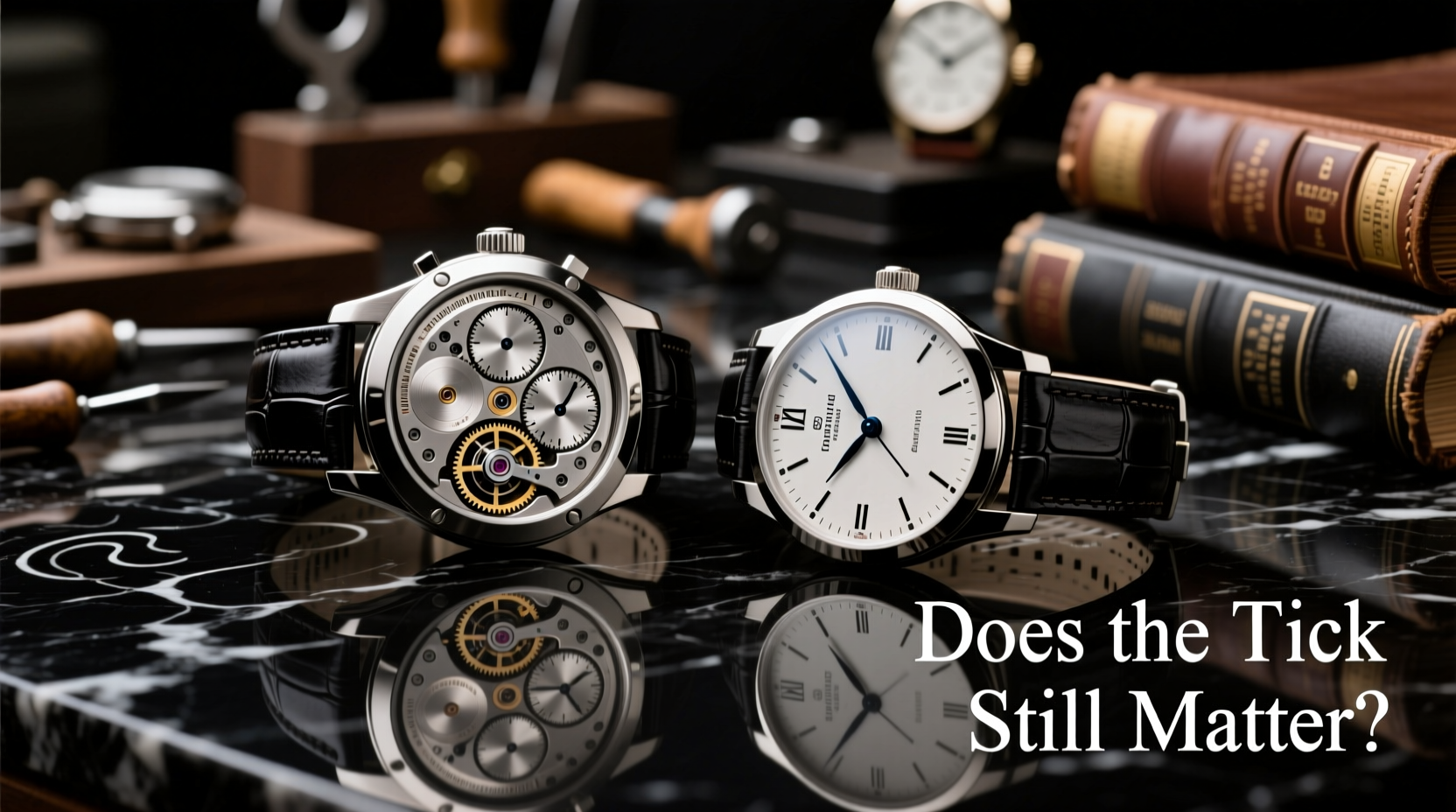
To understand why the difference between automatic and quartz matters—or doesn’t—one must first grasp how each works.
Automatic (mechanical) watches are powered by a mainspring wound through the natural motion of the wearer’s arm. As the spring unwinds, it releases energy that drives a series of gears and an oscillating balance wheel. Each swing regulates the release of power, creating the familiar “tick” (though technically, most automatics “sweep” due to high beat rates). These watches contain over 100 tiny components, often assembled by hand, and can run for 40–70 hours when fully wound.
Quartz watches, introduced widely in the 1970s during the \"Quartz Crisis,\" use a battery to send electricity through a tiny quartz crystal. The crystal vibrates at a precise frequency—32,768 times per second—which an integrated circuit counts and converts into one pulse per second, driving the motor that moves the hands. The result? Unmatched accuracy, typically within ±15 seconds per month.
A Cultural Shift: From Utility to Identity
Watches were once essential tools. Before smartphones, they were the primary way to tell time. In that context, accuracy was paramount. The quartz revolution disrupted the Swiss watch industry because it delivered superior timekeeping at a fraction of the cost. Many iconic brands nearly collapsed.
But something unexpected happened. Mechanical watches didn’t die. Instead, they evolved from instruments into artifacts—objects of passion, status, and personal expression. Enthusiasts began to value the complexity, history, and human touch behind automatic movements. The very inefficiency of a manually maintained timepiece became its virtue.
Today, wearing an automatic watch is less about telling time and more about making a statement. It signals appreciation for craftsmanship, patience, and analog beauty in a digital world. Quartz, meanwhile, has become synonymous with practicality. It powers reliable field watches, affordable fashion pieces, and rugged tool watches used by professionals who need dependable function without fuss.
“Mechanical watches are not about telling time—they’re about experiencing time.” — Dominique Renaud, Co-founder of R&D Watchmaking
Movement Comparison: Automatic vs Quartz
| Feature | Automatic Watch | Quartz Watch |
|---|---|---|
| Power Source | Mainspring (wound by motion or hand) | Battery |
| Accuracy | ±5 to ±30 seconds per day | ±15 seconds per month |
| Maintenance | Service every 5–7 years; daily wear recommended | Battery change every 1–3 years; minimal servicing |
| Lifespan | Generational (with care) | Limited by circuit longevity; ~20–30 years |
| Price Range | $300–$500,000+ | $10–$5,000 |
| Second Hand Motion | Sweeps smoothly (typically 6–8 ticks/sec) | One distinct tick per second |
| Environmental Impact | Reusable materials; long lifespan | Batteries require disposal; electronic components |
Do People Still Care About the Ticking?
The short answer: Yes—but differently than before.
For the average consumer, the distinction may be invisible. Most people check the time on their phones. A watch is often worn for style, habit, or as a gift. In this context, quartz dominates simply because it’s cheaper, more accurate, and requires less attention. Retailers like Casio, Timex, and Seiko sell millions of quartz-powered watches annually, many under $100.
Yet, a growing subculture deeply cares about movement. Online forums like Reddit’s r/Watches, WatchUSeek, and Hodinkee thrive on discussions about escapements, power reserves, and finishing techniques. Collectors dissect the nuances between a ETA 2824 and a Sellita SW200. They admire perlage, Geneva stripes, and hand-beveled edges visible only through display casebacks.
This isn’t snobbery—it’s appreciation. Much like vinyl records or manual transmission cars, mechanical watches offer a tactile, intentional experience. You wind them. You feel their heartbeat against your wrist. You learn their quirks. They demand engagement. And in return, they reward with character.
Meanwhile, high-end quartz hasn’t disappeared. Brands like Grand Seiko produce “9F” quartz movements with extreme precision, long service intervals, and luxurious finishing. Citizen’s Eco-Drive line combines solar power with quartz accuracy, eliminating battery changes entirely. These prove that quartz can also represent innovation and excellence.
Real Example: The Office Professional’s Dilemma
Consider Mark, a 34-year-old project manager in Chicago. He owns three watches: a $40 Timex Weekender (quartz), a vintage-inspired Hamilton Khaki Field Auto, and a stainless steel Apple Watch.
On casual Fridays, he wears the Timex—lightweight, no worries, matches his jeans. During client meetings, he switches to the Hamilton. Not because it’s more accurate, but because it looks substantial, feels authentic, and sparks conversation. “People notice it,” he says. “They ask if it’s ‘real’—meaning mechanical. There’s respect in that.”
His Apple Watch stays on during workouts and travel days. But after work, he often swaps it for the Hamilton. “It’s not about checking the time,” he admits. “It’s about feeling connected to something older, slower, more deliberate.”
Mark doesn’t obsess over beats per hour or hacking seconds. But he cares about what each watch represents. And in that sense, yes—he cares about the ticking, even if indirectly.
Expert Insight: What Horologists Say
In a 2023 interview with *Europa Star*, independent watchmaker Andreas Strehler stated: “The soul of a watch is in its movement. A quartz watch tells time perfectly. An automatic watch tells you something about the person wearing it.”
This sentiment echoes across the industry. While quartz democratized timekeeping, automatics preserved the art. Even brands like Rolex and Patek Philippe, which could easily adopt hybrid technology, remain committed to mechanical movements. Their marketing emphasizes legacy, hand assembly, and lifetime serviceability.
As Strehler notes, “You don’t buy a Stradivarius for its volume. You buy it for its voice. A mechanical watch is the same—a voice from centuries of horological evolution.”
Practical Checklist: Choosing Between Automatic and Quartz
Still unsure which movement suits your lifestyle? Use this checklist to decide:
- ✅ Do you want a watch that lasts decades—or generations? → Automatic
- ✅ Is accuracy your top priority? → Quartz
- ✅ Will you wear it daily, or occasionally? → Occasional wear favors Quartz (no winding needed)
- ✅ Do you enjoy learning about mechanics and maintenance? → Automatic
- ✅ Are you on a tight budget? → Quartz offers better value under $300
- ✅ Do you appreciate fine craftsmanship and design details? → Automatic
- ✅ Do you hate changing batteries or servicing watches? → Quartz (low maintenance)
Frequently Asked Questions
Does the second hand tick really matter?
Functionally, no. But aesthetically and emotionally, yes. The smooth sweep of an automatic watch is often seen as more elegant. The one-second tick of quartz is unmistakable and utilitarian. Some collectors find the tick disruptive; others barely notice it.
Can a quartz watch be collectible?
Absolutely. Vintage quartz models from the 1970s, such as the Omega Megaquartz or Longines Ultra-Quartz, are gaining collector interest. Modern high-accuracy quartz watches like Grand Seiko’s 9F or Breitling’s SuperQuartz™ are also prized for their engineering. However, mechanical watches still dominate the secondary market.
Is automatic better than quartz?
Better depends on context. For precision and convenience, quartz wins. For craftsmanship, emotional appeal, and longevity, automatic takes the lead. Neither is objectively superior—they serve different purposes and values.
Conclusion: The Ticking Still Matters—Just Differently
The question isn’t whether people care about the ticking, but why they care. In a world of instant gratification and disposable tech, the persistence of the mechanical watch is a quiet rebellion. It celebrates slowness, complexity, and permanence.
Quartz remains the rational choice for most. It’s efficient, accessible, and reliable. But automatic watches endure because they speak to something deeper: our desire for meaning, connection, and beauty in everyday objects.
So yes, people still care about the ticking—even if they don’t realize it. Whether it’s the silent pulse of a quartz crystal or the whispering beat of a balance wheel, how a watch keeps time says something about how we choose to live ours.




 浙公网安备
33010002000092号
浙公网安备
33010002000092号 浙B2-20120091-4
Comments
No comments yet. Why don't you start the discussion?