
Folding a fitted sheet is one of those household tasks that seems simple in theory but often ends in frustration. The elastic corners twist, the fabric bunches, and what should be a neat rectangle turns into a crumpled mess. Yet, achieving a perfectly folded fitted sheet isn’t reserved for laundry experts or hotel staff — it’s a skill anyone can learn with the right method. With consistent practice and a few smart techniques, you can eliminate the struggle once and for all.
The challenge lies in the design: elasticated edges are meant to stretch over mattresses, not lie flat on shelves. But by understanding how to manipulate the corners and align the seams, you can transform even the most unruly king-sized fitted sheet into a tidy package. This guide breaks down proven folding systems, shares insider tips from linen professionals, and offers practical steps to help you master this elusive chore.
Why Folding Fitted Sheets Matters
A neatly folded fitted sheet doesn’t just look better — it improves storage efficiency, prevents deep creases, and reduces wear over time. When sheets are crammed into drawers haphazardly, fibers become strained, and repeated wrinkling can shorten their lifespan. In contrast, proper folding preserves the integrity of the fabric, especially important for delicate materials like Egyptian cotton or sateen weaves.
Well-folded linens also make changing beds faster and more pleasant. Imagine pulling out a crisp, compact stack instead of untangling a knot of elastic and fabric. For households with limited storage space, such as apartments or RVs, efficient folding is essential. And if you manage guest rooms or run a short-term rental, professional-looking linen organization reflects attention to detail that guests notice.
“Learning to fold a fitted sheet properly is like mastering a small life hack that pays off every week. It saves time, reduces stress, and keeps your linen closet looking curated.” — Lydia Grant, Home Organization Consultant
The Corner-Matching Method: A Step-by-Step Guide
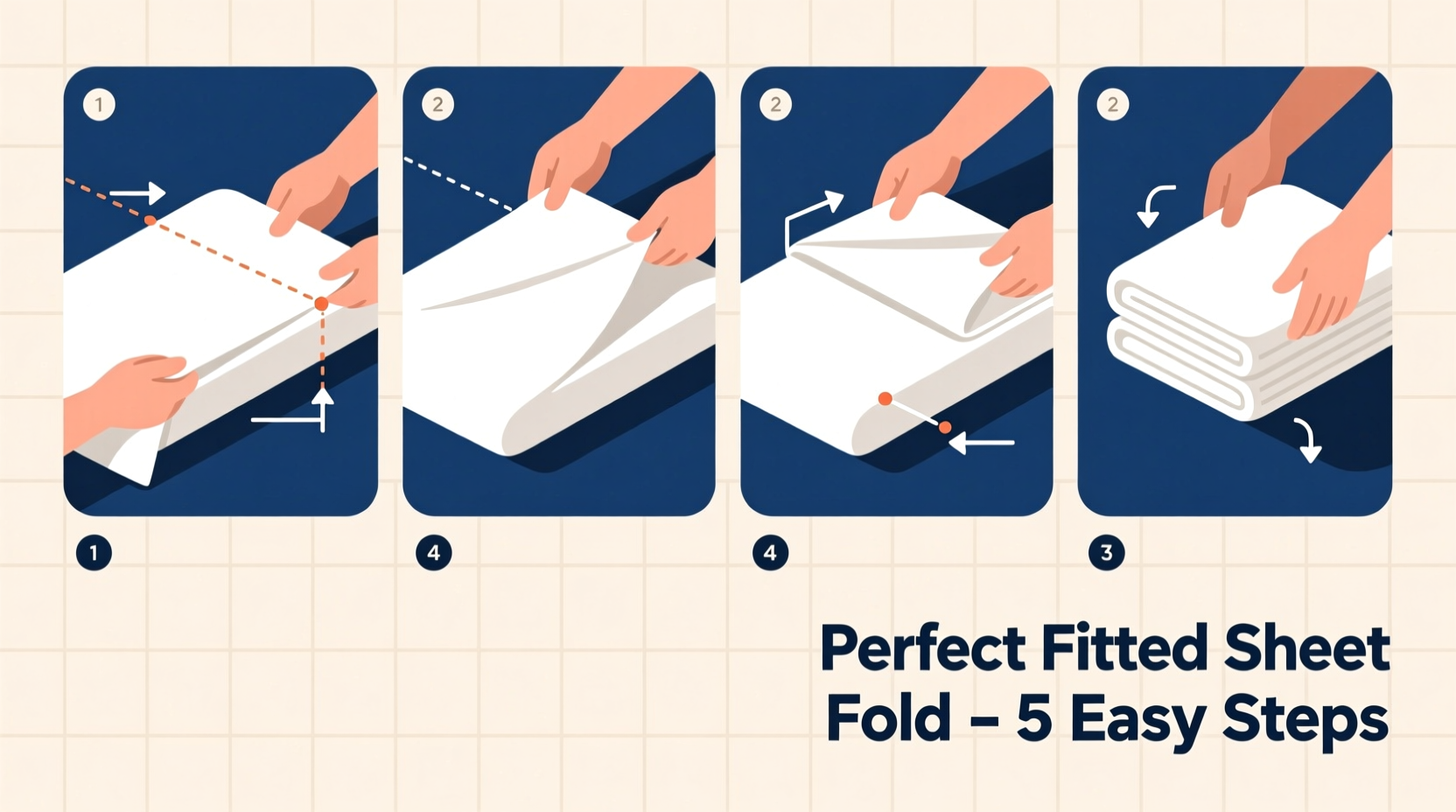
This widely recommended technique focuses on aligning the elastic corners first, creating a stable foundation before flattening the rest of the sheet. It works for all sizes — twin, full, queen, and king — and becomes second nature with repetition.
- Hold the sheet upside down with two adjacent corners in each hand. Turn it inside out so the outer (top) side faces inward. This hides the messy tuck lines and prepares the surface for smoothing.
- Insert one hand into a corner of your left pair, then reach into the corresponding right corner and pull them together until they meet. You now have both hands holding two connected corners, with the other two dangling behind.
- Repeat with the remaining corners. Bring the back two corners together the same way, tucking one into the other. At this point, all four corners are paired, and the sheet resembles a long rectangle with no loose edges.
- Lay the sheet flat on a bed or table. Smooth out wrinkles with your palms, starting from the center outward.
- Fold lengthwise by bringing one edge toward the center, then repeating with the opposite side. This creates a narrower strip.
- Fold into thirds or quarters, depending on desired size. Tuck any uneven edges neatly as you go.
- Store immediately to maintain shape. Place folded sheet on a shelf or stack with its matching flat sheet and pillowcases.
The Military Fold: Precision for Long-Term Storage
Popularized by military barracks and luxury hotels, the “military fold” produces a tight, rectangular bundle ideal for uniform storage. While slightly more involved, it ensures minimal air exposure and maximum durability over time.
Begin by completing the corner-matching steps above. Once the sheet lies flat with all corners secured:
- Fold one-third of the sheet inward from the bottom. Repeat from the top, overlapping slightly to form a long rectangle.
- Rotate the sheet horizontally.
- Fold the left side one-third inward, then the right side over it. Press firmly after each fold.
- For extra crispness, place a heavy book on top for a few minutes.
This method minimizes shifting during storage and prevents moisture buildup in tightly packed linen closets. It's particularly effective for seasonal rotations — store summer sheets folded this way and retrieve them months later without mustiness or deep creases.
Common Mistakes That Sabotage Your Fold
Even with the correct sequence, small errors can undermine your results. Avoid these frequent pitfalls:
| Mistake | Why It’s a Problem | Solution |
|---|---|---|
| Folding while damp | Causes mildew, shrinkage, and permanent wrinkles | Ensure complete dryness before folding |
| Ignoring corner alignment | Leads to bulges and asymmetry | Always pair elastic corners first |
| Rushing the smoothing step | Traps creases that deepen over time | Take 10–15 seconds to flatten thoroughly |
| Storing in plastic bags | Traps moisture; promotes yellowing | Use breathable cotton bags or open bins |
| Overstuffing linen cabinets | Crushes folds and strains fabric | Leave 2 inches of clearance around stacks |
One of the most overlooked factors is lighting. Attempting to fold sheets in dim conditions makes it harder to spot misaligned seams or trapped fabric layers. Always work under bright, natural-adjacent light for best visibility.
Real-Life Example: From Chaos to Control
Sarah, a mother of three in Portland, used to dread laundry day. Her linen closet was a jumble of mismatched sets, half-folded sheets, and orphaned pillowcases. After watching yet another video fail to deliver results, she decided to apply the corner-matching method consistently for one month.
She started with freshly dried twin sheets — smaller and easier to manage — practicing daily until the motions felt natural. Within a week, she could fold a queen-sized fitted sheet in under two minutes. By organizing her sets with matching pillowcases tucked inside each folded flat sheet, her closet transformed from cluttered to coordinated.
“It sounds silly,” she says, “but being able to close my linen cabinet without something falling out gave me real satisfaction. Now I teach the method to my kids. It’s become a little family ritual.”
Alternative Techniques for Different Preferences
Not everyone finds the corner-matching method intuitive. Fortunately, there are alternative approaches tailored to different learning styles and physical abilities.
The Flat-Lay Technique
Ideal for visual learners, this method begins with laying the sheet completely flat on a large surface. Locate all four corners and label them mentally: front-left, front-right, back-left, back-right. Fold the back corners over the front ones, aligning edges precisely. Then proceed with standard folding as if handling a flat sheet.
The Roll Method
Preferred by campers and minimalist households, rolling eliminates sharp creases entirely. After pairing corners and smoothing, roll the sheet tightly from one end to the other. Secure with a fabric tie or rubber band. Rolling reduces stress on elastic and is excellent for travel storage.
The Inside-Out Flip
Start with the sheet inside out. Pair two corners in each hand, then flip one set over the other so the right side emerges cleanly. Lay flat and finish folding. This trick hides seams and delivers a polished outer layer.
Expert Tips for Lasting Results
Professional housekeepers and linen managers rely on consistency and routine. Here are their top recommendations:
- Fold immediately after drying — Delay increases wrinkle retention.
- Keep a folding station — Dedicate a cleared-off bed or table for uninterrupted work.
- Pair sets before storing — Tuck pillowcases inside folded flat sheets and place fitted sheet on top.
- Rotate stock regularly — Prevents older linens from deteriorating at the back of the shelf.
- Wash similar sizes together — Reduces confusion and makes folding batches easier.
“Hotels don’t have magic powers — they have systems. The key is doing it the same way every time, without skipping steps.” — Marcus Reed, Executive Housekeeper at The Willard Hotel
FAQ
Can I fold a fitted sheet without a flat surface?
Yes, though it’s more challenging. Hold the sheet vertically, locate two adjacent corners, and connect them as described. Drape the joined corners over one arm, then bring the remaining two together with your free hand. Lower gently and complete folds by hand. This method works well when traveling or in cramped spaces.
What if my fitted sheet has extra-deep pockets?
Deep-pocket sheets require extra attention to seam alignment. After connecting corners, run your fingers along the side seams to ensure they lie flat and parallel. Smoothing may take longer, but the result is worth it. Consider folding vertically first to reduce width before final tucks.
How often should I refold stored sheets?
Refold every 3–4 months, especially if stored long-term. This prevents permanent crease lines from setting in and allows you to check for moisture or pests. Refolding also redistributes pressure points, extending fabric life.
Checklist: Perfect Fitted Sheet Folding Routine
- Remove sheet from dryer only when fully dry
- Lay on a clean, flat surface (bed or table)
- Turn inside out or orient correctly
- Match and connect elastic corners (front and back pairs)
- Smooth out all wrinkles from center outward
- Fold lengthwise into thirds or quarters
- Store with matching set components
- Label or organize by room/size for quick access
Conclusion
Folding a fitted sheet perfectly isn’t about innate talent — it’s about applying a repeatable process with patience and precision. Whether you adopt the corner-matching method, the military fold, or a personalized variation, the goal remains the same: transforming chaos into order, one sheet at a time. These skills compound over weeks and months, turning a dreaded chore into a quiet moment of accomplishment.
Start today. Pull out one fitted sheet and walk through the steps slowly. Do it again next laundry day. Soon, you’ll fold without thinking, store with confidence, and enjoy a linen closet that looks — and functions — like it belongs in a five-star hotel.




 浙公网安备
33010002000092号
浙公网安备
33010002000092号 浙B2-20120091-4
Comments
No comments yet. Why don't you start the discussion?